

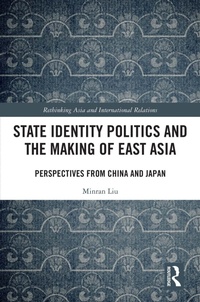
State Identity Politics and the Making of East Asia
Perspectives from China and Japan
1st Edition
Published on 5. February 2026
204 pages
978-1-040-64819-3 (ISBN)
Description

East Asia is shaped as much by identity-based dynamics as by material forces. This book examines how the evolving state identities of China and Japan have interacted with the regional order and its prospects for both cooperation and conflict.
While identity-based dynamics have long been recognised as enduring features by observers of East Asia, conventional accounts often emphasise the absence of a shared identity, persistent historical grievances, and nationalism-fuelled territorial disputes-particularly between China and Japan-as key obstacles to regional cooperation. This volume instead offers a state identity politics approach that moves beyond viewing the 'ghosts of the past' as fixed constraints. It focuses on how domestic actors in both countries construct and mobilise state identities, how domestic politics interact with international relations, and how these identities shape regional order. Through analysis of China's and Japan's evolving approaches to key post-Cold War regional initiatives, the author demonstrates why state identity politics is vital to understanding Sino-Japanese relations and broader regional dynamics in East Asia.
This book will be of interest to scholars and students of East Asian politics, Sino-Japanese relations, diplomatic studies, and domestic-international interactions, as well as policymakers engaged in these fields.
While identity-based dynamics have long been recognised as enduring features by observers of East Asia, conventional accounts often emphasise the absence of a shared identity, persistent historical grievances, and nationalism-fuelled territorial disputes-particularly between China and Japan-as key obstacles to regional cooperation. This volume instead offers a state identity politics approach that moves beyond viewing the 'ghosts of the past' as fixed constraints. It focuses on how domestic actors in both countries construct and mobilise state identities, how domestic politics interact with international relations, and how these identities shape regional order. Through analysis of China's and Japan's evolving approaches to key post-Cold War regional initiatives, the author demonstrates why state identity politics is vital to understanding Sino-Japanese relations and broader regional dynamics in East Asia.
This book will be of interest to scholars and students of East Asian politics, Sino-Japanese relations, diplomatic studies, and domestic-international interactions, as well as policymakers engaged in these fields.
Reviews / Votes
"Relations between China and Japan, and indeed between states in East Asia and its wider region, are often described with little thought to agency and in terms of essentialised cultural determinants. While the events of the past certainly provide context to those international relations they cannot adequately explain variations over time or with policy areas. Through case studies focussing on Asia-Pacific regional institutions, Southeast Asia, and Northeast Asia the considerable worth of this volume is its focus on the the role of political actors in their respective domestic contexts and their strategic choices in shaping regional outcomes."- David S. G. Goodman, Professor and Director, China Studies Centre, University of Sydney
"State Identity Politics and the Making of East Asia offers a refreshing analysis of how domestic factors such as strong leadership and effective coalition building in China and Japan affect national identity formation and foreign policy formulation. Drawing on Neoclassic Realism, its agent-centred approach sheds light on the dynamic interplay between state identity politics and external environments that generates both constraints and opportunities for cooperation and conflict in East Asia."
- Jingdong Yuan, Senior Researcher and Director, SIPRI China and Asia Security Programme, Stockholm International Peace Research Institute
"In this well-researched and thought-provoking book, Minran Liu offers a bold and original reinterpretation of East Asia's evolving regionalism through the lens of state identity politics. With a nuanced analysis of China and Japan's shifting national identities, Liu shows how domestic political actors construct and reconstruct national narratives that shape each country's regional policies. A must-read for anyone seeking to understand the complex dynamics behind cooperation and conflict in East Asia."
- Jian Zhang, Professor, International & Political Studies, University of New South Wales
"This groundbreaking study, rich in both theoretical and empirical content, offers a unique exploration of the domestic dynamics involved in state identity formation. Liu delves deeply into the intricacies of "state identity politics" in China and Japan, shedding light on how these dynamics shape their bilateral relations and the broader strategic landscape of East Asia. This is a must-read for comprehending the current dynamics of Sino-Japanese rivalry and cooperation."
- Takeshi Yuzawa, Professor, Department of Global and Interdisciplinary Studies, Hosei University
"Taking a fresh but judicious approach to shed new light, Minran Liu focuses on state identity to explain the dynamics of China-Japan relations and assess larger questions of East Asian regionalism. Excellently organized both theoretically and through robust case studies, this first major work by a rising star scholar sparks new debate and deepens insights on the future of the world's most important region. "
- Bates Gill, Senior Fellow for Asian Security, National Bureau of Asian Research, and Senior Fellow, United Nations Institute for Disarmament Research
More details
Series
Edition
1. Auflage
Language
English
Place of publication
London
United Kingdom
Publishing group
Taylor & Francis Ltd
Target group
College/higher education
Product notice
Reflowable
File size
3,30 MB
ISBN-13
978-1-040-64819-3 (9781040648193)
Copyright in bibliographic data and cover images is held by Nielsen Book Services Limited or by the publishers or by their respective licensors: all rights reserved.
Schweitzer Classification
Other editions
Additional editions
Book
approx. 02/2026
1st Edition
Routledge
€211.00
Not yet published
Person
Minran Liu is a Lecturer in International Relations in the School of Political Science and International Studies at the University of Queensland, Australia. His teaching and research primarily focus on Asia-Pacific security, East Asian politics, Chinese politics and strategy, and constructivist international relations theory. His recent work has been published in International Relations of the Asia-Pacific, Contemporary Politics, and many edited volumes. He holds a PhD from the Department of Government and International Relations at the University of Sydney. Prior to joining UQ, he held lectureships at the University of Sydney and UNSW Canberra.
Content
1. Introduction 2. Making East Asia 3. State Identity Politics in International Relations 4. China, Japan, and the Asia-Pacific 5. China, Japan and Southeast Asia 6. China, Japan and Northeast Asia 7. Findings and Implications
