

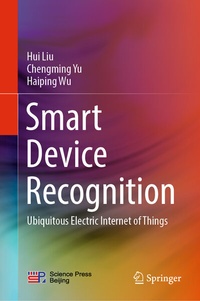
Smart Device Recognition
Description

The book is the first international reference on the field of smart device recognition and Ubiquitous Electric Internet of Things (UEIOT). It presents a range of state-of-the-art key methods and applications for smart device recognition. In future smart environments, obtaining energy consumption information for identifying every device is an effective approach to guarantee the energy efficiency of smart industrial systems. Such as, the Ubiquitous Electric Internet of Things (UEIOT) technology represents one of the most effective measures for electricity and energy management and has attracted considerable attention from scientists and engineers around the world. The realization of smart device recognition in the UEIOT framework has become the core and basis of UEIOT's success. The device smart recognition can help governments and managers to distribute energy and power better, and help device manufacturers to improve their products regarding smart energy conservation. Accordingly, in the future smart industry, implementing smart device recognition is desired and very important. In the book, several methods, strategies, and experiments for achieving smart device recognition are presented in details. As the first monograph in the field of smart device recognition, the book can provide beneficial reference for students, engineers, scientists, and managers in the fields of power, energy, electromechanical devices, smart cities, artificial intelligence, etc.
More details
Other editions
Additional editions
Persons
Prof. Hui Liu is a professor of Robotics & Artificial Intelligence, Central South University, China; Vice dean, Faculty of Traffic & Transportation Engineering, Central South University, China. He holds double PhD degrees from the Central South University in China and the University of Rostock in Germany, and obtained habilitation degree on automation from the University of Rostock. He published over 80 articles in leading journals, as well as four monographs in Elsevier or Springer press. He holds 56 Chinese invention patents in the fields of artificial intelligence, smart cities, non-intrusive load monitoring, smart grid, and time series big data (as the first inventor). He is an associate editor of the journal Transportation Safety & Environment (Oxford University Press), and a committee member of more than 30 international flagship academic conferences.
Mr. Chengming Yu is Scientist in the research group 'Non-Intrusive Load Monitoring & Artificial Intelligence,' CentralSouth University, China.
Mr. Haiping Wu is Scientist in the research group 'Non-Intrusive Load Monitoring & Artificial Intelligence,' Central South University, China.
Content
Introduction.- Smart non-intrusive device recognition based on physical methods.- Smart non-intrusive device recognition based on intelligent single-label classification methods.-Smart non-intrusive device recognition based on intelligent multi-label classification methods
