

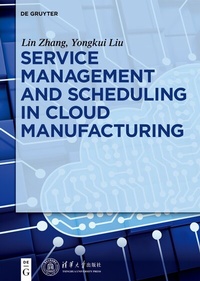
Service management and scheduling in cloud manufacturing
1st Edition
Published on 1. August 2022
XIV, 429 pages
978-3-11-047036-9 (ISBN)
Description

The book introduces the concept of cloud manufacturing and describes the cloud service technology system behind it. The authors discuss key technologies of manufacturing cloud service management, including service construction, evaluation and composition, and scheduling. With abundant case studies, the book is an essential reference for researchers and engineers in manufacturing and information management.
More details
Other editions
Additional editions
Yongkui Liu | Lin Zhang
Service management and scheduling in cloud manufacturing
Book
08/2022
1st Edition
De Gruyter
€169.95
Shipment within 7-9 days
Yongkui Liu | Lin Zhang
Service management and scheduling in cloud manufacturing
E-Book
08/2022
1st Edition
De Gruyter
€159.95
Available for download
Persons
Yongkui Liu and Lin Zhang , Beijing University of Aeronautics and Astronautics, Beijing, China.
Content
Table of content:
Chapter 1 Concepts of cloud manufacturing
1.1 Background of the appearance of cloud manufacturing
1.2 What is cloud manufacturing?
1.3 Technologies behind cloud manufacturing
1.4 Cloud manufacturing as the extension of cloud computing in manufacturing
1.5 Model and technical characteristic of cloud manufacturing
1.6 Cloud manufacturing as a new way in information based manufacturing
1.7 Summary
References
Chapter 2 Architecture and system structure of cloud manufacturing platform
2.1 Multi-view for cloud manufacturing system
2.2 Architecture of cloud manufacturing system
2.3 Technical system of cloud manufacturing
2.4 Summary
References
Chapter 3 Resources sensation and access
3.1 The sensation, access and adaption of physical resources
3.2 The sensation, access and adaption of software resources and data
3.3 Data analysis and processing in sensation and accessing resources
3.4 Summary
References
Chapter 4 Virtualization and service-oriented architecture of resources
4.1 Resources virtualization
4.2 The mapping and transform of physical-virtual resources
4.3 Structuring and management of virtual resources pool
4.4 Service encapsulation technologies for manufacturing resources
4.5 Summary
References
Chapter 5 Description of manufacturing capability and service-oriented capability
5.1 What is manufacturing capability?
5.2 Information structure of manufacturing capability
5.3 Mechanism for service-oriented capability
5.4 Sensation and access of manufacturing capability
5.5 Manufacturing capability network
5.6 Summary
References
Chapter 6 Cloud service management
6.1 Matching and searching of cloud service
6.2 Composition of cloud service
6.3 Optimization of cloud computing service
6.4 Summary
References
Chapter 7 Operation and evaluation of cloud service
7.1 Running cloud service
7.2 Evaluating cloud service
7.3 Summary
References
Chapter 8 Interface and visualization technologies in cloud manufacturing
8.1 Characteristic analysis of user-interface in cloud manufacturing
8.2 Customized service for users
8.3 Platform structure for customized service
8.4 Key techniques
8.5 Visualization platform
8.6 Visualization platform analysis
8.7 Summary
References
Chapter 9 Case studies and applications in complex projects
9.1 Case studies in astronomical devices manufacturing
9.2 Case studies in rail transit equipment manufacturing
9.3 Summary
References
Chapter 10 Case studies and applications for small and middle sized enterprises
Chapter 11 Prospect and development
Chapter 1 Concepts of cloud manufacturing
1.1 Background of the appearance of cloud manufacturing
1.2 What is cloud manufacturing?
1.3 Technologies behind cloud manufacturing
1.4 Cloud manufacturing as the extension of cloud computing in manufacturing
1.5 Model and technical characteristic of cloud manufacturing
1.6 Cloud manufacturing as a new way in information based manufacturing
1.7 Summary
References
Chapter 2 Architecture and system structure of cloud manufacturing platform
2.1 Multi-view for cloud manufacturing system
2.2 Architecture of cloud manufacturing system
2.3 Technical system of cloud manufacturing
2.4 Summary
References
Chapter 3 Resources sensation and access
3.1 The sensation, access and adaption of physical resources
3.2 The sensation, access and adaption of software resources and data
3.3 Data analysis and processing in sensation and accessing resources
3.4 Summary
References
Chapter 4 Virtualization and service-oriented architecture of resources
4.1 Resources virtualization
4.2 The mapping and transform of physical-virtual resources
4.3 Structuring and management of virtual resources pool
4.4 Service encapsulation technologies for manufacturing resources
4.5 Summary
References
Chapter 5 Description of manufacturing capability and service-oriented capability
5.1 What is manufacturing capability?
5.2 Information structure of manufacturing capability
5.3 Mechanism for service-oriented capability
5.4 Sensation and access of manufacturing capability
5.5 Manufacturing capability network
5.6 Summary
References
Chapter 6 Cloud service management
6.1 Matching and searching of cloud service
6.2 Composition of cloud service
6.3 Optimization of cloud computing service
6.4 Summary
References
Chapter 7 Operation and evaluation of cloud service
7.1 Running cloud service
7.2 Evaluating cloud service
7.3 Summary
References
Chapter 8 Interface and visualization technologies in cloud manufacturing
8.1 Characteristic analysis of user-interface in cloud manufacturing
8.2 Customized service for users
8.3 Platform structure for customized service
8.4 Key techniques
8.5 Visualization platform
8.6 Visualization platform analysis
8.7 Summary
References
Chapter 9 Case studies and applications in complex projects
9.1 Case studies in astronomical devices manufacturing
9.2 Case studies in rail transit equipment manufacturing
9.3 Summary
References
Chapter 10 Case studies and applications for small and middle sized enterprises
Chapter 11 Prospect and development
