

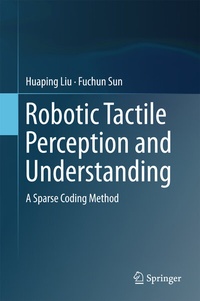
Robotic Tactile Perception and Understanding
Description

This book introduces the challenges of robotic tactile perception and task understanding, and describes an advanced approach based on machine learning and sparse coding techniques. Further, a set of structured sparse coding models is developed to address the issues of dynamic tactile sensing. The book then proves that the proposed framework is effective in solving the problems of multi-finger tactile object recognition, multi-label tactile adjective recognition and multi-category material analysis, which are all challenging practical problems in the fields of robotics and automation. The proposed sparse coding model can be used to tackle the challenging visual-tactile fusion recognition problem, and the book develops a series of efficient optimization algorithms to implement the model. It is suitable as a reference book for graduate students with a basic knowledge of machine learning as well as professional researchers interested in robotic tactile perception and understanding, andmachine learning.
More details
Other editions
Additional editions
Persons
Huaping Liu is an associate professor at the Department of Computer Science and Technology, Tsinghua University. He serves as an associate editor for various journals, including IEEE Transactions on Automation Science and Engineering, IEEE Transactions on Industrial Informatics, IEEE Robotics & Automation Letters, Neurocomputing, Cognitive Computation. He has served as an associate editor for ICRA and IROS and on IJCAI, RSS, and IJCNN Program Committees. His research interests include robotic perception and learning.
Fuchun Sun is a full professor at the Department of Computer Science and Technology, Tsinghua University. He is the recipient of National Science Fund for Distinguished Young Scholars. He serves as an associate editor for a number of international journals, including IEEE Transactions on Systems, Man and Cybernetics: Systems, IEEE Transactions on Fuzzy Systems, Mechatronics, Robotics and Autonomous Systems. His research interests include intelligentcontrol and robotics.
Content
Introduction.- Representation of Tactile and Visual Modalities.- Tactile Object Recognition using Joint Sparse Coding.- Tactile Object Recognition using Supervised Dictionary Learning.- Tactile Adjective Understanding using Structured Output-Associated Dictionary Learning.- Tactile Material Identification using Semantics-Regularized Dictionary Learning.- Visual-Tactile Fusion Object Recognition using Joint Sparse Coding.- Visual-Tactile Fusion Material Identification using Dictionary Learning.- Visual-Tactile Cross-Modal Matching using Common Dictionary Learning.-Conclusions.
