

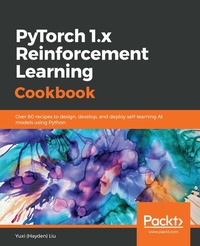
PyTorch 1.x Reinforcement Learning Cookbook
Over 60 recipes to design, develop, and deploy self-learning AI models using Python
Published on 23. September 2024
340 pages
978-1-83855-323-4 (ISBN)
Description

Implement reinforcement learning techniques and algorithms with the help of real-world examples and recipes
Key Features
Use PyTorch 1.x to design and build self-learning artificial intelligence (AI) models
Implement RL algorithms to solve control and optimization challenges faced by data scientists today
Apply modern RL libraries to simulate a controlled environment for your projects
Book DescriptionReinforcement learning (RL) is a branch of machine learning that has gained popularity in recent times. It allows you to train AI models that learn from their own actions and optimize their behavior. PyTorch has also emerged as the preferred tool for training RL models because of its efficiency and ease of use. With this book, you'll explore the important RL concepts and the implementation of algorithms in PyTorch 1.x. The recipes in the book, along with real-world examples, will help you master various RL techniques, such as dynamic programming, Monte Carlo simulations, temporal difference, and Q-learning. You'll also gain insights into industry-specific applications of these techniques. Later chapters will guide you through solving problems such as the multi-armed bandit problem and the cartpole problem using the multi-armed bandit algorithm and function approximation. You'll also learn how to use Deep Q-Networks to complete Atari games, along with how to effectively implement policy gradients. Finally, you'll discover how RL techniques are applied to Blackjack, Gridworld environments, internet advertising, and the Flappy Bird game. By the end of this book, you'll have developed the skills you need to implement popular RL algorithms and use RL techniques to solve real-world problems.What you will learn
Use Q-learning and the state-action-reward-state-action (SARSA) algorithm to solve various Gridworld problems
Develop a multi-armed bandit algorithm to optimize display advertising
Scale up learning and control processes using Deep Q-Networks
Simulate Markov Decision Processes, OpenAI Gym environments, and other common control problems
Select and build RL models, evaluate their performance, and optimize and deploy them
Use policy gradient methods to solve continuous RL problems
Who this book is forMachine learning engineers, data scientists and AI researchers looking for quick solutions to different reinforcement learning problems will find this book useful. Although prior knowledge of machine learning concepts is required, experience with PyTorch will be useful but not necessary.
Key Features
Use PyTorch 1.x to design and build self-learning artificial intelligence (AI) models
Implement RL algorithms to solve control and optimization challenges faced by data scientists today
Apply modern RL libraries to simulate a controlled environment for your projects
Book DescriptionReinforcement learning (RL) is a branch of machine learning that has gained popularity in recent times. It allows you to train AI models that learn from their own actions and optimize their behavior. PyTorch has also emerged as the preferred tool for training RL models because of its efficiency and ease of use. With this book, you'll explore the important RL concepts and the implementation of algorithms in PyTorch 1.x. The recipes in the book, along with real-world examples, will help you master various RL techniques, such as dynamic programming, Monte Carlo simulations, temporal difference, and Q-learning. You'll also gain insights into industry-specific applications of these techniques. Later chapters will guide you through solving problems such as the multi-armed bandit problem and the cartpole problem using the multi-armed bandit algorithm and function approximation. You'll also learn how to use Deep Q-Networks to complete Atari games, along with how to effectively implement policy gradients. Finally, you'll discover how RL techniques are applied to Blackjack, Gridworld environments, internet advertising, and the Flappy Bird game. By the end of this book, you'll have developed the skills you need to implement popular RL algorithms and use RL techniques to solve real-world problems.What you will learn
Use Q-learning and the state-action-reward-state-action (SARSA) algorithm to solve various Gridworld problems
Develop a multi-armed bandit algorithm to optimize display advertising
Scale up learning and control processes using Deep Q-Networks
Simulate Markov Decision Processes, OpenAI Gym environments, and other common control problems
Select and build RL models, evaluate their performance, and optimize and deploy them
Use policy gradient methods to solve continuous RL problems
Who this book is forMachine learning engineers, data scientists and AI researchers looking for quick solutions to different reinforcement learning problems will find this book useful. Although prior knowledge of machine learning concepts is required, experience with PyTorch will be useful but not necessary.
More details
Edition
Digital original
Language
English
Place of publication
Birmingham
United Kingdom
Target group
Professional and scholarly
US School Grade: College Graduate Student
Edition type
Digital original
File size
8,97 MB
ISBN-13
978-1-83855-323-4 (9781838553234)
Copyright in bibliographic data and cover images is held by Nielsen Book Services Limited or by the publishers or by their respective licensors: all rights reserved.
Schweitzer Classification
Other editions
Additional editions
Yuxi (Hayden) Liu
PyTorch 1.x Reinforcement Learning Cookbook
Over 60 recipes to design, develop, and deploy self-learning AI models using Python
Book
10/2019
Packt Publishing
€51.30
Shipment within 3-4 weeks
Person
Liu Yuxi (Hayden) :
Yuxi (Hayden) Liu was a Machine Learning Software Engineer at Google. With a wealth of experience from his tenure as a machine learning scientist, he has applied his expertise across data-driven domains and applied his ML expertise in computational advertising, cybersecurity, and information retrieval. He is the author of a series of influential machine learning books and an education enthusiast. His debut book, also the first edition of Python Machine Learning by Example, ranked the #1 bestseller in Amazon and has been translated into many different languages.
Yuxi (Hayden) Liu was a Machine Learning Software Engineer at Google. With a wealth of experience from his tenure as a machine learning scientist, he has applied his expertise across data-driven domains and applied his ML expertise in computational advertising, cybersecurity, and information retrieval. He is the author of a series of influential machine learning books and an education enthusiast. His debut book, also the first edition of Python Machine Learning by Example, ranked the #1 bestseller in Amazon and has been translated into many different languages.
Content
Table of Contents
Getting started with reinforcement learning and PyTorch
Markov Decision Process and Dynamic Programming
Monte Carlo Methods for making numerical estimations
Temporal Difference and Q-Learning
Solving Multi Armed Bandit problems
Scaling up Learning with Function Approximation
Deep Q-Networks in Action
Implementing Policy Gradients and Policy Optimization
Capstone Project: Playing Flappy Bird with DQN
Getting started with reinforcement learning and PyTorch
Markov Decision Process and Dynamic Programming
Monte Carlo Methods for making numerical estimations
Temporal Difference and Q-Learning
Solving Multi Armed Bandit problems
Scaling up Learning with Function Approximation
Deep Q-Networks in Action
Implementing Policy Gradients and Policy Optimization
Capstone Project: Playing Flappy Bird with DQN
