

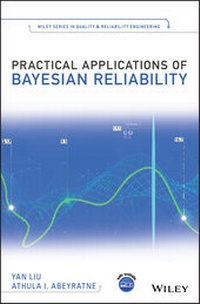
Practical Applications of Bayesian Reliability
Description

This self-contained reference provides fundamental knowledge of Bayesian reliability and utilizes numerous examples to show how Bayesian models can solve real life reliability problems. It teaches engineers and scientists exactly what Bayesian analysis is, what its benefits are, and how they can apply the methods to solve their own problems. To help readers get started quickly, the book presents many Bayesian models that use JAGS and which require fewer than 10 lines of command. It also offers a number of short R scripts consisting of simple functions to help them become familiar with R coding.
Practical Applications of Bayesian Reliability starts by introducing basic concepts of reliability engineering, including random variables, discrete and continuous probability distributions, hazard function, and censored data. Basic concepts of Bayesian statistics, models, reasons, and theory are presented in the following chapter. Coverage of Bayesian computation, Metropolis-Hastings algorithm, and Gibbs Sampling comes next. The book then goes on to teach the concepts of design capability and design for reliability; introduce Bayesian models for estimating system reliability; discuss Bayesian Hierarchical Models and their applications; present linear and logistic regression models in Bayesian Perspective; and more.
* Provides a step-by-step approach for developing advanced reliability models to solve complex problems, and does not require in-depth understanding of statistical methodology
* Educates managers on the potential of Bayesian reliability models and associated impact
* Introduces commonly used predictive reliability models and advanced Bayesian models based on real life applications
* Includes practical guidelines to construct Bayesian reliability models along with computer codes for all of the case studies
* JAGS and R codes are provided on an accompanying website to enable practitioners to easily copy them and tailor them to their own applications
Practical Applications of Bayesian Reliability is a helpful book for industry practitioners such as reliability engineers, mechanical engineers, electrical engineers, product engineers, system engineers, and materials scientists whose work includes predicting design or product performance.
More details
Other editions
Additional editions
Persons
YAN LIU, PHD, is Principal Reliability Engineer at Medtronic PLC, (USA). She is a certified Master Black Belt at Medtronic and has 12 years of working and consulting experience on reliability engineering and design for Six Sigma.
ATHULA I. ABEYRATNE, PHD, is Senior Principal Statistician and a certified DRM Black Belt at Medtronic PLC, (USA), where he has provided statistical consulting, training, data analyses, and modelling for 27 years.
Content
Preface xi
Acknowledgments xv
About the Companion Website xvii
1 Basic Concepts of Reliability Engineering 1
1.1 Introduction 1
1.1.1 Reliability Definition 3
1.1.2 Design for Reliability and Design for Six Sigma 4
1.2 Basic Theory and Concepts of Reliability Statistics 5
1.2.1 Random Variables 5
1.2.2 Discrete Probability Distributions 6
1.2.3 Continuous Probability Distributions 6
1.2.4 Properties of Discrete and Continuous Random Variables 6
1.2.4.1 Probability Mass Function 6
1.2.4.2 Probability Density Function 7
1.2.4.3 Cumulative Distribution Function 8
1.2.4.4 Reliability or Survival Function 8
1.2.4.5 Hazard Rate or Instantaneous Failure Rate 9
1.2.4.6 Cumulative Hazard Function 10
1.2.4.7 The Average Failure Rate Over Time 10
1.2.4.8 Mean Time to Failure 10
1.2.4.9 Mean Number of Failures 11
1.2.5 Censored Data 11
1.2.6 Parametric Models of Time to Failure Data 13
1.2.7 Nonparametric Estimation of Survival 14
1.2.8 Accelerated Life Testing 16
1.3 Bayesian Approach to Reliability Inferences 18
1.3.1 Brief History of Bayes' Theorem and Bayesian Statistics 18
1.3.2 How Does Bayesian Statistics Relate to Other Advances in the Industry? 19
1.3.2.1 Advancement of Predictive Analytics 20
1.3.2.2 Cost Reduction 20
1.4 Component Reliability Estimation 20
1.5 System Reliability Estimation 20
1.6 Design Capability Prediction (Monte Carlo Simulations) 21
1.7 Summary 22
References 23
2 Basic Concepts of Bayesian Statistics and Models 25
2.1 Basic Idea of Bayesian Reasoning 25
2.2 Basic Probability Theory and Bayes' Theorem 26
2.3 Bayesian Inference (Point and Interval Estimation) 32
2.4 Selection of Prior Distributions 35
2.4.1 Conjugate Priors 35
2.4.2 Informative and Non-informative Priors 38
2.5 Bayesian Inference vs. Frequentist Inference 44
2.6 How Bayesian Inference Works with Monte Carlo Simulations 48
2.7 Bayes Factor and its Applications 50
2.8 Predictive Distribution 53
2.9 Summary 57
References 57
3 Bayesian Computation 59
3.1 Introduction 59
3.2 Discretization 60
3.3 Markov Chain Monte Carlo Algorithms 66
3.3.1 Markov Chains 67
3.3.1.1 Monte Carlo Error 67
3.3.2 Metropolis-Hastings Algorithm 68
3.3.3 Gibbs Sampling 80
3.4 Using BUGS/JAGS 85
3.4.1 Define a JAGS Model 86
3.4.2 Create, Compile, and Run the JAGS Model 89
3.4.3 MCMC Diagnostics and Output Analysis 91
3.4.3.1 Summary Statistics 91
3.4.3.2 Trace Plots 92
3.4.3.3 Autocorrelation Plots 93
3.4.3.4 Cross-Correlation 93
3.4.3.5 Gelman-Rubin Diagnostic and Plots 94
3.4.4 Sensitivity to the Prior Distributions 95
3.4.5 Model Comparison 96
3.5 Summary 98
References 98
4 Reliability Distributions (Bayesian Perspective) 101
4.1 Introduction 101
4.2 Discrete Probability Models 102
4.2.1 Binomial Distribution 102
4.2.2 Poisson Distribution 104
4.3 Continuous Models 108
4.3.1 Exponential Distribution 108
4.3.2 Gamma Distribution 113
4.3.3 Weibull Distribution 115
4.3.3.1 Fit Data to a Weibull Distribution 116
4.3.3.2 Demonstrating Reliability using Right-censored Data Only 120
4.3.4 Normal Distribution 135
4.3.5 Lognormal Distribution 139
4.4 Model and Convergence Diagnostics 143
References 143
5 Reliability Demonstration Testing 145
5.1 Classical Zero-failure Test Plans for Substantiation Testing 146
5.2 Classical Zero-failure Test Plans for Reliability Testing 147
5.3 Bayesian Zero-failure Test Plan for Substantiation Testing 149
5.4 Bayesian Zero-failure Test Plan for Reliability Testing 161
5.5 Summary 162
References 163
6 Capability and Design for Reliability 165
6.1 Introduction 165
6.2 Monte Caro Simulations with Parameter Point Estimates 166
6.2.1 Stress-strength Interference Example 166
6.2.2 Tolerance Stack-up Example 171
6.3 Nested Monte Carlo Simulations with Bayesian Parameter Estimation 174
6.3.1 Stress-strength Interference Example 175
6.3.2 Tolerance Stack-up Example 182
6.4 Summary 186
References 186
7 System Reliability Bayesian Model 187
7.1 Introduction 187
7.2 Reliability Block Diagram 188
7.3 Fault Tree 196
7.4 Bayesian Network 197
7.4.1 A Multiple-sensor System 199
7.4.2 Dependent Failure Modes 202
7.4.3 Case Study: Aggregating Different Sources of Imperfect Data 204
7.5 Summary 214
References 214
8 Bayesian Hierarchical Model 217
8.1 Introduction 217
8.2 Bayesian Hierarchical Binomial Model 221
8.2.1 Separate One-level Bayesian Models 221
8.2.2 Bayesian Hierarchical Model 222
8.3 Bayesian Hierarchical Weibull Model 228
8.4 Summary 238
References 238
9 Regression Models 239
9.1 Linear Regression 239
9.2 Binary Logistic Regression 246
9.3 Case Study: Defibrillation Efficacy Analysis 257
9.4 Summary 277
References 278
Appendix A Guidance for Installing R, R Studio, JAGS, and rjags 279
A.1 Install R 279
A.2 Install R Studio 279
A.3 Install JAGS 280
A.4 Install Package rjags 280
A.5 Set Working Directory 280
Appendix B Commonly Used R Commands 281
B.1 How to Run R Commands 281
B.2 General Commands 281
B.3 Generate Data 282
B.4 Variable Types 283
B.5 Calculations and Operations 285
B.6 Summarize Data 286
B.7 Read and Write Data 287
B.8 Plot Data 288
B.9 Loops and Conditional Statements 290
Appendix C Probability Distributions 291
C.1 Discrete Distributions 291
C.1.1 Binomial Distribution 291
C.1.2 Poisson Distribution 291
C.2 Continuous Distributions 292
C.2.1 Beta Distribution 292
C.2.2 Exponential Distribution 292
C.2.3 Gamma Distribution 292
C.2.4 Inverse Gamma Distribution 293
C.2.5 Lognormal Distribution 293
C.2.6 Normal Distribution 293
C.2.7 Uniform Distribution 294
C.2.8 Weibull Distribution 294
Appendix D Jeffreys Prior 295
Index 299
1
Basic Concepts of Reliability Engineering
This chapter reviews basic concepts and common reliability engineering practices in the manufacturing industry. In addition, we briefly introduce the history of Bayesian statistics and how it relates to advances in the field of reliability engineering.
Experienced reliability engineers who are very familiar with reliability basics and would like to start learning Bayesian statistics right away, may skip this chapter and start with Chapter 2. Bayesian statistics has unique advantages for reliability estimations and predictive analytics in complex systems. In other cases, Bayesian methods may provide flexible solutions to aggregate various sources of information to potentially reduce necessary sample sizes and therefore achieve cost effectiveness. The following chapters provide more specific discussions and case study examples to expand on these topics.
1.1 Introduction
High product quality and reliability are critical to any industry in today's competitive business environment. In addition, predictable development time, efficient manufacturing with high yields, and exemplary field reliability are all hallmarks of a successful product development process.
Some of the popular best practices in industry include Design for Reliability and Design for Six Sigma programs to improve product robustness during the design phase. One core competency in these programs is to adopt advanced predictive analytics early in the product development to ensure first-pass success, instead of over-reliance on physical testing at the end of the development phase or on field performance data after product release.
The International Organization for Standardization () defines reliability as the "ability of a structure or structural member to fulfil the specified requirements, during the working life, for which it has been designed" (ISO 2394:2015 General principles on reliability for structures, Section 2.1.8). Typically, reliability is stated in terms of probability and associated confidence level. As an example, the reliability of a light bulb can be stated as the probability that the light bulb will last 5000 hours under normal operating conditions is 0.95 with 95% confidence.
Accurate and timely reliability prediction during the product development phase provides inputs for the design strategy and boosts understanding and confidence in product reliability before products are released to the market. It is also desirable to utilize and aggregate information from different sources in an effective way for reliability predictions.
Textbooks on reliability engineering nowadays are dominated by frequentist statistics approaches for reliability modeling and predictions. In a frequentist/classical framework, it is often difficult or impossible to propagate individual component level classical confidence intervals to a complex system comprising many components or subsystems. In a Bayesian framework, on the other hand, posterior distributions are true probability statements about unknown parameters, so they may be easily propagated through these system reliability models. Besides, it is often more flexible to use Bayesian models to integrate different sources of information, and update inferences when new data becomes available.
Given the benefits mentioned above, potential applications of Bayesian methods on reliability prediction are quite extensive. Historically, Bayesian methods for reliability engineering were applied on component reliability assessment where conjugate prior (will be discussed in Chapter 2) distributions were widely used due to mathematical tractability. Recent breakthroughs in computational algorithms have made it feasible to solve more complex Bayesian models, which have greatly boosted advancement and applications of Bayesian modeling. One popular algorithm is Markov chain Monte Carlo () sampling, a method of simulating from a probability distribution based on constructing a Markov chain. MCMC methods along with rapid advancement in high-speed computing have made it possible for building and solving complex Bayesian models for system reliability.
Over the past one or two decades, Bayesian statistics books have appeared in different scientific fields. However, most existing Bayesian statistics books do not focus on reliability analysis/predictions, thus real-life practical examples on reliability modeling are often absent. This challenge prevents reliability engineers from adopting the Bayesian approach to solve real-life problems. The goal of our book is to address this gap.
A few general topics covered in this book are:
- Design for reliability
- Basic concepts of Bayesian statistics and models
- Bayesian models for component reliability estimation
- Bayesian models for system reliability estimation
- Bayesian networks
- Advanced Bayesian reliability models.
Specifically, the topics covered are:
- Design for reliability
This topic includes reliability definition, basic probability theory and computations, statistical models, basics of component reliability prediction, basics of system reliability prediction, critical feature capability prediction, Monte Carlo simulations, and accelerated life testing (), etc.
- Basic concepts of Bayesian statistics and models
This topic includes Bayes' theorem and history, Bayesian inference vs. frequentist inference, basic statistical concepts: point estimate, confidence interval, discrete and continuous probability distributions, censored data, and selection of prior distributions (conjugate priors, non-informative priors, and informative priors), likelihood function, model selection criteria, introduction of MCMC algorithms and sampling methods, and Bayesian computation software (WinBUGS, OpenBUGS, Just Another Gibbs Sampler (), R, etc.).
- Bayesian models for component reliability estimation
This topic includes component level reliability prediction from reliability life testing, binomial distribution, Poisson distribution, exponential distribution, Weibull distribution, normal distribution, log-normal distribution, and reliability prediction from ALT (Arrhenius model, inverse power law model, etc.).
- Bayesian models for system reliability estimation
This topic includes reliability block diagram, series system, parallel system, mixed series and parallel system, fault tree analysis with uncertainty, process capability or design capability analysis with uncertainty, Monte Carlo simulation, and two-level nested Monte Carlo simulation and examples (strength-stress interference, tolerance stack up, etc.).
- Bayesian networks
This topic includes basics of conditional probability, joint probability distributions, marginal probability distributions, structures of a Bayesian network, examples, and basic steps to construct a Bayesian network model.
- Advanced Bayesian reliability models
This topic includes using hierarchical Bayesian models to predict reliability during iterative product development, to predict reliability of specific failure mechanisms, to aggregate different sources of imperfect data, to aggregate component level and system level data for system reliability prediction, and to borrow partial strength from historical product reliability information.
The first three chapters introduce commonly used reliability engineering methods and basics of Bayesian concepts and computations. The following chapters focus more on applications related to the individual topics introduced above. Readers are free to tailor their reading to specific chapters according to their interests and objectives.
1.1.1 Reliability Definition
In reliability engineering, product reliability is defined as the probability that a component or a system performs a required function under specified use conditions for a stated period of time. Note that the three key elements in the reliability definition are probability, use condition, and duration. Probability measures the likelihood of something happening. For example, when tossing a fair coin there is a 50% probability of the coin landing heads. When throwing a six-faced fair dice, the probability of observing each of the six outcomes (1, 2, 3, 4, 5, 6) is 1/6. Use conditions describe the conditions a product is operated under, e.g. temperature, humidity, pressure, voltage. Duration is usually related to the lifetime of a product. Reliability is usually estimated based on time to failure data from bench tests, accelerated life tests, or field service.
In engineering practices, it is common to define design requirements and use different types of tests, such as design verification tests or qualification tests, to ensure the product or the incoming parts meet these requirements. Here quality is measured by the probability of meeting a certain requirement, which can be thought of as reliability at time zero. Though these are quality assurance practices, the term "reliability" is sometimes used to refer to the probability of meeting a certain requirement.
Often in design verification tests, the samples are preconditioned through an equivalent lifecycle under specified stress conditions (to ensure reliable products, the stress conditions applied in the tests are usually as aggressive as or more aggressive than the actual use conditions in the field) before being tested against a requirement. In such cases, the...
