

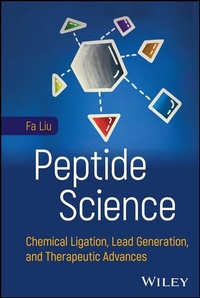
Peptide Science
Description

Understand the nature and applications of peptides with this clear and comprehensive guide
Peptides are signaling molecules comprised of amino acids which play an important role in modulating certain physiological processes. They have a wide range of applications, particularly with respect to biological studies and therapeutical potentials. The explosive growth of peptide science in recent years and the variety of achievements in peptide drug discovery and related areas have made it an important area of study for new researchers and industry professionals.
Peptide Science offers a clear, systematic overview of this burgeoning field and its major applications. Covering the chemistry, the pertinent technologies, and major existing therapies, it provides the tools required to integrate peptide research with virtually any area of research and development. Fully cognizant of the latest technological advances, it's a must-own for anyone looking to understand a vital field of chemistry.
Peptide Science readers will also find:
- Through coverage of peptide hit generation technologies from nature, to various display libraries and to modern computational designs
- Detailed discussion of therapies for conditions including cancer, diabetes, infectious diseases, and more
- A section dedicated to key challenges and future directions in peptide therapeutics
Peptide Science is ideal for industry professionals and researchers in organic chemistry, peptide science/chemistry, protein chemistry, biochemistry, and pharmaceutical sciences.
More details
Other editions
Additional editions
Person
Fa Liu, PhD, is the CSO of Full-Life Technologies, which centers on targeted alpha-radionuclide therapies. Prior to joining Full-Life, he was the CEO and Co-founder of Focus-X Therapeutics (2020-2022), later acquired by Full-Life. Before founding Focus-X, Dr. Liu headed the Chemistry of Novo Nordisk US sites, and Calibrium LLC (acquired by Novo Nordisk) (2014-2020), and served as a Group Leader at the Eli Lilly Peptide Discovery (2009-2014). Prior to Lilly, Dr. Liu worked at National Cancer Institute as a Staff Scientist (2004-2009). He received his Ph.D. in Synthetic Organic Chemistry from Shanghai Institute of Organic Chemistry in 2004.
Content
List of contributors xiii
Preface xvii
Section I New Developments in Peptide Chemistry 1
1 Chemical Peptide Ligations 3
Yihui Cao and Xuechen Li
1.1 Introduction 3
1.2 Ligation Driven by Trans-esterification 4
1.3 Ligation Driven by Imine Capture 8
1.4 Ligation Initiated by Hydroxylamine 10
1.5 Ligation in Protein Synthesis 12
1.6 Ligations in Drug Development 17
1.7 Summary and Outlook 21
2 Protein and Peptide Ligation Using Peptide Ligases 29
Anna Koijen and Leendert J. van den Bos
2.1 Introduction 29
2.2 Peptide Ligases Mechanism of Action 32
2.3 Sortase 33
2.4 Peptide Asparaginyl Ligases 38
2.5 Subtilisin-derived Peptide Ligases 41
2.6 Trypsiligase 44
2.7 Conclusion 46
3 Modern Methods for Late-stage Peptide Modification 55
Yuxuan Ding and Zachary T. Ball
3.1 Introduction 55
3.2 Methionine 57
3.3 Aspartate and Glutamate 59
3.4 Arginine 61
3.5 Tryptophan 62
3.6 Functionalization of sp2 C-H Bonds: Tyr, Phe, and His 66
3.7 Functionalization of sp3 C-H Bonds 71
3.8 Other X-H Functionalizations 73
3.9 Conclusion 74
Section II Peptide Drug Hit Identification 87
4 Generating Phage Libraries Bearing Unnatural Pharmacophores 89
Christin Kossmann, Arunika Ekanayake and Ratmir Derda
4.1 Introduction 89
4.2 Biotin Capture Assay to Detect Chemical Modification of Phage Libraries 93
4.3 N-terminal Oxidation and Functionalization to Incorporate Unnatural Fragments 106
4.4 Macrocyclization of Phage-displayed Peptides Bearing Cysteines 110
4.5 Macrocyclization and Installation of Warheads in Phage-displayed Libraries 114
4.6 Outlook 120
5 Computational Peptide Design for Diverse Structures and Functions 127
Stephen Rettie, David Juergens and Gaurav Bhardwaj
5.1 The Various Types of Peptides 128
5.2 In Silico Peptide Design: From Physics-based Methods to DL 129
5.3 Physics-based Methods 130
5.4 DL Methods for Peptide Design 136
5.5 Optimizing for Membrane Permeability and Stability 140
5.6 Remaining Challenges 141
5.7 Conclusion 143
Section III Peptide Drug Lead Generation and Optimization 151
6 Peptide Discovery: Lead Generation 153
Yvonne Angell, Wendy Hartsock, Hans Melo and Timothy M. Reichart
6.1 Introduction 153
6.2 Approved Drugs Discovered Through Phage Display 174
6.3 Approved Drugs Discovered Through mRNA Display 177
6.4 A Successful Example 185
6.5 Conclusion 188
7 A Survey and Guide to the Development of Fatty Acid-derivatized Peptide Therapeutics 203
Michael T. Jacobsen, Christian Poulsen, Katharina L. Kopp, Jørgen Olsen and Nick Cox
7.1 Introduction 203
7.2 Basics of Fatty Acid Derivatization of Peptides 204
7.3 Evolution of GLP-1-based Incretins into Stable, Long-acting Therapeutics 205
7.4 Diverse Mechanisms of Fatty Acid Derivatization to Extend Insulin Half-life 210
7.5 Development of a Stable, Fatty Acid-derivatized Amylin Analog 214
7.6 Stabilization and Fatty Acid Derivatization of Peptide YY (PYY) 217
7.7 Guidance for Advancing Fatty Acid-derivatized Peptides 222
7.8 Concluding Remarks 242
Section IV Peptide Drug Case Studies 269
8 Insulin in Its Second Century: History, Evolution, and Aspirations 271
John P. Mayer, Kishore Thalluri, Ethan Mickelson, Michael H.B. Stowell and Richard D. DiMarchi
8.1 Introduction 271
8.2 The Evolution of Insulin Therapy 272
8.3 Structure 278
8.4 Synthesis 280
8.5 Aspirational Aims 286
8.6 Concluding Thoughts 290
9 Incretins and Development of Incretin-based Therapeutics 305
Nan Zheng, Xiao-xuan Su, Shengping Zhang and Weijun Shen
9.1 Introduction 305
9.2 Development of Novel GLP-1 and GIP-based Therapeutics 309
9.3 Development of Multi-receptor Agonists Targeting Incretin and Other Hormonal Receptors 315
9.4 Summary and Perspective 329
10 Peptide-based Therapeutics for Inflammatory and Autoimmune Diseases 339
Sunay V. Chankeshwara, Werngard Czechtizky and Wu Su
10.1 Introduction 339
10.2 Literature Search and Methods 341
10.3 Representative Anti-inflammatory Peptides in Clinical Trials 342
10.4 Summary and Discussion 351
11 Radioligand as a Unique Rising Modality for Cancer Diagnosis and Treatment 359
Ming-Jin Jheng, Xiaozhu Wang, Pengyun Li and Fa Liu
11.1 Radioligand Introduction 359
11.2 Radionuclides and Chelators Developed for Medical Imaging and Cancer Treatment 361
11.3 Notable Radioligands Developed for Cancer Diagnosis and Treatment 364
11.4 Emerging Targets 371
11.5 Emerging Binder Modalities as Radioligand Vector 379
11.6 Perspectives: Promises and Challenges 384
12 Peptide-small Molecule Drug Conjugates for Cancer, Metabolic Diseases, and Beyond 401
Rongjun He, Sumeet Singh and Adam Mezo
12.1 Introduction 401
12.2 Peptide-drug Conjugates for Cancer 402
12.3 Peptide-drug Conjugates for Metabolic Diseases 409
12.4 Peptide-drug Conjugates for Other Diseases 415
12.5 Challenges in Peptide-drug Conjugate Design 415
12.6 Summary 416
13 Emerging Landscape of Therapeutic Oligonucleotide Delivery by Cell-penetrating Peptide 425
Xiang Li, Xiulong Shen, Ashweta Sahni and Ziqing Qian
13.1 Introduction 425
13.2 Cell-penetrating Peptides 426
13.3 Applications of CPPs for the Delivery of Therapeutic Oligonucleotides 433
13.4 Future Perspectives and Summary 447
Section V Peptide CMC and Regulatory 469
14 Peptides Chemistry, Manufacturing, and Controls 471
Jack Xu
14.1 Introduction 471
14.2 CMC Information and Format for DS 472
14.3 CMC Information and Format for DP 477
14.4 Synthetic Peptide CMC Development 483
14.5 Conclusions 504
Index 509
Chapter 1
Chemical Peptide Ligations
Yihui Cao and Xuechen Li
Department of Chemistry, the University of Hong Kong, Hong Kong SAR, P. R. China
1.1 Introduction
Proteins play crucial roles in basic physiological processes and are responsible for a variety of biochemical functions, including signaling transduction, energy utilization, and immune response. Correlating protein structure with function has always been a charming topic among researchers. Although recombinant expression from bacteria or cell lines is a convenient means to produce proteins, it is still difficult to control specific post-translational modifications such as glycosylations, incorporate any uncanonical amino acid, or introduce unnatural reporters such as fluorescent tags, using the natural cellular machinery [1]. Herein, chemical protein synthesis that assembles protein sequence through atom-by-atom control provides a solution for generating site-specific natural or unnatural modification(s), and mirror-image proteins.
The solid-phase peptide synthesis (SPPS) by Merrifield provides an efficient peptide synthesis approach [2]. Utilization of SPPS methodology, along with the condensation of protected peptide fragments, has significantly expanded the range of polypeptide lengths that can be achieved via chemical synthesis. However, SPPS is limited by the peptide length. Due to the statistical reasons for linear stepwise coupling, each step during SPPS is incomplete, which causes byproducts to accumulate with peptide chain elongation. The peptide length from SPPS mostly remains within 50 amino acids to maintain good synthesis quality. Besides, the limited solubility of protected peptides in organic solvents hampers the ability of this method to meet the increasing synthesis demand for complex protein structures [3]. Consequently, novel synthetic approaches that can be conducted in aqueous buffers for handling unprotected peptide segments are strongly demanded.
The concept of peptide ligation, which allows condensation of unprotected peptide segments, was first proposed in the 1980s [4,5]. It involves a weakly activated peptide C-terminus to chemoselectively react with the N-terminus of the second peptide, resulting in a ligation intermediate that links the two fragments together, followed by an irreversible rearrangement step to form a natural peptide linkage (Figure 1.1). In this chapter, the driving forces of ligation, chemoselectivity details, and their applications in protein synthesis are discussed.
Figure 1.1 Generic chemical peptide ligation.
1.2 Ligation Driven by Trans-esterification
1.2.1 Native Chemical Ligation
Native chemical ligation (NCL) (Figure 1.2a), developed by Kent et al. in 1994, is the most widely applied ligation method [6]. NCL requires one peptide with a C-terminal thioester and the second peptide with an N-terminal cysteine (Cys). Ligation occurs when two fragments are mixed in a neutral or slightly basic aqueous buffer. The thiol group of N-terminal Cys undergoes reversible trans-thioesterification, replacing the thioester at the C-terminal of the first fragment. After that, a rapid [1,4] -to- acyl transfer converts the thioester intermediate into a native Xaa-Cys peptide (Xaa represents any amino acid) and generates the desired ligation product. Chemoselectivity can be considered to originate from "soft base-soft acid" interaction between the thioester (soft acid) and the thiol group (soft base) from free Cys. Other nucleophiles present on unprotected peptides, such as amines, are "hard" bases that do not have the same reactivity as the thiol group. Next, the irreversible and rapid acyl transfer drives the equilibrium. Even though the internal Cys could be involved in the reversible trans-thioesterification, the reaction equilibrium cannot move forward and does not produce a stable product. The ligating C-terminal residue and the thioester type highly affect the NCL reaction rate. For instance, -branched amino acids (Val, Ile, Thr) significantly decrease ligation rates due to their bulky side chains [7]. Additionally, because of carbonyl oxygen interference, proline carbonyl is less electrophilic, which restricts trans-esterification [6]. For the formation of intermolecular thioesters, 4-mercaptophenylacetic acid (MPAA) is widely used as an additive due to its low pKa, good water solubility in NCL buffer, and odorless nature. Other thiols with higher pKa values, such as trifluoroethanethiol (TFET), can be also used [8].
Figure 1.2 Ligation through trans-esterification.
1.2.1.1 Desulfurization
Even though NCL is a powerful technique, the demand for one N-terminal Cys restricts its potential applications in protein chemical synthesis due to its low natural abundance (1.8%). The situation has changed after the invention of post-ligation desulfurization. Desulfurization, first reported in 2001 by Dawson, took advantage of metal-catalyzed reduction under a hydrogen atmosphere [9]. Nevertheless, the requirement of excess metal could occasionally cause side reactions and result in low yields. In addition, utilization of metal catalysts potentially induced epimerization of secondary alcohols and caused reduction of thiols and thioesters [10]. Later, the establishment of free radical-based desulfurization by Danishefsky et al. provided a milder and more reliable means for chemoselective peptide desulfurization (Figure 1.2b) [10]. Radical-induced desulfurization requires a radical initiator, phosphine compound, and hydrogen source. The reaction is initiated by water-soluble radical initiator 2,2-azobis[2-(2-imidazolin-2-yl)propane]dihydrochloride (VA-044) at 37 °C. The initiator radical attacks the Cys on the peptide, generating a thiyl radical. Subsequently, the thiyl radical rapidly reacts with tris(2-carboxyethyl)phosphine (TCEP) to generate the phosphonium radical. After that, the phosphine sulfide is cleaved from the complex, driving the alkyl radical formation. The desulfurized product is eventually generated after the application of hydrogen atom transfer (HAT) from thiol additives such as tert-butylthiol (tBuSH) or glutathione (GSH). Other thiyl radicals generated continue the radical chain reaction until its full conversion.
Based on the radical desulfurization strategy, photon-induced radical initiation has been developed. Pyane's group designed a flow chemistry system allowing NCL and UV-induced desulfurization to take place sequentially [11]. Later, visible light-induced metal complexes [12] and peroxide [13] radical initiator were reported, expanding the scope of radical initiator. Lately, Li et al. applied a novel radical generator, tetra-organylborate, to peptide desulfurization [14]. This strategy significantly increases the desulfurization reaction rate. It can be accomplished through a simple add-and-done procedure to finish within 30 seconds. Sodium tetraethylborate effectively serves as a radical initiator in the presence of atmospheric oxygen, inducing peptide desulfurization. Besides, the byproduct triethylborane from the initiation step serves as a hydrogen donor, demonstrating comparable efficiency to thiol additives such as tBuSH. Therefore, odorous thiol additives are not necessary for this strategy. In addition, the expeditious production of radicals can surpass the inhibitory impact of traces of MPAA residue , which allows NCL and desulfurization to perform in one pot. Furthermore, the mild conditions are compatible with some reductive functional groups, such as serotonylated substrates.
With the effective desulfurization technique established, the development of thiolated amino acids has drawn wide attention. The first thiolated amino acid to be used in NCL-desulfurization was -thiolated phenylalanine [15]. NCL-desulfurization via both the nickel method and the free radical VA-044 method has been successfully applied to it [16,17]. Remarkably, commercially available penicillamine (Pen) has been used as the valine surrogate to expand the ligation site to one of the most abundant amino acids (6.8%) [18]. So far, a number of research groups have contributed to developing 13 Fmoc-SPPS-compatible thiolated amino acids, including -thiolated, -thiolated, and -thiolated amino acids [1,19,20]. Although desulfurization may be difficult to some steric hindrance residue [18], NCL surrogate has been significantly expanded.
1.2.1.2 Auxiliary-assisted NCL
In parallel with the development of desulfurization, another strategy to overcome the low Cys abundance problem is the auxiliary-assisted NCL (Figure 1.2c). It introduces a thiol-containing handle at or near the peptide N-terminus, which mediates trans-thioesterification and -to- acyl transfer in a similar manner as Cys. After ligation, the auxiliary thiol hand can be removed. For glycopeptides, the branching sugar can serve as the handle through a thiol substitution. Its ligation site can be 1-6 amino acids away from the sugar-substituted amino acid [21,22]. In such cases, the acyl transfer via a large ring transition state significantly affects the reaction rate and efficiency, as compared to NCL. On the other hand, a variety of substitutions, including -2-mer-captoethyl type and -2-mercaptobenzyl type [23], have been developed. They are designed to allow for acyl transfer through a five- or six-member ring for a rapid...
