

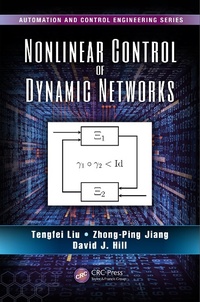
Nonlinear Control of Dynamic Networks
1st Edition
Published on 3. September 2018
345 pages
978-1-4665-8460-0 (ISBN)
Description

Significant progress has been made on nonlinear control systems in the past two decades. However, many of the existing nonlinear control methods cannot be readily used to cope with communication and networking issues without nontrivial modifications. For example, small quantization errors may cause the performance of a "well-designed" nonlinear control system to deteriorate.
Motivated by the need for new tools to solve complex problems resulting from smart power grids, biological processes, distributed computing networks, transportation networks, robotic systems, and other cutting-edge control applications, Nonlinear Control of Dynamic Networks tackles newly arising theoretical and real-world challenges for stability analysis and control design, including nonlinearity, dimensionality, uncertainty, and information constraints as well as behaviors stemming from quantization, data-sampling, and impulses.
Delivering a systematic review of the nonlinear small-gain theorems, the text:
Supplies novel cyclic-small-gain theorems for large-scale nonlinear dynamic networks
Offers a cyclic-small-gain framework for nonlinear control with static or dynamic quantization
Contains a combination of cyclic-small-gain and set-valued map designs for robust control of nonlinear uncertain systems subject to sensor noise
Presents a cyclic-small-gain result in directed graphs and distributed control of nonlinear multi-agent systems with fixed or dynamically changing topology
Based on the authors' recent research, Nonlinear Control of Dynamic Networks provides a unified framework for robust, quantized, and distributed control under information constraints. Suggesting avenues for further exploration, the book encourages readers to take into consideration more communication and networking issues in control designs to better handle the arising challenges.
Motivated by the need for new tools to solve complex problems resulting from smart power grids, biological processes, distributed computing networks, transportation networks, robotic systems, and other cutting-edge control applications, Nonlinear Control of Dynamic Networks tackles newly arising theoretical and real-world challenges for stability analysis and control design, including nonlinearity, dimensionality, uncertainty, and information constraints as well as behaviors stemming from quantization, data-sampling, and impulses.
Delivering a systematic review of the nonlinear small-gain theorems, the text:
Supplies novel cyclic-small-gain theorems for large-scale nonlinear dynamic networks
Offers a cyclic-small-gain framework for nonlinear control with static or dynamic quantization
Contains a combination of cyclic-small-gain and set-valued map designs for robust control of nonlinear uncertain systems subject to sensor noise
Presents a cyclic-small-gain result in directed graphs and distributed control of nonlinear multi-agent systems with fixed or dynamically changing topology
Based on the authors' recent research, Nonlinear Control of Dynamic Networks provides a unified framework for robust, quantized, and distributed control under information constraints. Suggesting avenues for further exploration, the book encourages readers to take into consideration more communication and networking issues in control designs to better handle the arising challenges.
More details
Series
Language
English
Place of publication
Baton Rouge
United States
Publishing group
Taylor & Francis Inc
Target group
College/higher education
Graduate students, instructors, and practicing engineers involved in controls and automation.
Illustrations
65 s/w Abbildungen
65 Illustrations, black and white
File size
4,70 MB
ISBN-13
978-1-4665-8460-0 (9781466584600)
Copyright in bibliographic data and cover images is held by Nielsen Book Services Limited or by the publishers or by their respective licensors: all rights reserved.
Schweitzer Classification
Other editions
Additional editions
Tengfei Liu | Zhong-Ping Jiang | David J. Hill
Nonlinear Control of Dynamic Networks
Book
03/2017
1st Edition
CRC Press
€123.50
Shipment within 10-20 days
Tengfei Liu | Zhong-Ping Jiang | David J. Hill
Nonlinear Control of Dynamic Networks
Book
04/2014
1st Edition
CRC Press
€326.83
Shipment within 15-20 days
Persons
Dr. Tengfei Liu holds a BE in automation and ME in control theory and engineering from the South China University of Technology, Guangzhou, as well as a Ph.D in engineering from the Australian National University, Acton, Canberra. He is a visiting assistant professor at the Polytechnic Institute of New York University, Brooklyn, USA. His current research interests include stability theory and robust nonlinear, quantized, and distributed control and their applications in mechanical, power, and transportation systems. Dr. Liu, with Prof. Zhong-Ping Jiang and Prof. David J. Hill, received the Guan Zhao-Zhi Best Paper Award at the 2011 Chinese Control Conference.
Prof. Zhong-Ping Jiang holds a BS in mathematics from the University of Wuhan, China; MS in statistics from the University of Paris XI, France; and Ph.D in automatic control and mathematics from the Ecole des Mines de Paris, France. Currently, he is full professor of electrical and computer engineering at New York University, Brooklyn, USA. His research interests include stability theory, robust and adaptive nonlinear control, and adaptive dynamic programming and their applications to underactuated mechanical systems, communication networks, multi-agent systems, smart grids, and neuroscience. An IEEE and IFAC fellow, he has coauthored two books and edited several publications.
Prof. David J. Hill holds a BE and BS from the University of Queensland, Australia, as well as a Ph.D from the University of Newcastle, Australia. Currently, he holds the chair of electrical engineering at the University of Hong Kong. He is also part-time professor at the University of Sydney, Australia. An IEEE, SIAM, and Australian Academies fellow and IVA (Sweden) foreign member, he has held various positions at Sydney University and the universities of Melbourne (Australia), California (Berkeley), Newcastle, Lund (Sweden), Munich (Germany), and Hong Kong (City and Polytechnic).
Prof. Zhong-Ping Jiang holds a BS in mathematics from the University of Wuhan, China; MS in statistics from the University of Paris XI, France; and Ph.D in automatic control and mathematics from the Ecole des Mines de Paris, France. Currently, he is full professor of electrical and computer engineering at New York University, Brooklyn, USA. His research interests include stability theory, robust and adaptive nonlinear control, and adaptive dynamic programming and their applications to underactuated mechanical systems, communication networks, multi-agent systems, smart grids, and neuroscience. An IEEE and IFAC fellow, he has coauthored two books and edited several publications.
Prof. David J. Hill holds a BE and BS from the University of Queensland, Australia, as well as a Ph.D from the University of Newcastle, Australia. Currently, he holds the chair of electrical engineering at the University of Hong Kong. He is also part-time professor at the University of Sydney, Australia. An IEEE, SIAM, and Australian Academies fellow and IVA (Sweden) foreign member, he has held various positions at Sydney University and the universities of Melbourne (Australia), California (Berkeley), Newcastle, Lund (Sweden), Munich (Germany), and Hong Kong (City and Polytechnic).
Content
Introduction. Interconnected Nonlinear Systems. Large-Scale Dynamic Networks. Control Under Sensor Noise. Quantized Nonlinear Control. Distributed Nonlinear Control. Conclusions and Future Challenges. Appendices.
