

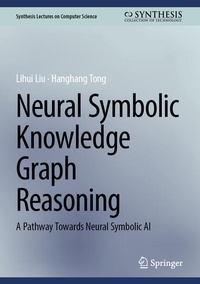
Neural Symbolic Knowledge Graph Reasoning
Description

This book explores various aspects of knowledge graph reasoning to solve different tasks, encompassing first, traditional symbolic methods for knowledge graph reasoning; second, recent developments in neural-based knowledge graph reasoning techniques; and third, cutting-edge advancements in neural-symbolic hybrid approaches to knowledge graph reasoning. The authors focus on the model and algorithm design aspect and study knowledge graphs from two perspectives: background knowledge graph and input query. Knowledge graph reasoning, which aims to infer and discover new knowledge from existing information in the knowledge graph, has played an important role in many real-world applications, such as question answering and recommender systems. A new trend in knowledge graph reasoning is the combination of neural models with symbolic knowledge graphs, allowing for the design of models that are not only efficient and accurate, but also interpretable. In this book, the authors study the application of neural-symbolic knowledge reasoning to different tasks from two perspectives: the input query and the background knowledge graph.
More details
Other editions
Additional editions
Persons
Lihui Liu, Ph.D., is an Assistant Professor in the Department of Computer Science at Wayne State University. He received his Ph.D. from the Department of Computer Science at the University of Illinois at Urbana-Champaign. His research focuses on large-scale data mining and machine learning, particularly on graphs, with an emphasis on knowledge graph reasoning. Dr. Liu's research has been published at several major conferences and in journals on data mining and artificial intelligence. He has also served as a reviewer and program committee member for top-tier data mining and artificial intelligence conferences and journals, including KDD, WWW, AAAI, IJCAI, and BigData.
Hanghang Tong, Ph.D, is a Professor and University Scholar at Siebel School of Computing and Data Science at the University of Illinois at Urbana-Champaign. He received his M.Sc. and Ph.D. degrees from Carnegie Mellon University in 2008 and 2009, both in Machine Learning. His research interests include large scale data mining for graphs and multimedia. Dr. Tong has published 300+ papers, and his research has received several awards, including SDM/IBM 2018 early career data mining research award, two 'test of time' awards (ICDM 2015 & 2022 10-Year Highest Impact Paper award), ICDM Tao Li award (2019), NSF CAREER award, and several best paper awards. He was Editor-in-Chief of ACM SIGKDD Explorations (2018 - 2022). He is also a distinguished member of ACM (2021) and a Fellow of IEEE (2022).
Content
Introduction: Background and Challenges.- Knowledge Graph Reasoning for Accurate Query and Complete Graph.- Knowledge Graph Reasoning for Accurate Query and Incomplete Graph.- Knowledge Graph Reasoning for Ambiguous Query and Incomplete Graph.- Knowledge Graph Reasoning for Dynamic Query and Incomplete Graph.- Knowledge Graph Reasoning with Large Language Models.- Conclusion, Open Challenges, and Future Directions.
