

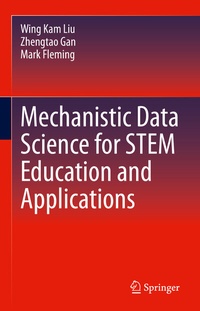
Mechanistic Data Science for STEM Education and Applications
Description

This book introduces Mechanistic Data Science (MDS) as a structured methodology for combining data science tools with mathematical scientific principles (i.e., "mechanistic" principles) to solve intractable problems. Traditional data science methodologies require copious quantities of data to show a reliable pattern, but the amount of required data can be greatly reduced by considering the mathematical science principles. MDS is presented here in six easy-to-follow modules: 1) Multimodal data generation and collection, 2) extraction of mechanistic features, 3) knowledge-driven dimension reduction, 4) reduced order surrogate models, 5) deep learning for regression and classification, and 6) system and design. These data science and mechanistic analysis steps are presented in an intuitive manner that emphasizes practical concepts for solving engineering problems as well as real-life problems. This book is written in a spectral style and is ideal as an entry leveltextbook for engineering and data science undergraduate and graduate students, practicing scientists and engineers, as well as STEM (Science, Technology, Engineering, Mathematics) high school students and teachers.
More details
Other editions
Additional editions
Persons
Dr. Wing Kam Liu is Walter P. Murphy Professor of Mechanical Engineering & Civil and Environmental Engineering and (by courtesy) Materials Science and Engineering, and Director of Global Center on Advanced Material Systems and Simulation (CAMSIM) at Northwestern University in Evanston, Illinois; Dr. Zhengtao Gan is Research Assistant Professor in the Department of Mechanical Engineering at Northwestern University in Evanston, Illinois; and Dr. Mark Fleming, is the Chief Technical Officer of Fusion Engineering, and an Adjunct Professor in the Department of Mechanical Engineering at Northwestern University in Evanston, Illinois.
Content
1-Introduction to Mechanistic Data Science.- 2-Multimodal Data Generation and Collection.- 3-Optimization and Regression.- 4-Extraction of Mechanistic Features.- 5-Knowledge-Driven Dimension Reduction and Reduced Order Surrogate Models.- 6-Deep Learning for Regression and Classification.- 7-System and Design
