

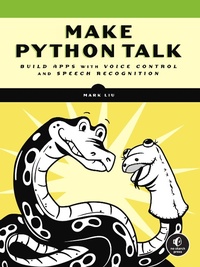
Make Python Talk
Build Apps with Voice Control and Speech Recognition
Published on 24. August 2021
384 pages
978-1-7185-0157-7 (ISBN)
Description

A project-based book that teaches beginning Python programmers how to build working, useful, and fun voice-controlled applications.
This fun, hands-on book will take your basic Python skills to the next level as you build voice-controlled apps to use in your daily life. Starting with a Python refresher and an introduction to speech-recognition/text-to-speech functionalities, you'll soon ease into more advanced topics, like making your own modules and building working voice-controlled apps.
Each chapter scaffolds multiple projects that allow you to see real results from your code at a manageable pace, while end-of-chapter exercises strengthen your understanding of new concepts. You'll design interactive games, like Connect Four and Tic-Tac-Toe, and create intelligent computer opponents that talk and take commands; you'll make a real-time language translator, and create voice-activated financial-market apps that track the stocks or cryptocurrencies you are interested in. Finally, you'll load all of these features into the ultimate virtual personal assistant - a conversational VPA that tells jokes, reads the news, and gives you hands-free control of your email, browser, music player, desktop files, and more.
Along the way, you'll learn how to:
● Build Python modules, implement animations, and integrate live data into an app
● Use web-scraping skills for voice-controlling podcasts, videos, and web searches
● Fine-tune the speech recognition to accept a variety of input
● Associate regular tasks like opening files and accessing the web with speech commands
● Integrate functionality from other programs into a single VPA with computational knowledge engines to answer almost any question
Packed with cross-platform code examples to download, practice activities and exercises, and explainer images, you'll quickly become proficient in Python coding in general and speech recognition/text to speech in particular.
This fun, hands-on book will take your basic Python skills to the next level as you build voice-controlled apps to use in your daily life. Starting with a Python refresher and an introduction to speech-recognition/text-to-speech functionalities, you'll soon ease into more advanced topics, like making your own modules and building working voice-controlled apps.
Each chapter scaffolds multiple projects that allow you to see real results from your code at a manageable pace, while end-of-chapter exercises strengthen your understanding of new concepts. You'll design interactive games, like Connect Four and Tic-Tac-Toe, and create intelligent computer opponents that talk and take commands; you'll make a real-time language translator, and create voice-activated financial-market apps that track the stocks or cryptocurrencies you are interested in. Finally, you'll load all of these features into the ultimate virtual personal assistant - a conversational VPA that tells jokes, reads the news, and gives you hands-free control of your email, browser, music player, desktop files, and more.
Along the way, you'll learn how to:
● Build Python modules, implement animations, and integrate live data into an app
● Use web-scraping skills for voice-controlling podcasts, videos, and web searches
● Fine-tune the speech recognition to accept a variety of input
● Associate regular tasks like opening files and accessing the web with speech commands
● Integrate functionality from other programs into a single VPA with computational knowledge engines to answer almost any question
Packed with cross-platform code examples to download, practice activities and exercises, and explainer images, you'll quickly become proficient in Python coding in general and speech recognition/text to speech in particular.
More details
Other editions
Additional editions
Book
08/2021
No Starch Press
€33.00
Shipment within 3-4 weeks
Person
Dr. Mark H. Liu is an Associate Professor and director of the Master of Science in Finance Program at the University of Kentucky, where he teaches Python Predictive Analytics and runs Python workshops. He has more than 20 years of coding experience in C++, SAS, Stata, and Python, and his research has been published in many top finance journals.
Content
Introduction
Part I: Getting Started
Chapter 1: Install Python via Anaconda and Spyder
Chapter 2: Python Refresher
Part II: Learning to Talk
Chapter 3: Speech Recognition
Chapter 4: Make Python Talk
Chapter 5: Speaking Applications
Chapter 6: Web Scraping Podcasts, Radios, and Videos
Chapter 7: Building a Virtual Personal Assistant
Chapter 8: Know-it-all VPA
Part III: Interactive Games
Chapter 9: Graphics and Animation with the turtle Module
Chapter 10: Tic-Tac-Toe
Chapter 11: Connect Four
Chapter 12: guess-the-word Game
Chapter 13: Smart Games: Adding Intelligence
Part IV: Going Further
Chapter 14: Financial Applications
Chapter 15: Stock Market Watch
Chapter 16: Use Other Languages: Translator
Chapter 17: Ultimate VPA
Appendix A: Useful Speech Modules
Appendix B: Answers to End of Chapter Exercises
Index
Part I: Getting Started
Chapter 1: Install Python via Anaconda and Spyder
Chapter 2: Python Refresher
Part II: Learning to Talk
Chapter 3: Speech Recognition
Chapter 4: Make Python Talk
Chapter 5: Speaking Applications
Chapter 6: Web Scraping Podcasts, Radios, and Videos
Chapter 7: Building a Virtual Personal Assistant
Chapter 8: Know-it-all VPA
Part III: Interactive Games
Chapter 9: Graphics and Animation with the turtle Module
Chapter 10: Tic-Tac-Toe
Chapter 11: Connect Four
Chapter 12: guess-the-word Game
Chapter 13: Smart Games: Adding Intelligence
Part IV: Going Further
Chapter 14: Financial Applications
Chapter 15: Stock Market Watch
Chapter 16: Use Other Languages: Translator
Chapter 17: Ultimate VPA
Appendix A: Useful Speech Modules
Appendix B: Answers to End of Chapter Exercises
Index
