

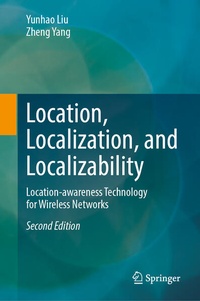
Location, Localization, and Localizability
Description

Time flies since the debut of this book. In the past ten years, localization technology has evolved from small saplings into towering trees. Robots and drones with autonomous positioning and navigation capabilities, once considered unreachable fantasies, have gradually become a reality. However, while we are being amazed at the groundbreaking changes brought about by technology, as researchers, we still need to remain acutely attentive to the current limitations of localization. Some significant challenges still impede the widespread deployment. For example, traditional Wi-Fi fingerprint-based wireless localization, due to various challenges in fingerprint database collection and maintenance, has remained stay in the laboratory, and even when using smartphones for localization in malls, we still cannot achieve the outdoor GPS-like experience. The list goes on and on.
Against this backdrop, the reissue of this book aims to more comprehensively reflect the latest developments in localization technology. We have added introductions to emerging technologies such as passive high-precision localization based on wireless signal CSl and autonomous localization for smart devices. Additionally, we have integrated and further streamlined technical chapters that now appear outdated adapting to the pace of the times.
This book aims to provide a comprehensive and in-depth view of location-awareness technology in today's popular wireless networks. However, the obvious diversity of networks, from short-range Bluetooth to long-range telecommunication networks, makes it very challenging to organize materials. Although general principles exist, the implementation differs from network to network and application to application.
The book can serve as a guidebook for the technicians and practitioners in the industry of location systems. They can expect to obtain a comprehensive understanding of the field, in order to compare and select localization solutions fulfilling various application requirements. Abundant references in the book open up a broader domain for advanced study. In addition, the book is tailored toward a textbook for college researchers and graduate students.
More details
Other editions
Additional editions
Persons
Yunhao Liu is Chair Professor at Tsinghua University. Yunhao received his BS degree in Automation Department from Tsinghua University, an MS and a PhD degree in Computer Science and Engineering in Michigan State University. He is a fellow of ACM and IEEE. He is now serving as the Editor in Chief of ACM Transactions on Sensor Networks and Honorary Chair of ACM China.
Zheng Yang is an associate professor at Tsinghua University. His research interests include Internet of Things and Industrial Internet. He received his BE degree in the Department of Computer Science from Tsinghua University, and his PhD degree in the Department of Computer Science and Engineering of Hong Kong University of Science and Technology. He is a fellow of IEEE and a member of ACM.
Content
Chapter 1. Introduction.- Chapter 2. Physical Measurements.- Chapter 3. One-hop Location Estimation.- Chapter 4. Range-based Network Localization.- Chapter 5. Range-free Network Localization.- Chapter 6. Error Control.- Chapter 7. Localizability.- Chapter 8. Robust Indoor Localization.- Chapter 9. Automatic Fingerprint Database Update.- Chapter 10. Location Privacy.
