

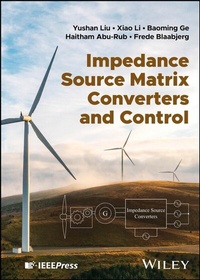
Impedance Source Matrix Converters and Control
Description

Technical resource presenting the latest power conversion solutions to advance the role of AC-AC power electronics in various applications.
Compiling state-of-the-art research from around the world, Impedance Source Matrix Converters and Control provides a rich diversity of scientific work experience and scholarly approaches on the fundamentals and advances of power electronic converters for motor drives, renewable energies, and industry applications. The reader will be able to apply the learnt design approaches in this book for building and researching the future generation of efficient power electronic converters: more efficient, more reliable, less expensive, lighter, and less voluminous.
The text introduces impedance source matrix converters in four distinct parts, covering the basics, converter topology, control, and applications. Its main focus is on the detailed understanding of advanced concepts related to fundamentals of impedance source matrix converters, and provides associated models, analysis, modulation, and final design and optimization control.
Additional tables, questions/answers, tutorials, PowerPoint presentations, and selected simulation and experimental results are discussed in order to impart seamless reader comprehension.
Written by four highly qualified academics with significant experience in the field, Impedance Source Matrix Converters and Control covers sample topics such as:
- Operating principles and modulation methods for impedance source direct/indirect matrix converters and 3-1-phase matrix converters
- Optimum operation control of LC filter integrated impedance source indirect matrix converters and comparison and control strategies of typical impedance source matrix converters
- Design and improvement in the electricity supply's reliability, efficiency, compact volume, power quality, and sustainability
- Challenges and key technologies within the field of impedance source matrix converters, and solutions and directions for further research and applications
Impedance Source Matrix Converters and Control is an essential resource on the latest developments in the field for researchers, postgraduate students, and graduate students studying power electronics and renewable energy conversion. The text is also a useful reference for R&D engineers involved with the development of power converters/inverters.
More details
Other editions
Additional editions
Persons
Yushan Liu, is an Associate Professor at Beihang University, China. Dr. Liu received the Ph.D. degree in Electrical Engineering from the School of Electrical Engineering, Beijing Jiaotong University, China, in 2014.
Xiao Li, is an Assistant Professor at Beihang University, China. He worked with the Renasas Inc. and Efficient Power Conversion Inc. from 2017 to 2020.
Baoming Ge, is a Former Professor at Beijing Jiaotong University, China, now at Ford Motor Company, USA. He has published 3 books, 2 book chapters, more than 230 papers, and holds 56 patents.
Haitham Abu-Rub, is Professor at Texas A&M University at Qatar, and is the Managing Director of the Smart Grid Center at the same university.
Frede Blaabjerg, is Professor with the Department of AAU Energy at Aalborg University, Denmark. He is the former President of the IEEE Power Electronics Society and Vice-President of the Danish Academy of Technical Sciences.
Content
About the Authors xi
Preface xiii
Acknowledgment xiv
1 Background 1
1.1 Power Electronics Converter Topologies and Applications in Modern Power Systems 1
1.1.1 Introduction 1
1.1.2 Matrix Converter 5
1.1.2.1 Direct Matrix Converter 5
1.1.2.2 Indirect Matrix Converter 5
1.1.2.3 Power Switches of MCs 6
1.1.2.4 Research Status of MCs 9
1.2 ZS/QZS Converters 11
1.3 Advantages of ZS/QZS MCs Compared to Existing Technology 12
1.4 Current Status and Future Trends 15
1.5 Contents Overview 16
References 17
2 Z-Source/Quasi-Z-Source Direct Matrix Converter 27
2.1 Introduction 27
2.2 Topology and Operating Principle 29
2.2.1 Topologies 29
2.2.2 Operation and Modeling 32
2.2.2.1 Basic Model 32
2.2.2.2 Buck/Boost Conversion Mode 34
2.3 Modulation Methods 35
2.3.1 PWM Method for Traditional mc 35
2.3.2 PWM Method for the Simplified Voltage-Fed ZS-MC 35
2.3.3 Voltage Gain of the Simplified Voltage-Fed ZS-MC 37
2.3.4 Implementation of Control Method 42
2.4 Simulation and Experimental Results 44
2.5 Conclusion 49
References 49
3 Z-Source/Quasi-Z-Source Indirect Matrix Converter (Non-All SiC Solution) 53
3.1 Introduction 53
3.2 Topologies and Operating Principle 55
3.2.1 Topologies 55
3.2.2 Operating Principle 58
3.2.3 Parameters Design of the QZS Network 61
3.3 Modulation Methods 62
3.4 Simulation Results and Applications 65
3.4.1 Applications 65
3.4.2 Simulation Results 68
3.5 Conclusion 71
References 72
4 Z-Source/Quasi-Z-Source Indirect Matrix Converter (All SiC Solution) 75
4.1 Introduction 75
4.2 Topologies and Operating Principle 75
4.2.1 Topologies 75
4.2.2 Operating Principle 78
4.2.3 Parameters Design of the QZS-Network 81
4.3 Modulation Methods 82
4.3.1 Conventional Space Vector Modulation Method 82
4.3.1.1 Rectifier-stage SVM 82
4.3.1.2 Inverter-stage SVM 85
4.3.1.3 Coordination of dual SVM 87
4.3.2 Modulation Methods with Common-mode Voltage Reduction 88
4.3.2.1 Common-mode Voltage 89
4.3.2.2 Common-Mode Voltage Reduction Method I 92
4.3.2.3 Common-mode Voltage Reduction Method II 94
4.4 Simulation and Experimental Results 97
4.5 Conclusion 101
References 102
5 Comparison of Typical Z-Source/Quasi-Z-Source Matrix Converters 105
5.1 Introduction 105
5.2 Operation Analysis of Novel QZS-IMC 109
5.2.1 Discussed Topology 109
5.2.2 Buck Operation 109
5.2.3 Boost Operation 109
5.2.3.1 Non-shoot-through state 110
5.2.3.2 Shoot-through state 111
5.3 Small-Signal Modeling of QZS-IMC 111
5.4 Voltage Gain Investigation 112
5.4.1 Modeling IMC 112
5.4.2 Voltage Gain Analysis 115
5.5 QZS Network's Filtering Function Investigation 116
5.5.1 Circuit Large Signal Analysis 116
5.5.2 S-Domain Small-Signal Analysis 117
5.6 Parameters Design of QZS Network 118
5.6.1 Switching Frequency Ripple Limit 118
5.6.2 Power Factor and Cut-off Frequency Requirements 120
5.7 Simulation and Experimental Results 121
5.7.1 Investigation of Modeling 122
5.7.2 Voltage Gain Verification 124
5.7.3 Filtering Function Verification 124
5.8 Conclusion 128
References 128
6 Z-Source/Quasi-Z-Source 3-1-Phase Matrix Converters 131
6.1 Introduction 131
6.2 Topology and Modulation of the 3-1-Phase QZS-MC 132
6.2.1 Topology 132
6.2.2 Equivalent Circuits 132
6.2.3 Modulation Method 134
6.3 Modeling and Analysis of Three-Phase-to-Single-Phase qZS-MC 135
6.3.1 Model of Three-Phase-to-Single-Phase qZS-MC 135
6.3.2 Voltage Gain Analysis 138
6.4 Simulation and Experimental Tests 139
6.4.1 Verification of Modeling 140
6.4.2 Verification of Voltage Gain 141
6.5 Conclusion 142
References 142
7 Z-Source/Quasi-Z-Source 3-1-Phase Matrix Converters With Low-Frequency Power Compensation 145
7.1 Introduction 145
7.2 The 3-1-Phase QZS-MC with Input Low-Frequency Harmonic Elimination 146
7.3 Existed Harmonic Components and Required Impedance Parameters Without Ripple Compensation 147
7.4 Predictive Control of Ripple Compensation Branch 149
7.4.1 Current Model of Compensation Branch 149
7.4.2 Power Model of Compensation Capacitor 150
7.4.3 2¿ Power of Single-Phase Side 150
7.4.4 Cost Function 150
7.5 Simulation and Experimental Tests 150
7.6 Conclusion 155
A Appendix 157
References 159
8 Model Predictive Control of LC Filter-Integrated Quasi-Z-Source Indirect Matrix Converter 161
8.1 Introduction 161
8.2 LC Filter-Integrated QZS-IMC 162
8.3 Principle of Model Predictive Control 163
8.4 Proposed MPC for LC Filter-Integrated QZS-IMC 164
8.4.1 Modeling of IMC 165
8.4.2 Predictive Models 166
8.4.2.1 Predictive Model of AC Load Current 166
8.4.2.2 Predictive Model of QZS Network 166
8.4.2.3 Cost Function Evaluation and Switching States Selection 167
8.5 Simulation and Experimental Results 169
8.6 Conclusion 173
References 174
9 Optimum Boost Control of LC Filter-Integrated Quasi-Z-Source Indirect Matrix Converter 177
9.1 Introduction 177
9.2 Gain Model and Modulation of QZS-IMC System 179
9.2.1 Derivation and Analysis of Gain Model 179
9.2.2 Modulation Method 180
9.3 Multi-Constraints Optimization and Operation Control for QZS-IMC 182
9.3.1 Constrained Optimization Method 182
9.3.2 Optimal Function Curve of QZS-IMC 183
9.3.2.1 Pre-constrained Condition 183
9.3.2.2 Constrained Condition When D is Nonzero 184
9.3.2.3 Optimal Function at D ¿ 0 184
9.3.2.4 Full-range Optimal Operation Curve 185
9.3.3 Optimal Operation Control of QZS-IMC 185
9.3.3.1 Main Flow Chart 187
9.3.3.2 Flow Chart of Boost Mode 187
9.3.3.3 Flow Chart of Buck Mode 187
9.4 Simulation and Experimental Verifications 188
9.4.1 Verification of Optimal Operation Control 188
9.4.1.1 Case 1: Boost Mode From Line-A to Line-B 189
9.4.1.2 Case 2: Buck Mode From Line-B to Line-A 194
9.4.2 Power Loss Comparison 202
9.4.2.1 Parameters 202
9.4.2.2 Measured Powers and Losses in Experiments 203
9.4.2.3 Analysis and Summary 203
9.5 Conclusion 203
References 204
10 Applications in Motor Drives 207
10.1 Introduction 207
10.2 LC Filter-Integrated QZS-IMC 208
10.3 QZS-IMC Induction Motor Drive Control 210
10.3.1 Dual Closed-Loop Vector Control of Induction Motor 210
10.3.2 Comprehensive Control Algorithm 211
10.3.3 Pulse-Width Modulation 214
10.4 Simulation and Experimental Verifications 215
10.4.1 Input Voltage Sag and Load Change 215
10.4.2 Rotor Speed Change at Input Voltage Sags 219
10.4.3 Power Loss Analysis 222
10.5 Conclusions 224
References 225
11 Future Trends 227
11.1 General Expectation 227
11.2 Dual-Three-Level QZS-IMC-Based Power Drive System 229
11.2.1 Topology 229
11.2.2 Operating Principle 231
11.2.3 Modulation Method 232
11.3 Motor Control Strategy 236
11.3.1 General Description 236
11.3.2 Control Variables 237
11.3.3 Boost Controller Design 238
11.4 Experimental Verifications 240
11.5 Discussion 245
11.6 Conclusion 247
References 247
Index 251
1
Background
1.1 Power Electronics Converter Topologies and Applications in Modern Power Systems
1.1.1 Introduction
In modern society, electrical energy is the most convenient and widely available form of energy, making it the most crucial energy source. However, in recent years, with rapid economic development, global electricity consumption has surged, leading to prominent issues of energy scarcity and environmental pollution. On one hand, electrical energy cannot meet the demands of industrial production and people's daily lives. On the other hand, extensive reliance on traditional fossil fuels for electricity generation has caused severe environmental problems and inefficient utilization of electrical energy [1].
According to statistics from the International Energy Agency in 2014, from 1973 to 2012, the proportion of coal and oil in global terminal energy consumption decreased by 3.6% and 7.5%, respectively. In contrast, the share of electricity consumption increased from 9.4% to 18.1%, ranking second only to oil, as shown in Figure 1.1. It is projected that by 2030, electricity will constitute 25% of global terminal energy consumption, and by 2050, this share is expected to surpass 50%, as depicted in Figure 1.2 [2-5].
Power electronics technology, serving as the vital link for energy conversion and a necessary means to address environmental pollution in the context of new energy sources, has permeated various aspects of electrical applications. This includes applications in power systems, industry, transportation, aerospace, information technology, and telecommunications, as depicted in Figure 1.3 [6]. It has directly or indirectly generated significant economic and societal benefits. In the future, approximately 90% of electrical energy will need to be processed through power electronics technology to enhance energy efficiency and production efficiency, thereby maximizing the utilization of renewable energy sources [7].
AC variable frequency drive technology is a significant application of power electronics in energy-efficient and high-capacity AC transmission control systems. Within this technology, AC converters play a crucial role as integral components of AC speed control systems. Currently, AC converters are extensively employed in high-power AC motor drive systems and power systems [8]. The classification of converters can be seen in Figure 1.4 [9].
The frequency converter, known as a thyristor-based AC/AC converter circuit, directly converts AC power of a certain frequency into adjustable-frequency AC power. As it lacks a direct current (DC) stage, it falls into the category of direct-frequency conversion circuits. However, this type of converter has notable drawbacks, with its output upper-frequency limit not exceeding 1/3 to 1/2 of the grid frequency. For single-phase AC circuits, two sets of converters are needed, while three-phase circuits require six sets, resulting in numerous components and highly complex control systems.
Figure 1.1 (a) Comparison of energy consumption structure between 1973 and 2012; (b) Global terminal energy consumption structure from 2010 to 2050.
Figure 1.2 Global terminal energy consumption structure from 2010 to 2050.
AC/DC/AC converter is presently one of the most widely used AC/AC frequency conversion circuits. This converter first rectifies AC power into DC power and then inverts DC power back into AC power. Due to the presence of a DC stage, this circuit falls under the category of indirect-frequency conversion circuits. Depending on whether the intermediate DC stage is composed of capacitors or inductors, it can be classified into voltage-source indirect AC/DC/AC converters and current-source indirect AC/DC/AC converters [8]. Among them, the voltage-source AC/DC/AC converter can be further divided into non-controlled rectifier + inverter (Figure 1.5a), which lacks boosting capability and generates high-input current harmonics, resulting in severe grid pollution. The controlled rectifier + inverter (Figure 1.5b) utilizes a boosting rectifier at the input stage, requiring the addition of an inductor. To mitigate harmonic pollution to the grid, inductor-capacitor (LC) or inductor-capacitor-inductor (LCL) filters need to be designed at the input stage. The primary drawback of both types of converters lies in the intermediate energy storage components, which not only have large volume and high mass but are also challenging to maintain, leading to lower power density in power converters.
Figure 1.3 Application fields of power electronics [6].
Figure 1.4 AC frequency converter classification.
The current-source AC/DC/AC converter Figure 1.6 introduces challenges related to the need for large-capacity flat-wave reactors and issues like current distortion and oscillations caused by AC-side LC filter. In comparison to voltage-source converters, it is more costly and complex to control, thereby limiting its application and research. However, with the advancement of superconducting technology, the current-source converter has found successful applications in superconducting energy storage. Furthermore, it has garnered significant attention in medium-voltage high-power wind power generation and motor drive applications [10, 11].
Figure 1.5 AC/DC/AC voltage-source converter (a) uncontrolled rectifier with inverter, (b) controlled rectifier with inverter.
Figure 1.6 AC/DC/AC current-source converter.
To overcome the drawbacks associated with converters featuring intermediate energy storage components and to enhance the power density and reliability of AC/AC converters, researchers began to explore the possibility of AC/AC converters without the use of DC energy storage elements. It was at this juncture that matrix converter (MC) emerged. MC is an electrical conversion device based on bidirectional switches and utilizes pulse-width modulation to generate the desired output voltage. Among various novel AC power converters, MC has gained significant attention from researchers worldwide due to its simple structure and full silicon integration, among other excellent performance attributes [9]. Depending on their structural characteristics, MCs can be classified into two categories: direct matrix converters (DMCs) and indirect matrix converters (IMCs). IMCs not only inherit the advantageous features of DMC but also possess the advantage of zero-current switching at the rectifier stage, significantly reducing control complexity, making them one of the most promising types of AC power converters. IMCs have further led to the development of three-level MCs and generalized sparse IMCs.
1.1.2 Matrix Converter
MCs have been in development for over 40 years, and substantial progress has been made in key areas such as topology design, modulation strategies, control theory, and device development [12-14].
1.1.2.1 Direct Matrix Converter
The concept of DMCs and bidirectional switches was first proposed by Gugi and Pelly [15]. In 1980, Venturini and Alesina introduced the idea of using transistors to construct bidirectional switches for implementing MCs. They developed a prototype based on this concept and presented a series of attractive results. The topology of a DMC is shown in Figure 1.7. This topology employs nine bidirectional switches to interconnect each input phase with every output phase, allowing for the synthesis of the desired output and input currents through a single-stage transformation. Since each bidirectional switch consists of two antiparallel insulated gate bipolar transistors (IGBTs), a DMC requires a total of 18 IGBT power devices [16].
The advantages of a DMC include: (i) bidirectional energy flow, achieving four-quadrant operation; (ii) both input and output currents are sinusoidal; (iii) power factor at the input side can be unity for any load; and (iv) no need for a DC energy storage stage, resulting in a compact circuit structure and high integration level [17].
Despite over 40 years of development, MC technology still faces challenges preventing widespread industrial adoption [18]. These challenges include: (i) maximum boost ratio limited to 0.866; (ii) a relatively high number of power devices, leading to complex commutation control; (iii) difficulty in control under abnormal grid voltage conditions due to the absence of an intermediate DC stage, impacting system performance; (iv) interference on the load side directly affects input-side performance, leading to suboptimal electromagnetic compatibility with the grid; and (v) complex protection circuits, large physical footprint, and higher cost.
1.1.2.2 Indirect Matrix Converter
In pursuit of simplifying the structure of DMCs, reducing the count of power switching components, minimizing system energy losses, and alleviating control intricacies, scholars have introduced a category of IMCs, as depicted in Figure 1.8. In this topology, the input-side rectification employs bidirectional switches, while the inversion stage relies on unidirectional switches, necessitating a total of 18 IGBT power devices. The initial conceptualization of this topology was attributed to Wei at University of...
