

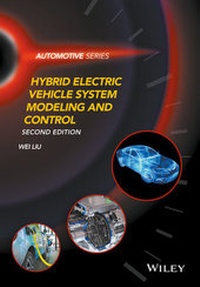
Hybrid Electric Vehicle System Modeling and Control
Description

More details
Other editions
Additional editions

Person
Dr. Wei (Kevin) Liu is an Engineering Specialist in the Electric Power & Advanced Systems Department of General Motors with expertise in dynamic system design, performance analysis, modeling and control. He has 14 years of hybrid electric vehicle engineering experience and 15 years of academic experience. Dr. Liu's primary technical interests are dynamic system control, modeling, performance analysis and fault diagnosis. He currently focuses on the energy management strategy, energy storage system modeling and control algorithm development of hybrid vehicle systems at General Motors. He has authored over 30 technical papers and holds eight patents.
Content
Preface xiv
List of Abbreviations xviii
Nomenclature xxii
1 Introduction 1
1.1 Classification of Hybrid Electric Vehicles 2
1.1.1 Micro Hybrid Electric Vehicles 2
1.1.2 Mild Hybrid Electric Vehicles 2
1.1.3 Full Hybrid Electric Vehicles 3
1.1.4 Electric Vehicles 3
1.1.5 Plug-in Hybrid Electric Vehicles 4
1.2 General Architectures of Hybrid Electric Vehicles 4
1.2.1 Series Hybrid 4
1.2.2 Parallel Hybrid 5
1.2.3 Series-Parallel Hybrid 6
1.3 Typical Layouts of the Parallel Hybrid Electric Propulsion System 7
1.4 Hybrid Electric Vehicle System Components 8
1.5 Hybrid Electric Vehicle System Analysis 10
1.5.1 Power Flow of Hybrid Electric Vehicles 10
1.5.2 Fuel Economy Benefits of Hybrid Electric Vehicles 11
1.5.3 Typical Drive Cycles 11
1.5.4 Vehicle Drivability 11
1.5.5 Hybrid Electric Vehicle Fuel Economy and Emissions 13
1.6 Controls of Hybrid Electric Vehicles 13
References 14
2 Basic Components of Hybrid Electric Vehicles 15
2.1 The Prime Mover 15
2.1.1 Gasoline Engines 15
2.1.2 Diesel Engines 17
2.1.3 Fuel Cells 17
2.2 Electric Motor with a DC-DC Converter and a DC-AC Inverter 20
2.3 Energy Storage System 21
2.3.1 Energy Storage System Requirements for Hybrid Electric Vehicles 21
2.3.2 Basic Types of Battery for Hybrid Electric Vehicle System Applications 25
2.3.3 Ultracapacitors for Hybrid Electric Vehicle System Applications 34
2.4 Transmission System in Hybrid Electric Vehicles 35
References 37
3 Hybrid Electric Vehicle System Modeling 38
3.1 Modeling of an Internal Combustion Engine 38
3.1.1 Cranking (Key Start) 39
3.1.2 Engine Off 41
3.1.3 Idle 41
3.1.4 Engine On 41
3.1.5 Engine Fuel Economy and Emissions 44
3.2 Modeling of an Electric Motor 48
3.2.1 Operation in the Propulsion Mode 48
3.2.2 Operation in the Regenerative Mode 49
3.2.3 Operation in Spinning Mode 49
3.3 Modeling of the Battery System 53
3.3.1 Modeling Electrical Behavior 54
3.3.2 SOC Calculation 56
3.3.3 Modeling Thermal Behavior 56
3.4 Modeling of the Transmission System 59
3.4.1 Modeling of the Clutch and Power Split Device 60
3.4.2 Modeling of the Torque Converter 67
3.4.3 Modeling of the Gearbox 69
3.4.4 Modeling of the Transmission Controller 70
3.5 Modeling of a Multi-mode Electrically Variable Transmission 73
3.5.1 Basics of One-mode ECVT 73
3.5.2 Basics of Two-mode ECVT 78
3.6 Lever Analogy as a Tool for ECVT Kinematic Analysis 85
3.6.1 Lever System Diagram Set-up 85
3.6.2 Lever Analogy Diagram for ECVT Kinematic Analysis 87
3.7 Modeling of the Vehicle Body 91
3.8 Modeling of the Final Drive and Wheel 92
3.8.1 Final Drive Model 92
3.8.2 Wheel Model 92
3.9 PID-based Driver Model 94
3.9.1 Principle of PID Control 95
3.9.2 Driver Model 96
References 96
4 Power Electronics and Electric Motor Drives in Hybrid Electric Vehicles 97
4.1 Basic Power Electronic Devices 97
4.1.1 Diodes 98
4.1.2 Thyristors 99
4.1.3 Bipolar Junction Transistors (BJTs) 101
4.1.4 Metal Oxide Semiconductor Field Effect Transistors (MOSFETs) 103
4.1.5 Insulated Gate Bipolar Transistors (IGBTs) 105
4.2 DC-DC Converters 107
4.2.1 Basic Principle of a DC-DC Converter 107
4.2.2 Step-down (Buck) Converter 109
4.2.3 Step-up (Boost) Converter 117
4.2.4 Step-down/up (Buck-boost) Converter 121
4.2.5 DC-DC Converters Applied in Hybrid Electric Vehicle Systems 125
4.3 DC-AC Inverters 129
4.3.1 Basic Concepts of DC-AC Inverters 129
4.3.2 Single-phase DC-AC Inverters 134
4.3.3 Three-phase DC-AC Inverters 137
4.4 Electric Motor Drives 141
4.4.1 BLDC Motor and Control 141
4.4.2 AC Induction Motor and Control 152
4.5 Plug-in Battery Charger Design 162
4.5.1 Basic Configuration of a PHEV/BEV Battery Charger 162
4.5.2 Power Factor and Correcting Techniques 164
4.5.3 Controls of a Plug-in Charger 168
References 168
5 Energy Storage System Modeling and Control 169
5.1 Introduction 169
5.2 Methods of Determining the State of Charge 171
5.2.1 Current-based SOC Determination Method 172
5.2.2 Voltage-based SOC Determination Method 177
5.2.3 Extended Kalman-filter-based SOC Determination Method 183
5.2.4 SOC Determination Method Based on Transient Response Characteristics (TRCs) 186
5.2.5 Fuzzy-logic-based SOC Determination Method 189
5.2.6 Combination of SOCs Estimated Through Different Approaches 191
5.2.7 Further Discussion on SOC Calculations in Hybrid Electric Vehicle Applications 192
5.3 Estimation of Battery Power Availability 196
5.3.1 PNGV HPPC Power Availability Estimation Method 198
5.3.2 Revised PNGV HPPC Power Availability Estimation Method 199
5.3.3 Power Availability Estimation Based on the Electrical Circuit Equivalent Model 200
5.4 Battery Life Prediction 207
5.4.1 Aging Behavior and Mechanism 207
5.4.2 Definition of the State of Life 209
5.4.3 SOL Determination under Storage Conditions 210
5.4.4 SOL Determination under Cycling Conditions 214
5.4.5 Lithium Metal Plating Issue and Symptoms in Li-ion Batteries 223
5.5 Cell Balancing 224
5.5.1 SOC Balancing 224
5.5.2 Hardware Implementation of Balancing 224
5.5.3 Cell-balancing Control Algorithms and Evaluation 227
5.6 Estimation of Cell Core Temperature 236
5.6.1 Introduction 236
5.6.2 Core Temperature Estimation of an Air-cooled, Cylinder-type HEV Battery 237
5.7 Battery System Efficiency 241
References 242
6 Energy Management Strategies for Hybrid Electric Vehicles 243
6.1 Introduction 243
6.2 Rule-based Energy Management Strategy 244
6.3 Fuzzy-logic-based Energy Management Strategy 245
6.3.1 Fuzzy Logic Control 246
6.3.2 Fuzzy-logic-based HEV Energy Management Strategy 253
6.4 Determination of the Optimal ICE Operational Points of Hybrid Electric Vehicles 261
6.4.1 Mathematical Description of the Problem 261
6.4.2 Procedures of Optimal Operational Point Determination 263
6.4.3 Golden Section Searching Method 264
6.4.4 Finding the Optimal Operational Points 265
6.4.5 Example of the Optimal Determination 265
6.4.6 Performance Evaluation 269
6.5 Cost-function-based Optimal Energy Management Strategy 278
6.5.1 Mathematical Description of Cost-function-based Optimal Energy Management 279
6.5.2 An Example of Optimization Implementation 282
6.6 Optimal Energy Management Strategy Incorporated with Cycle Pattern Recognition 282
6.6.1 Driving Cycle/Style Pattern Recognition Algorithm 282
6.6.2 Determination of the Optimal Energy Distribution 285
References 287
7 Other Hybrid Electric Vehicle Control Problems 288
7.1 Basics of Internal Combustion Engine Control 288
7.1.1 SI Engine Control 288
7.1.2 Diesel Engine Control 289
7.2 Engine Torque Fluctuation Dumping Control Through the Electric Motor 289
7.2.1 Sliding Mode Control 293
7.2.2 Engine Torque Fluctuation Dumping Control Based on the Sliding Mode Control Method 296
7.3 High-voltage Bus Spike Control 298
7.3.1 Bang-Bang Control Strategy of Overvoltage Protection 300
7.3.2 PID-based ON/OFF Control Strategy for Overvoltage Protection 301
7.3.3 Fuzzy-logic-based ON/OFF Control Strategy for Overvoltage Protection 301
7.4 Thermal Control of an HEV Battery System 304
7.4.1 Combined PID Feedback with Feedforward Battery Thermal System Control Strategy 306
7.4.2 Optimal Battery Thermal Control Strategy 308
7.5 HEV/EV Traction Motor Control 311
7.5.1 Traction Torque Control 311
7.5.2 Anti-rollback Control 313
7.6 Active Suspension Control in HEV/EV Systems 313
7.6.1 Suspension System Model of a Quarter Car 314
7.6.2 Active Suspension System Control 318
7.7 Adaptive Charge-sustaining Setpoint and Adaptive Recharge SOC Determination for PHEVs 325
7.7.1 Scenarios of Battery Capacity Decay and Discharge Power Capability Degradation 326
7.7.2 Adaptive Recharge SOC Termination Setpoint Control Strategy 326
7.8 Online Tuning Strategy of the SOC Lower Bound in CS Operational Mode 333
7.8.1 PHEV Charge-sustaining Operational Characteristics 333
7.8.2 PHEV Battery CS-operation SOC Lower Bound Online Tuning 335
7.9 PHEV Battery CS-operation Nominal SOC Setpoint Online Tuning 343
7.9.1 PHEV CS-operation Nominal SOC Setpoint Determination at BOL 343
7.9.2 Online Tuning Strategy of PHEV CS-operation Nominal SOC Setpoint 345
References 347
8 Plug-in Charging Characteristics, Algorithm, and Impact on the Power Distribution System 348
8.1 Introduction 348
8.2 Plug-in Hybrid Vehicle Battery System and Charging Characteristics 349
8.2.1 AC-120 Plug-in Charging Characteristics 349
8.2.2 AC-240 Plug-in Charging Characteristics 350
8.2.3 DC Fast-charging Characteristics 353
8.3 Battery Life and Safety Impacts of Plug-in Charging Current and Temperature 355
8.4 Plug-in Charging Control 355
8.4.1 AC Plug-in Charge Control 355
8.4.2 DC Fast-charging Control 358
8.5 Impacts of Plug-in Charging on the Electricity Network 360
8.5.1 Impact on the Distribution System 360
8.5.2 Impact on the Electric Grid 362
8.6 Optimal Plug-in Charging Strategy 364
8.6.1 The Optimal Plug-in Charge Back Point Determination 364
8.6.2 Cost-based Optimal Plug-in Charging Strategy 366
References 372
9 Hybrid Electric Vehicle Vibration, Noise, and Control 373
9.1 Basics of Noise and Vibration 373
9.1.1 Sound Spectra and Velocity 373
9.1.2 Basic Quantities Related to Sound 374
9.1.3 Frequency Analysis Bandwidths 380
9.1.4 Basics of Vibration 382
9.1.5 Basics of Noise and Vibration Control 389
9.2 General Description of Noise, Vibration, and Control in Hybrid Electric Vehicles 391
9.2.1 Engine Start/Stop Vibration, Noise, and Control 392
9.2.2 Electric Motor Noise, Vibration, and Control 400
9.2.3 Power Electronics Noise and Control 405
9.2.4 Battery System Noise, Vibration, and Control 408
References 411
10 Hybrid Electric Vehicle Design and Performance Analysis 412
10.1 Hybrid Electric Vehicle Simulation System 412
10.2 Typical Test Driving Cycles 414
10.2.1 Typical EPA Fuel Economy Test Schedules 414
10.2.2 Typical Supplemental Fuel Economy Test Schedules 418
10.2.3 Other Typical Test Schedules 421
10.3 Sizing Components and Vehicle Performance Analysis 430
10.3.1 Drivability Calculation 431
10.3.2 Preliminary Sizing of the Main Components of a Hybrid Electric Vehicle 433
10.4 Fuel Economy, Emissions, and Electric Mileage Calculation 454
10.4.1 Basics of Fuel Economy and Emissions Calculation 454
10.4.2 EPA Fuel Economy Label Test and Calculation 457
10.4.3 Electrical Energy Consumption and Miles per Gallon Gasoline Equivalent Calculation 463
References 478
Appendix A 480
Appendix B 520
Index 553
Preface
With hybrid electric vehicle systems having undergone many great changes in recent years, hybrid electric vehicle modeling and control techniques have also advanced. Electrified powertrains are providing dramatic new opportunities in the automotive industry. Since hybrid vehicle systems naturally have nonlinear characteristics, exhibit fast parameter variation, and operate under uncertain and changing conditions, the associated modeling and control problems are extremely complex. Nowadays, hybrid vehicle system engineers must face head-on the challenge of mastering cutting-edge system modeling and control theories and methodologies in order to achieve unprecedented vehicle performance.
Hybrid electric vehicle systems, combining an internal combustion engine with one or more electric motors for propulsion, operate in changing environments involving different fuels, load levels, and weather conditions. They often have conflicting requirements and design objectives that are very difficult to formalize. Most hybrid controls are fundamentally multivariable problems with many actuators, performance variables, and sensors, but some key control variables are not directly measurable. To articulate these challenges, I published the first edition of this book in 2013 to meet the needs of those involved in hybrid vehicle system modeling and control development.
Continued advances in hybrid vehicle system technology make periodic revision of technical books in this area necessary in order to meet the ever-increasing demand for engineers to look for rigorous methods for hybrid vehicle system control design and analysis. The principal aims of this revision are to place added emphasis on advanced control techniques and to expand the various modeling and analysis topics to reflect recent advances in hybrid electric vehicle systems. Overall, many parts of the book have been revised. The most apparent change is that a chapter on noise and vibration has been added to present the unique control challenges arising in hybrid electric vehicle integration to meet driving comfort requirements.
The material assembled in this book is an outgrowth of my over fifteen years' work on hybrid vehicle research, development, and production at the National Research Council Canada, Azure Dynamics, and General Motors. The book is intended to contribute to a better understanding of hybrid electric vehicle systems, and to present all the major aspects of hybrid vehicle modeling, control, simulation, performance analysis, and preliminary design in the same book.
This revised edition retains the best of the first edition while rewriting some key sections. The basic structure of the book is unchanged. The book consists of ten main chapters and two appendices. Chapter 1 provides an introduction to hybrid vehicle system architecture, energy flow, and the controls of a hybrid vehicle system. Chapter 2 reviews the main components of a hybrid system and their characteristics, including the internal combustion engine, the electric motor/generator, the energy storage system, and hybrid electric transmission. This chapter also introduces the construction, basic materials, and requirements of Li-ion batteries for hybrid electric vehicle application.
Chapter 3 presents detailed mathematical models of hybrid system components for system design and simulation analysis, which include the internal combustion engine, the transmission system, the motor/generator, the battery system, and the vehicle body system, as well as the driver. One-mode and two-mode electrical continuously variable transmission system modeling and the lever analogy technique are introduced for hybrid transmission kinematic analysis in this chapter. The models presented in this chapter can be used either for individual component analysis or for building a whole vehicle simulation system.
Chapter 4 introduces the basics of power electronics and electric motor drives applied in hybrid electric vehicle systems. The characteristics of commonly used power electronic switches are presented first, followed by the introduction of the operational principles of the DC-DC converter and DC-AC inverter. Brushless DC motors and AC induction motors and their control principles are also introduced for hybrid vehicle applications. The techniques of plug-in charger design are presented in the last part of this chapter.
Chapter 5 addresses the modeling and controls of the energy storage system. Algorithms relating to the battery system play a very important role in hybrid electric vehicle systems because they directly affect the overall fuel economy and drivability and safety of a vehicle; however, due to the complexity of electrochemical reactions and dynamics as well as the availability of key variable measurements, hybrid vehicle system and algorithm engineers are facing head-on technical challenges in the development of the algorithms required for hybrid electric vehicles. In this chapter, the state of charge determination algorithms and technical challenges are first discussed. Then, the power capability algorithms and state of life algorithms with aging behavior and the aging mechanism are addressed, and the lithium metal plating issue and symptoms in Li-ion batteries are discussed as well. The cell-balancing algorithm necessary for hybrid vehicles, the battery cell core temperature estimation method, and the battery system efficiency calculation are also presented in this chapter.
Chapter 6 is concerned with the solution of energy management problems under different drive cycles. Both direct and indirect optimization methods are discussed. The methods presented in this chapter can be treated as the most general and practical techniques for the solution of hybrid vehicle energy management problems.
Chapter 7 elaborates on the other control problems in hybrid vehicle systems, including active engine fluctuation torque dumping control, voltage ripple control in the high-voltage bus, thermal control of the energy storage system, motor traction and anti-rollback control, and electric active suspension system control. For plug-in hybrid vehicles, the CS setpoint self-tuning control strategy and the CS lower bound real-time determination algorithm are presented to compensate for battery aging in this chapter.
Chapter 8 discusses the characteristics of AC-120, AC-240, and fast public plug-in charging for emerging plug-in hybrid and purely battery-powered vehicles. This chapter also presents plug-in charge control requirements and techniques for battery-powered electric vehicles. The impact of plug-in charging on battery life and safety as well as on the electric grid and power distribution system is presented in this chapter. In addition, the various plug-in charging strategies, including the optimal charging strategy, are introduced in this chapter.
Chapter 9 deals with noise and vibration issues. Noise and vibration have become an important aspect of hybrid powertrain development and the vehicle integration process, and there are stringent requirements to reduce HEV/PHEV/BEV vibration and noise levels. To articulate these challenges, this chapter first introduces the basics of vibration and noise, and then addresses the unique vibration and noise characteristics and issues associated with powertrain vibration, driveline vibration, gear rattle noise, and electrified-component-specific vibration and noise, such as accessory whine, motor/generator electromagnetic vibration and noise, and vibration and growl in the energy storage system, as well as vibration and noise pattern changes compared with traditional vehicles.
Chapter 10 presents typical cycles and procedures for fuel economy, emissions, and electric range tests, including FTP, US06, SC03, LA92, NEDC, and WLTP for hybrid electric vehicles, as well as single and multiple cycles for battery-powered electric vehicles. The necessary calculations and simulations for sizing/optimizing components and analyzing system performance at the concept/predesign stage of a hybrid vehicle system are addressed in this chapter.
Appendix A reviews the system identification, state and parameter estimation methods and techniques. Commonly used mathematical models are introduced for hybrid vehicle system control algorithm development. Recursive least squares and generalized least squares techniques are presented for parameter estimation. The Kalman filter and extended Kalman filter are introduced in this appendix to solve state and parameter estimation problems. In addition, the appendix also presents the necessary computational stability enhancement techniques of practical hybrid vehicle systems.
Appendix B briefly introduces some advanced control methods which are necessary to improve the performance of a hybrid electric vehicle system. These include system pole-placement control, objective-function-based optimal control, dynamic-programming-based optimal control, minimal variance, and adaptive control techniques for systems with stochastic behavior. To enhance the reliability and safety of a hybrid vehicle system, fault-tolerant control strategies are briefly introduced in this appendix.
In the hybrid electric vehicle system control field, there are many good practices that cannot be fully justified from basic principles. These practices are the 'art' of hybrid vehicle system control, and thus several questions arise for control engineers and researchers on the future...
