

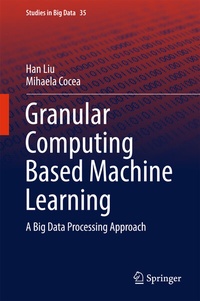
Granular Computing Based Machine Learning
Description

This book is aimed at PhD students, postdoctoral researchers and academics who are actively involved in fundamental research on machine learning or applied research on data mining and knowledge discovery, sentiment analysis, pattern recognition, image processing, computer vision and big data analytics. It will also benefit a broader audience of researchers and practitioners who are actively engaged in the research and development of intelligent systems.
More details
Other editions
Additional editions
Persons
Han Liu is currently a Research Associate in Data Science in the School of Computer Science and Informatics at the Cardiff University. He has previously been a Research Associate in Computational Intelligence in the School of Computing at the University of Portsmouth. He received a BSc in Computing from University of Portsmouth in 2011, an MSc in Software Engineering from University of Southampton in 2012, and a PhD in Machine Learning from University of Portsmouth in 2015.
His research interests include data mining, machine learning, rule based systems, granular computing, intelligent systems, fuzzy systems, big data, computational intelligence and applications in cyber security, cyber crime, cyber bullying, cyber hate and pattern recognition.
He published a research monograph with Springer in the third year of his PhD. He also published over 25 papers in the areas such as data mining, machine learning and granular computing. One of his papers wasidentified as a key scientific article contributing to scientific and engineering research excellence by the selection team at Advances in Engineering and the selection rate is less than 0.1% as indicated. He also has a paper selected as a finalist of Lotfi Zadeh Best Paper Award in the 16th International Conference on Machine Learning and Cybernetics (ICMLC 2017) and has another paper nominated for Lotfi Zadeh Best Paper Award in the 15th International Conference on Machine Learning and Cybernetics (ICMLC 2016).
He has been registered as a reviewer for several established journals, such as IEEE Transactions on Fuzzy Systems, and Information Sciences (Elsevier). He has also recently been a member of the programme committee for the 17th UK Workshop on Computational Intelligence (UKCI 2017), the 16 th International Conference on Machine Learning and Cybernetics (ICMLC 2017) and the 2nd IET International Conference on Biomedical Image and Signal Processing (ICBISP 2017). He is a member of IEEE and IET.
Author 2
Mihaela Cocea is currently a Senior Lecturer in the School of Computing at the University of Portsmouth. She holds a BSc in Computer Science, a BSc in Psychology and Education and a MSc in Communication and Human Relations from the University of Iasi, Romania. She also has an MSc by Research in Learning Technologies from the National College of Ireland (2007), a PhD in Computer Science from Birkbeck College, University of London, UK (2011), and a Postgraduate Certificate in Learning and Teaching in Higher Education from the University of Portsmouth (2012).
Her research interests are in the area of Intelligent System, focusing on intelligent techniques using data and knowledge engineering to provide adaptation and personalisation, as well as decision support. She has received funding through: (a) scholarships from the National College of Ireland and Birkbeck College, University of London, UK; (b) an internship through the EU Leonardo da Vinci programme; (b) a mobility fellowship from the European Network of Excellence in Technology Enhanced Learning (STELLARnet); (c) research development funds from the University of Portsmouth and (d) travel grants from EATEL (European Association for Technology Enhanced Learning), User Modeling Inc. and NSF (National Science Foundation).
She has published over 75 peer-reviewed papers and has received a Best Project Award at the Summer School on Personalized e-Learning, Dublin (2006), a Best PhD paper award at the 14 th International Conference on Knowledge-Based and Intelligent Information & Engineering Systems (2010) and was runner up for the 2011 Best PhD Thesis in the School of Business, Economics & Informatics, Birkbeck College, University of London. She acted as co-chair for the "Architectures, techniques & methodologies for UMAP" track of the 24th ACM Conference on User Modeling, Adaptation and Personalisation (UMAP 2016), the Workshop on Social Media Analysis in conjunction with the 33rd International Conference of the British Computer Society's Specialist Group on Artificial Intelligence (SGAI 2013), and the International Workshop on Sentiment Discovery from Affective Data (SDAD) in conjunction with the European Conference on Machine Learning and Principles and Practice of Knowledge Discovery in Databases (ECML PKDD 2012). She is a member of the IEEE and the IEEE System, Man and Cybernetics Society.
