

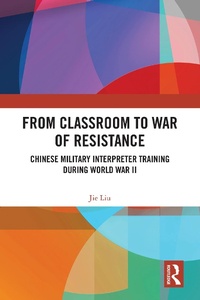
From Classroom to War of Resistance
Chinese Military Interpreter Training during World War II
1st Edition
Published on 26. December 2023
152 pages
978-1-003-81514-3 (ISBN)
Description

This book focuses on a long- neglected yet important topic in China's translation history: interpreter/ translator training and wartime translation studies. It examines the military interpreter training programmes after the outbreak of the Pacific War (1941-1945), further revealing the indispensable role of translation and interpreting in war.
The author explores the relationship between linguistic education and war context in the China- Burma- India Theatre, where international cooperation was salient. Some 4,000 interpreting officers played a vital role in assisting in air defence, transportation, training of the Chinese army and coordinating expeditionary operations. The book seeks to bring these interpreters to life, telling the stories of why they joined the war, how they were trained and what they did in the war. Through the study of training programmes, historical archives, accounts and trainees' memoirs, discussions revolve around key strands of education, including curriculums, textbooks and training methods. Utilising foreign language education practices as its main case study, the book analyses these through the framework of linguistic and translation theories.
The book contributes to Chinese interpreting history by exploring its first-ever nationwide professional interpreting (and translation) training practices, and will inspire scholars of translation/ interpreting training, world modern history and foreign language education in general.
The author explores the relationship between linguistic education and war context in the China- Burma- India Theatre, where international cooperation was salient. Some 4,000 interpreting officers played a vital role in assisting in air defence, transportation, training of the Chinese army and coordinating expeditionary operations. The book seeks to bring these interpreters to life, telling the stories of why they joined the war, how they were trained and what they did in the war. Through the study of training programmes, historical archives, accounts and trainees' memoirs, discussions revolve around key strands of education, including curriculums, textbooks and training methods. Utilising foreign language education practices as its main case study, the book analyses these through the framework of linguistic and translation theories.
The book contributes to Chinese interpreting history by exploring its first-ever nationwide professional interpreting (and translation) training practices, and will inspire scholars of translation/ interpreting training, world modern history and foreign language education in general.
Reviews / Votes
"A fascinating and detailed account of interpreting/translation in China during World War Two. In bringing to life the stories of translation/interpreting trainees, it makes a significant contribution to our understanding of the political context, to languages at war studies, and to the history of translation/interpreting."Hilary Footitt, Associate Fellow, Institute of Languages, Cultures and Societies, School of Advanced Study, University of London, U.K.
"Combining new research methodologies on wartime language education and drawing on a vast number of first-hand materials which bring us close to trainees' memories and to the stories of interpreting officers, this is a groundbreaking contribution to the field of war interpreting studies. An innovative and interdisciplinary volume that explores China's translation and interpreting history between 1937 and 1945 and presents a rigorous investigation on Chinese military interpreter training programmes after the outbreak of the Pacific War. No doubt, this book is an outstanding contribution to explore the vital role of languages at war."
Africa Vidal, Full Professor of Translation Studies, University of Salamanca, Spain
More details
Edition
1. Auflage
Language
English
Place of publication
London
United Kingdom
Publishing group
Taylor & Francis Ebooks
Target group
College/higher education
Professional and scholarly
Illustrations
8 Tables, black and white; 2 Line drawings, black and white; 11 Halftones, black and white; 13 Illustrations, black and white
ISBN-13
978-1-003-81514-3 (9781003815143)
Copyright in bibliographic data and cover images is held by Nielsen Book Services Limited or by the publishers or by their respective licensors: all rights reserved.
Schweitzer Classification
Other editions
Additional editions
Jie Liu
From Classroom to War of Resistance
Chinese Military Interpreter Training during World War II
Book
05/2025
1st Edition
Routledge
€64.70
Shipment within 10-20 days
Jie Liu
From Classroom to War of Resistance
Chinese Military Interpreter Training during World War II
Book
12/2023
1st Edition
Routledge
€205.80
Shipment within 10-20 days
Person
Jie Liu is currently an affiliated Research Fellow at Central China Normal University (CCNU) in Wuhan, China, and visiting scholar at the Institute of Chinese Studies, the Chinese University of Hong Kong. He received his Ph.D. from Utrecht University and has been Research Scholar at the University of Florida. Previously, he held Associate Professorship at the National Huaqiao University, where he also served as Lead Interpreter. His work has been published in several international interpretation and translation journals. Over the past decade or so, Jie Liu has been an active conference interpreter and member of the Translators' Association of China (TAC), and the European Society of Translation Studies (EST).
Content
1. The opening of the Pacific Theatre and the demand for military interpreters 2. Historical developments of military interpreters training 3. Talent cultivation and characteristics of the interpreter training centres 4. Analysis of textbook Forty English Lessons for Interpreting Officers 5. Chinese Interpreters' assignments and work practices 6. Conclusions
