

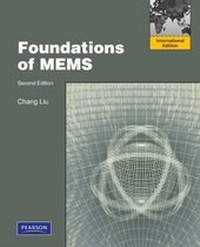
Foundation of MEMA
International Edition
2nd Edition
Published on 18. September 2014
576 pages
978-1-292-01398-5 (ISBN)
Description

For courses in Micro-Electro-Mechanical Systems (MEMS) taken by advanced undergraduate students, beginning graduate students, and professionals.Foundations of MEMS is an entry-level text designed to systematically teach the specifics of MEMS to an interdisciplinary audience. Liu discusses designs, materials, and fabrication issues related to the MEMS field by employing concepts from both the electrical and mechanical engineering domains and by incorporating evolving microfabrication technology all in a time-efficient and methodical manner. A wealth of examples and problems solidify students understanding of abstract concepts and provide ample opportunities for practicing critical thinking.
More details
Edition
2nd edition
Language
English
Place of publication
Harlow
United Kingdom
Target group
Professional and scholarly
ISBN-13
978-1-292-01398-5 (9781292013985)
Copyright in bibliographic data and cover images is held by Nielsen Book Services Limited or by the publishers or by their respective licensors: all rights reserved.
Schweitzer Classification
Other editions
Additional editions
Chang Liu
Foundation of MEMS
Book
06/2024
2nd Edition
Pearson International
€109.99
Shipment within 10-20 days
Person
Chang Liu received his M.S. and Ph.D. degrees from the California Institute of Technology in 1991 and 1995, respectively. His Ph.D. thesis was titled Micromachined sensors and actuators for fluid mechanics applications. In January 1996, he joined the Microelectronics Laboratory of the University of Illinois as a postdoctoral researcher. In January 1997, he became an assistant professor with major appointment in the Electrical and Computer Engineering Department and joint appointment in the Mechanical and Industrial Engineering Department. In 2003, he was promoted to the rank of Associate Professor with tenure. In 2007, Chang Liu joined Northwestern University (Evanston, Illinois) as a full professor of engineering. He established the MedX Laboratory to conduct advanced engineering research for medicine and health care.
Dr. Liu has 20 years of research experience in the MEMS area and has published 200 technical papers in journals and refereed conference proceedings. He teaches undergraduate and graduate courses covering broad-ranging topics, including MEMS, solid-state electronics, electromechanics, sensor technology, circuits, dynamics, and heat transfer. He won a campus "Incomplete list of teachers ranked as excellent" honor in 2001 for developing and teaching the MEMS class, a precursor to this book. He received the National Science Foundation's CAREER award in 1998 for his research proposal of developing artificial haircells using MEMS technology. He is currently a Subject Editor of the IEEE/ASME Journal of MEMS, and was an Associate Editor of the IEEE Sensors Journal. His work has been cited in popular media. Dr. Liu is a cofounder of Integrated Micro Devices (IMD) Corporation and a member of the scientific advisory board of NanoInk Corporation (Chicago, IL). In 2004, he won the University of Illinois College of Engineering Xerox Award for Faculty Research. In the same year, he was elected a Faculty Associate at the Center for Advanced Studies at the University of Illinois, to pursue research in large-format integrated sensors. He is a Fellow of the IEEE, the world's largest professional association for the advancement of technology.
Dr. Liu has 20 years of research experience in the MEMS area and has published 200 technical papers in journals and refereed conference proceedings. He teaches undergraduate and graduate courses covering broad-ranging topics, including MEMS, solid-state electronics, electromechanics, sensor technology, circuits, dynamics, and heat transfer. He won a campus "Incomplete list of teachers ranked as excellent" honor in 2001 for developing and teaching the MEMS class, a precursor to this book. He received the National Science Foundation's CAREER award in 1998 for his research proposal of developing artificial haircells using MEMS technology. He is currently a Subject Editor of the IEEE/ASME Journal of MEMS, and was an Associate Editor of the IEEE Sensors Journal. His work has been cited in popular media. Dr. Liu is a cofounder of Integrated Micro Devices (IMD) Corporation and a member of the scientific advisory board of NanoInk Corporation (Chicago, IL). In 2004, he won the University of Illinois College of Engineering Xerox Award for Faculty Research. In the same year, he was elected a Faculty Associate at the Center for Advanced Studies at the University of Illinois, to pursue research in large-format integrated sensors. He is a Fellow of the IEEE, the world's largest professional association for the advancement of technology.
Content
Preface to Second Edition
Preface to First Edition
Note to Instructors
About the Author
Notational Conventions
Chapter 1: Introduction
1.0. Preview
1.1. The History of MEMS Development
1.1.1. From the Beginning to 1990
1.1.2. From 1990 to 2001
1.1.3. 2002 to present
1.1.4. Future Trends
1.2. The Intrinsic Characteristics of MEMS
1.2.1. Miniaturization
1.2.2. Microelectronics Integration
1.2.3. Parallel Fabrication with Precision
1.3. Devices: Sensors and Actuators
1.3.1. Energy Domains and Transducers
1.3.2. Sensors Considerations
13.3. Sensor Noise and Design Complexity
1.3.4. Actuators Considerations
Summary
Problems
References
Chapter 2: First-Pass Introduction to Microfabrication
2.0. Preview
2.1. Overview of Microfabrication
2.2. Essential Overview of Frequently Used Microfabrication Processes
2.2.1. Photolithography
2.2.2. Thin film deposition
2.2.3. Thermal oxidation of silicon
2.2.4. Wet Etching
2.2.5. Silicon anisotropic etching
2.2.6. Plasma etching and reactive ion etching
2.2.7. Doping
2.2.8. Wafer dicing
2.2.9. Wafer bonding
2.3. The Microelectronics Fabrication Process Flow
2.4. Silicon-based MEMS Processes
2.5. Packaging and Integration
2.5.1. Integration Options
2.5.2. Encapsulation
2.6. New Materials and Fabrication Processes
2.7. Process Selection and Design
2.7.1. Points of Consideration for Deposition Processes
2.7.2. Points of Consideration for Etching Processes
2.7.3. Ideal Rules for Building a Process Flow
2.7.4. Rules for Building a Robust Process
Summary
Problems
References
Chapter 3: Review of Essential Electrical and Mechanical Concepts
3.0 Preview
3.1. Conductivity of Semiconductors
3.1.1. Semiconductor Materials
3.1.2. Calculation of Charge Carrier Concentr
Preface to First Edition
Note to Instructors
About the Author
Notational Conventions
Chapter 1: Introduction
1.0. Preview
1.1. The History of MEMS Development
1.1.1. From the Beginning to 1990
1.1.2. From 1990 to 2001
1.1.3. 2002 to present
1.1.4. Future Trends
1.2. The Intrinsic Characteristics of MEMS
1.2.1. Miniaturization
1.2.2. Microelectronics Integration
1.2.3. Parallel Fabrication with Precision
1.3. Devices: Sensors and Actuators
1.3.1. Energy Domains and Transducers
1.3.2. Sensors Considerations
13.3. Sensor Noise and Design Complexity
1.3.4. Actuators Considerations
Summary
Problems
References
Chapter 2: First-Pass Introduction to Microfabrication
2.0. Preview
2.1. Overview of Microfabrication
2.2. Essential Overview of Frequently Used Microfabrication Processes
2.2.1. Photolithography
2.2.2. Thin film deposition
2.2.3. Thermal oxidation of silicon
2.2.4. Wet Etching
2.2.5. Silicon anisotropic etching
2.2.6. Plasma etching and reactive ion etching
2.2.7. Doping
2.2.8. Wafer dicing
2.2.9. Wafer bonding
2.3. The Microelectronics Fabrication Process Flow
2.4. Silicon-based MEMS Processes
2.5. Packaging and Integration
2.5.1. Integration Options
2.5.2. Encapsulation
2.6. New Materials and Fabrication Processes
2.7. Process Selection and Design
2.7.1. Points of Consideration for Deposition Processes
2.7.2. Points of Consideration for Etching Processes
2.7.3. Ideal Rules for Building a Process Flow
2.7.4. Rules for Building a Robust Process
Summary
Problems
References
Chapter 3: Review of Essential Electrical and Mechanical Concepts
3.0 Preview
3.1. Conductivity of Semiconductors
3.1.1. Semiconductor Materials
3.1.2. Calculation of Charge Carrier Concentr
