

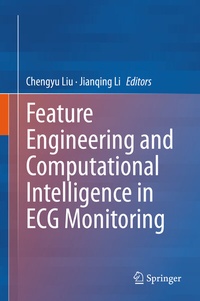
Feature Engineering and Computational Intelligence in ECG Monitoring
Description

This book discusses feature engineering and computational intelligence solutions for ECG monitoring, with a particular focus on how these methods can be efficiently used to address the emerging challenges of dynamic, continuous & long-term individual ECG monitoring and real-time feedback. By doing so, it provides a "snapshot" of the current research at the interface between physiological signal analysis and machine learning. It also helps clarify a number of dilemmas and encourages further investigations in this field, to explore rational applications of feature engineering and computational intelligence in ECG monitoring. The book is intended for researchers and graduate students in the field of biomedical engineering, ECG signal processing, and intelligent healthcare.
More details
Other editions
Additional editions
Persons
Dr. Jianqing Li received his B.S. and M.S. degrees in Automatic Technology, and his Ph.D. degree in Measurement Technology and Instruments from the School of Instrument Science and Engineering, Southeast University, China, in 1986, 1990 and 2000 respectively. He is currently the Vice-President of Nanjing Medical University, a Professor at the School of Biomedical Engineering and Informatics, Nanjing Medical University, and a Professor at the School of Instrument Science and Engineering at Southeast University. He is the founding Director of the Key Laboratory of Clinical Medical Engineering in Nanjing Medical University, and the deputy Director of the Jiangsu Key Lab of Remote Measurement and Control at Southeast University, where he leads the research on medical-industry, cross-innovation cooperation, medical device development and clinical applications. His research topics include wearable medical sensors and signal processing, rehabilitation robot technology, and robot telepresence technology. He has been awarded funding for more than 20 research projects and holds over 20 patents.
Content
Chapter 1. Feature engineering and computational intelligence in ECG monitoring - an introduction.- Chapter 2. Representative Databases for Feature Engineering and Computational Intelligence in ECG Processing.- Chapter 3. An Overview of signal quality indices on dynamic ECG signal quality assessment.- Chapter 4. Signal quality features in dynamic ECGs.- Chapter 5. Motion Artifact Suppression Method in Wearable ECG.- Chapter 6. Data Augmentation for Deep Learning based ECG analysis.- Chapter 7. Study on Automatic Classification of Arrhythmias.- Chapter 8. ECG Interpretation with deep learning.- Chapter 9. Visualizing ECG contribution into Convolutional Neural Network classification.- Chapter 10. Atrial fibrillation detection in dynamic signals.- Chapter 11. Applications of Heart rate variability in Sleep Apnea.- Chapter 12. False Alarm Rejection for ICU ECG Monitoring.- Chapter 13. Respiratory Signal Extraction from ECG Signal.- Chapter 14. Noninvasive Recording of Cardiac AutonomicNervous Activity--What's behind ECG?.- Chapter 15. A questionnaire study on artificial intelligence and its effects on individual health and wearable device.
