

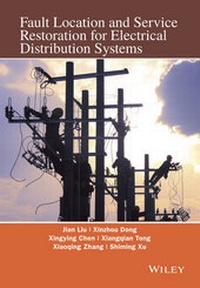
Fault Location and Service Restoration for Electrical Distribution Systems
Description

More details
Other editions
Additional editions
Persons
Jian Liu, Professor, Xian University of Technology, China and Chief Engineer at Shaanxi Electric Power Research Institute, China
Professor Liu received his Ph.D. in Electrical Engineering from Xi'an University of Technology, Xi'an, China. After graduation, he worked as an engineer at the Northwest Electric Power Corporation, as senior engineer at the Shaanxi Electric Power Corporation and Chief Engineer at the Shaanxi Electric Power Research Institute, respectively. Professor Liu started his research on distribution system and its automation in 1995. He established China's first urban Distribution Automation System (DAS) in Yinchuan Province. He published the paper 'The uniformed matrix algorithm of fault location for distribution systems' which was the country's first paper on fault location for distribution systems. He has published over 100 papers on modelling, analysis, planning, fault location, service restoration, network reconfiguration, feeder automation and self-healing for distribution systems. As the head of the DAS Testing Group of the State Grid Corporation of China, Prof. Liu established the DAS testing laboratory and has developed sets of simulation and testing equipment, and he has led and or supervised the testing work of over 80 DAS projects in China. He supervises all of the DAS standards of State Grid Corporation. Due to his contributions to electric power engineering, Prof. Liu has been awarded the national and provincial level of science and technology prizes on twelve occasions. He is a Senior Member of IEEE.
Prof. Xinzhou Dong, Department of Electrical Engineering, Tsinghua University, China; CIEEE Fellow.
Prof. Xingying Chen, Hohai University, China.
Prof. Xiangqian Tong, Xi'an University of Technology, China.
Mr. Xiaoqing Zhang, Senior Engineer, Shaanxi Electric Power Research Institute, China.
Dr. Shming Xu, Senior Engineer, Shaanxi Electric Power Research Institute, China.
Content
About the Authors ix
Preface xi
1 Progresses and Prospects for Fault Processing in Distribution Grids 1
Liu Jian
1.1 Introduction 1
1.2 Progresses in Local Intelligence?-Based Fault Processing 3
1.3 Progresses in Distributed Intelligence?-Based Fault Processing 3
1.4 Progresses in Centralized Intelligence?-Based Fault Processing 4
1.4.1 Fault Location 5
1.4.2 Fault Isolation and Service Restoration 5
1.5 Progresses in Single?]Phase Grounding Fault Processing 6
1.6 Prospects 7
2 Fault Processing Based on Local Intelligence 9
Tong Xiangqian and Liu Jian
2.1 Introduction 9
2.2 Fault Processing Based on Local Intelligence for Distribution Networks 10
2.2.1 Auto?-Reclosure Control 10
2.2.2 Automatic Backup Switching Control of the Reserve Source 11
2.2.3 Voltage Protection 13
2.2.4 Three-Section Over-Current Protection 14
2.2.5 Coordination between Current Protection Relaying and Auto-Reclosure 22
2.2.6 Directional Over?-Current Protection 23
2.2.7 Longitudinal Current Differential Protection 25
2.2.8 The Second Harmonic Braking Criterion in Current Protection 28
2.3 Fault Protection of the Active Distribution Network 32
2.3.1 The Influence of Distributed Generation on Current Protection and the Adaptive Improvement of Protection 32
2.3.2 Influence of Distributed Generation on Auto?]Reclosure and its Adaptive Improvements 38
2.3.3 Longitudinal Current Differential Protection of DG Connected Distribution Networks 40
2.4 Coordination of Multistage Protection in the Distribution Network 41
2.4.1 Time Difference Based Coordination of Multistage Protection in the Distribution Network 42
2.4.2 The Coordination of Multistage Protection Based on Three?]Section Over?]Current Protection in the Distribution Network 50
2.4.3 Coordination Modes and Setting Methods of Multistage Protection of Distribution Networks 58
2.4.4 Example Analysis 68
2.5 Summary 71
3 Fault Processing Based on Distributed Intelligence 73
Liu Jian, Xu Shiming and Chen Xingying
3.1 Introduction 73
3.2 FA based on Recloser and Voltage-Delay Type Sectionalizers 74
3.3 Reclosing with the Fast Over?-Current Protection Mode 78
3.3.1 Basic Principle 78
3.3.2 Improvements 80
3.4 Fast Healing Approach based on Neighbor Communication 82
3.4.1 Basic Principle 82
3.4.2 Improvements 85
3.5 Conclusion and Summary 88
4 Fault Processing Based on Centralized Intelligence 89
Liu Jian and Chen Xingying
4.1 Introduction 89
4.2 Simplified Modeling of Distribution Grids 92
4.2.1 Distribution Network Structure 92
4.2.2 Simplified Load Flow Analysis 98
4.3 Interphase Short Circuit Fault Location 103
4.3.1 Fault Location with Sufficient Information 103
4.3.2 Fault Location with Insufficient Information 111
4.3.3 Fault Location for Distribution Grids with DGs 117
4.4 Fault Isolation and Service Restoration 132
4.4.1 Fault Isolation 133
4.4.2 Service Restoration 135
4.4.3 Modeled Service Restoration 152
4.4.4 Coordination of the Four Types of Service Restoration 159
4.5 Conclusion and Summary 161
5 Single Phase to Ground Fault Processing 163
Dong Xinzhou and Shi Shenxing
5.1 Types of Ground Fault and Protection Strategy 164
5.1.1 The Neutral Grounding Mode and Ground Fault Types 164
5.1.2 The Protection Strategies for Different Types of Ground Faults 167
5.2 Detection of High Resistance Ground Faults in Low Resistance Grounded Systems 168
5.2.1 High Resistance Ground Faults 168
5.2.2 Zero Sequence Inverse?-Time Overcurrent Protection 169
5.2.3 Grounded Protection based on the Amplitude and Phase of the Third Harmonic Current 170
5.3 Grounding Protection in the System with Neutral Isolated 174
5.3.1 Characteristics of Single?-Phase-to-Ground Faults in Systems with Neutral Isolated 174
5.3.2 Single?-Phase-to-Ground Protection in Grids with Neutral Isolated 179
5.4 Grounding Protection in the System with Neutral Grounded Through an Arc Suppression Coil 180
5.4.1 Characteristics of Single-Phase-to-Ground Faults in Systems with Neutral Grounded through an Arc Suppression Coil 181
5.4.2 Single?-Phase-to-Ground Protection in Systems with Neutral Grounded through an Arc Suppression Coil 185
5.5 Single?-Phase-to?-Ground Fault Feeder Selection Technology in a Power Distribution System with Neutral Non-Effectively Grounded 186
5.5.1 Comparison of Magnitude and Phase based Single?-Phase?-to-Ground Fault Feeder Selection Methods 187
5.5.2 Characteristics of Single?-Phase-to-Ground Fault Generated Current Traveling Waves 187
5.5.3 Current Traveling Wave?-based Fault Feeder Selection Method 194
5.6 Prevention of and Protection from Single?]Phase?]to?]Ground Faults in Power Distribution Systems with Neutral Non?-Effectively Grounded 195
5.6.1 Basic Principle of Single-Phase-to-Ground Fault Prevention 195
5.6.2 Single?-Phase?-to-Ground Fault Prevention Technology 196
5.7 Single?-Phase?-to-Ground Fault Location in Systems with Neutral Non?]Effectively Grounded 198
5.7.1 Single?-Phase-to-Ground Fault Generated Initial Traveling Waves 198
5.7.2 Single-Phase?-to?-Ground Fault Location Method based on Propagation Speed of Traveling Waves 202
5.8 Conclusion and Summary 203
6 Practical Aspects of Fault Processing 204
Liu Jian and Zhang Xiaoqing
6.1 Introduction 204
6.2 Coordination of Fault Processing Approaches 205
6.2.1 Fault Processing Performance of Various Methodologies 205
6.3 Planning of Terminal Units 214
6.3.1 Elements Affecting the Reliability of Service 214
6.3.2 Cost?-Benefit Analysis of Action Node Planning 215
6.3.3 Planning the Amount of Terminal Units to Meet the Requirement of Service Reliability 217
6.4 Verification of the Property of Fault Processing 226
6.4.1 Master Injection Testing Methodology and the Testing Tool 227
6.4.2 Secondary Synchronous Injection Testing Methodology and Testing Facilities 231
6.4.3 Master and Secondary Synchronous Injection Testing Methodology 232
6.4.4 Direct Short-Circuit Test 234
6.4.5 Comparison of the Four Testing Methodologies 235
6.5 Conclusion and Summary 235
References 238
Index 242
1
Progresses and Prospects for Fault Processing in Distribution Grids
Liu Jian
Abstract
Progresses in fault processing technologies for electrical power distribution grids are overviewed, including progresses in local, distributed, and centralized intelligence-based interphase short circuit fault location and isolation, and service restoration, as well as progresses in single-phase-to-ground fault processing. The prospects for fault processing technologies in electrical power distribution grids are discussed.
Keywords
distribution grids, overview, prospects, interphase short circuit fault, single-phase-to-ground fault, fault location, fault isolation, service restoration, relay protection, distribution automation system (DAS), feeder automation (FA)
1.1 Introduction
According to statistics, failures in distribution grids cause more than 85% of outages due to faults. Thus, fault processing technologies for distribution grids are of great importance in improving service reliability.
Faults can be divided into two categories: interphase short circuit faults and single-phase grounding faults. These faults can then be further divided into permanent and temporary faults.
As for earth-neutral systems, fault processing technologies for interphase short circuit faults and single-phase grounding faults are the same. However, for neutral ineffective grounding systems, such as those in China, systems are allowed to operate under single-phase grounding fault conditions for no more than 2 hours in order to ensure service reliability. The position of a single-phase grounding fault should be located and repaired in time to avoid causing an interphase short circuit fault. Interphase short circuit faults should be cleared immediately and as many affected healthy regions should be restored as quickly as possible.
The fault processing technologies can be classified into three types: (1) fault processing based on local intelligence, (2) fault processing based on distributed intelligence, and (3) fault processing based on centralized intelligence.
Fault processing approaches based on local intelligence were the earliest technologies in which neither a communication system nor master station is needed. The decision is made based solely on the information collected at the local position. Fault processing approaches based on local intelligence are still used today and include relay protection, automatic reclosing control, and backup automatic switching control. They have the advantage of fast speeds. However, the coordination of over-current protection is rather difficult in some cases, such as the feeder trunk in an urban area. Automatic reclosing control is suitable for feeders with overhead lines. Backup automatic switching control may switch the load to the backup power supplying route in several seconds, but it is only effective for loads with more than one power supplying route.
Feeder Automation (FA) based on recloser and voltage-delay type sectionalizers, reclosing with a fast over-current protection mode, and the fast healing approach based on neighbor communication, are three typical technologies of fault processing approaches based on distribution intelligence. FA based on recloser and voltage-delay type sectionalizers was invented by Japanese engineers in the 1970s and has been successfully used in Asia for several decades, but it needs reclosing twice. Reclosing with the fast over-current protection mode is an improved approach that only needs reclosing once, but requires circuit breakers instead of the former's load switches. Both FA based on recloser and voltage-delay type sectionalizers and reclosing with a fast over-current protection mode do not require communication systems and the whole feeder must undergo a period of outage. With the fast healing approach based on neighbor communication, the fault area can be located and isolated immediately and the healthy areas are hardly affected by the fault. However, high speed communication and reliability are both needed. Besides, the sectionalizing switches should be circuit breakers.
The typical technology of fault processing based on centralized intelligence is the Distribution Automation System (DAS), which consists of a master station, some sub-working-stations, a large number of Feeder Terminal units (FTU), and the communication system. Since global information can be collected, the fault location area of DAS can be much smaller and the service restoration schemes may be optimized. But DAS based fault processing needs a rather long time period, typically several minutes.
With the increasing of the amount of Distribution Generations (DG) in distribution grids, fault processing technologies coping with such challenges have been achieved.
In this chapter, the progress in fault processing technologies will be overviewed, and included is most of the literature written by the authors, which is also included in the following chapters of this book.
1.2 Progresses in Local Intelligence-Based Fault Processing
Although relay protection technologies have been used in electrical power systems for a long time, the coordination of relay protection is rather difficult in some distribution grids, such as short length urban feeders.
In many utilities, one over-current relay protection is coordinated with one or two fuses. Even on the output circuit breaker of a feeder in the substation only one over-current protection is installed. Coordination and setting of three-section overcurrent protection is investigated in References [1]-[4]. It is pointed out in [5] that interphase short circuit currents along the sectionalizing switches of a short length urban feeder are almost the same, thus the coordination of three-section overcurrent protection is difficult. An approach of time-delay coordination of the over-current relay protection scheme is suggested, in which outage on the trunk can be avoided in case of branch fails and outage on the branch can be avoided in the case of lateral fails. Four modes of hybrid schemes of three section overcurrent protection and time-delay over-current coordination are proposed in [4], which are commonly used in Chinese utilities. The coordination of over-current protection with FA based on recloser and voltage-delay type sectionalizers is described in [6].
Automatic reclosing control and backup automatic switching control also have a rather long history of application. Reference [7] describes a scheme suitable for switches on the branches or laterals of a feeder. Reference [8] describes a coordination scheme of backup automatic switching control with DAS for an area requiring high service reliability.
The local intelligence-based fault processing technology will be detailed in Chapter 2.
1.3 Progresses in Distributed Intelligence-Based Fault Processing
A family of switches with distributed intelligence are described in Reference [9] including FA based on recloser and voltage-delay type sectionalizers, FA based on coordination of reclosers, and FA based on recloser and over-current counting type sectionalizers.
FA based on recloser and voltage-delay type sectionalizers invented by the Toshiba Co. is the most widely used technology. Hai and Chen imported the technology from Japan to China and set up production lines for mass manufacture. The basic principle of FA based on recloser and voltage-delay type sectionalizers is described in References [10]-[12]. The appropriate setting of the recloser and voltage-delay type sectionalizers is the critical application problem, which is investigated based on a hierarchical model in Reference [13] and a program is also used to calculate the setting values for arbitrary grid topologies is developed.
Reclosing with a fast over-current protection mode is another distributed intelligence-based fault processing technology, the basic principle of which is described in Reference [14]. But the method in [14] has some limitations, such as long restoration time for temporary faults and enlargement of fault isolation area due to overload. Improvements are made in [15]. The duration time of temporary fault restoration is considerably reduced by adding a time delay mechanism to the tripping procedure of sectionalizers in the case of out-of-voltage. The drawback of enlarging the outage area due to overload is avoided by introducing an out-of-voltage lock mechanism into sectionalizers and loop switches, respectively. A linear planning approach is also proposed for optimizing the setting values in [15].
The approach of FA based on recloser and voltage-current mode switches is described in [16], which can be regarded as the combination of FA based on recloser and voltage-delay type sectionalizers and reclosing with a fast over-current protection mode.
These distributed intelligence-based fault processing approaches do not need communication systems and have played a great role, but they have some drawbacks, such as setting values should be adjusted in the field when the operation mode is changed.
Some distributed intelligence-based fault processing approaches with communication systems are published in [17]-[20]. A fast healing approach based on communication with GOOSE among the adjacent FTUs is described in [17], which is the typical scheme for distributed intelligence-based fault processing approaches with communication systems. The basic approach in [17]...
