

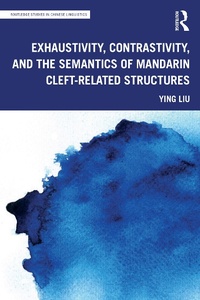
Exhaustivity, Contrastivity, and the Semantics of Mandarin Cleft-related Structures
1st Edition
Published on 30. December 2022
228 pages
978-1-000-82116-1 (ISBN)
Description

Exhaustivity, Contrastivity, and the Semantics of Mandarin Cleft-related Structures investigates the semantics of the cleft and cleft-related structures in Mandarin, which, over several decades, have presented analytical challenges for semantic theory.
The goal of this book, in broad terms, is three-fold: (i) to figure out what clefting adds to the semantics of a sentence; (ii) to set apart the meaning and the discourse function of each type of cleft-related structure; and (iii) to provide a uniform analysis of Mandarin clefts and their related structures. More specifically, it addresses the following questions: (i) what is the semantics of Mandarin clefts? (ii) what do exhaustivity and contrastivity contribute to the meaning of clefts? (iii) what are the semantic (or pragmatic) factors that determine the variation of clefts, related structures, and canonical sentences? and (iv) cross-linguistically speaking, how do Mandarin shi...de cleft and its related structures differ from similar constructions such as English it-cleft, French c'est cleft, and German es-cleft?
This book will be informative for linguists who are working on cleft constructions and focus on sensitive structures cross-linguistically, and those interested in experimental semantics and pragmatics.
The goal of this book, in broad terms, is three-fold: (i) to figure out what clefting adds to the semantics of a sentence; (ii) to set apart the meaning and the discourse function of each type of cleft-related structure; and (iii) to provide a uniform analysis of Mandarin clefts and their related structures. More specifically, it addresses the following questions: (i) what is the semantics of Mandarin clefts? (ii) what do exhaustivity and contrastivity contribute to the meaning of clefts? (iii) what are the semantic (or pragmatic) factors that determine the variation of clefts, related structures, and canonical sentences? and (iv) cross-linguistically speaking, how do Mandarin shi...de cleft and its related structures differ from similar constructions such as English it-cleft, French c'est cleft, and German es-cleft?
This book will be informative for linguists who are working on cleft constructions and focus on sensitive structures cross-linguistically, and those interested in experimental semantics and pragmatics.
More details
Series
Edition
1. Auflage
Language
English
Place of publication
London
United Kingdom
Publishing group
Taylor & Francis Ltd
Target group
Professional and scholarly
Product notice
Reflowable
Illustrations
13 Tables, black and white; 12 Line drawings, black and white; 2 Halftones, black and white; 14 Illustrations, black and white
ISBN-13
978-1-000-82116-1 (9781000821161)
Copyright in bibliographic data and cover images is held by Nielsen Book Services Limited or by the publishers or by their respective licensors: all rights reserved.
Schweitzer Classification
Other editions
Additional editions
Book
12/2022
1st Edition
Routledge
€186.00
Shipment within 15-20 days
Book
12/2022
1st Edition
Routledge
€60.20
Shipment within 15-20 days
Person
Ying Liu is an associate research fellow at the Institute of Modern Languages and Linguistics, Fudan University. Her research interests include formal semantics, experimental semantics, and Chinese grammar.
Content
1 Introduction
1.1 The data
1.2 The problem
1.3 Aim and methods
1.3.1 Aim
1.3.2 Empirical methods
1.3.3 Typological investigations
1.4 Major findings
1.5 The organization of the book
2 Theoretical background
2.1 Information Structure
2.2 Focus
2.2.1 What is focus?
2.2.2 Types of focus
2.2.3 Focus Marking
2.3 Multi-dimensionality and types of meaning
2.3.1 Assertion vs Presupposition
2.3.2 Implicatures
2.3.3 Features of entailment, presupposition, and implicature
2.4 Question Under Discussion
2.4.1 Question semantics and focus semantics
2.4.2 CQ congruence and DQ relevance
3 Clefts and the related structures
3.1 What is cleft construction?
3.2 Prototypical and non-prototypical clefts
3.2.1 Prototypical clefts
3.2.2 Non-prototypical clefts
3.3 Related structures
3.3.1 Pseudo-clefts
3.3.2 Definite specificational sentences
3.4 Shi...de and its related structures
3.4.1 Shi...de
3.4.2 Bare shi sentences
3.4.3 Bare de sentences
3.4.4 Pseudo-clefts and definite specificational sentences
3.4.5 Verum focus, propositional assertion, and sentence-initial shi
3.5 Interim discussion
4 The interpretation of clefts
4.1 Previous treatments of clefts' exhaustivity
4.1.1 The assertion account
4.1.2 The presupposition account
4.1.3 The conversational implicature account
4.1.4 Empirical evidence
4.2 Contrastivity and the interpretation of clefts
4.2.1 What is contrastivity?
4.2.2 Empirical evidence
4.2.3 Contrastivity and Chinese shi...(de) clefts
4.3 Experimental studies on the interpretation of Mandarin clefts
4.3.1 Experiment 1: Large-scale corpus and web-based experimental study
4.3.2 Experiments 2-4: the status of exhaustivity
4.4 General discussion
5. A unified analysis of shi-clefts
5.1 Unique identification and the semantics of bare shi
5.1.1 Unique identification
5.1.2 The derivation of the semantics of shi
5.1.3 The status of exhaustivity
5.2 Extending the current analysis to related structures
5.2.1 Empirical foundations of the uniform analysis
5.2.2 The analysis of the related structures
5.3 Interim discussion
6. The semantics of de
6.1 Previous analyses
6.1.1 What de cannot be
6.1.2 The aspect marker analyses
6.1.3 Evidentiality and emphatic effect analyses
6.2 Two types of de
6.3 Verum focus de and emphatic effects
6.3.1 De independently manifests emphatic effects
6.3.2 What are the emphatic effects?
6.3.3 Verum shi and de
6.4 Cleft focus de and perfectivity
6.4.1 Perfectivity
6.4.2 de, le, and guo
6.5 Interim discussion
7. Conclusion
References
Index
1.1 The data
1.2 The problem
1.3 Aim and methods
1.3.1 Aim
1.3.2 Empirical methods
1.3.3 Typological investigations
1.4 Major findings
1.5 The organization of the book
2 Theoretical background
2.1 Information Structure
2.2 Focus
2.2.1 What is focus?
2.2.2 Types of focus
2.2.3 Focus Marking
2.3 Multi-dimensionality and types of meaning
2.3.1 Assertion vs Presupposition
2.3.2 Implicatures
2.3.3 Features of entailment, presupposition, and implicature
2.4 Question Under Discussion
2.4.1 Question semantics and focus semantics
2.4.2 CQ congruence and DQ relevance
3 Clefts and the related structures
3.1 What is cleft construction?
3.2 Prototypical and non-prototypical clefts
3.2.1 Prototypical clefts
3.2.2 Non-prototypical clefts
3.3 Related structures
3.3.1 Pseudo-clefts
3.3.2 Definite specificational sentences
3.4 Shi...de and its related structures
3.4.1 Shi...de
3.4.2 Bare shi sentences
3.4.3 Bare de sentences
3.4.4 Pseudo-clefts and definite specificational sentences
3.4.5 Verum focus, propositional assertion, and sentence-initial shi
3.5 Interim discussion
4 The interpretation of clefts
4.1 Previous treatments of clefts' exhaustivity
4.1.1 The assertion account
4.1.2 The presupposition account
4.1.3 The conversational implicature account
4.1.4 Empirical evidence
4.2 Contrastivity and the interpretation of clefts
4.2.1 What is contrastivity?
4.2.2 Empirical evidence
4.2.3 Contrastivity and Chinese shi...(de) clefts
4.3 Experimental studies on the interpretation of Mandarin clefts
4.3.1 Experiment 1: Large-scale corpus and web-based experimental study
4.3.2 Experiments 2-4: the status of exhaustivity
4.4 General discussion
5. A unified analysis of shi-clefts
5.1 Unique identification and the semantics of bare shi
5.1.1 Unique identification
5.1.2 The derivation of the semantics of shi
5.1.3 The status of exhaustivity
5.2 Extending the current analysis to related structures
5.2.1 Empirical foundations of the uniform analysis
5.2.2 The analysis of the related structures
5.3 Interim discussion
6. The semantics of de
6.1 Previous analyses
6.1.1 What de cannot be
6.1.2 The aspect marker analyses
6.1.3 Evidentiality and emphatic effect analyses
6.2 Two types of de
6.3 Verum focus de and emphatic effects
6.3.1 De independently manifests emphatic effects
6.3.2 What are the emphatic effects?
6.3.3 Verum shi and de
6.4 Cleft focus de and perfectivity
6.4.1 Perfectivity
6.4.2 de, le, and guo
6.5 Interim discussion
7. Conclusion
References
Index
