

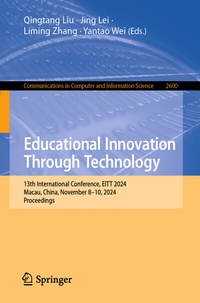
Educational Innovation Through Technology
Description

The volume CCIS 2600 constitutes the refereed post-conference proceedings of the 13th International Conference of Educational Innovation through Technology, EITT 2024, Macau, China, during November 8-10, 2024.
The 17 revised full papers and 7 short papers presented in these proceedings were carefully reviewed and selected from 78 submissions. The papers are organized in the following topical sections: AI-Powered Educational Innovation, Tech-Enhanced Curriculum & Teaching Innovations, and AI-driven Learning Analytics & Assessment.
More details
Other editions
Additional editions
Content
.- AI-Powered Educational Innovation.
.- Empowering Elementary School English Review Lessons with Generative AI: Constructing the RCPA Human-Machine Collaborative Teaching Model.
.- Design and Development of an LLM-empowered Arguing Pedagogical Agent with a Personalized Avatar, Movements, and Voice.
.- Student Emotion Recognition Research Based on Deep Learning Techniques: An Example of Primary and Secondary School Classrooms.
.- The Influence of GAI on the Development of Students' Higher-Order Thinking Ability: Meta-Analysis Based on Relevant Empirical Studies at Home and Abroad Since 2022.
.- Design of Knowledge Graph Solutions to Enhance Resilience in STEM Education.
.- Understanding College Students' AI Literacy in Course Essays: A Topic Modeling-Based Method.
.- Emotion Recognition for Learners Based on Facial Expressions and BVP Signals.
.- Making AI Forget You: Removing Educational Data from Intelligent Education Models.
.- A Low-consumption Teaching Role Recognition Method for Teaching Analysis.
.- Open Management of Research-oriented Laboratories in Universities Based on an "AI for Science" Paradigm.
.- Tech-Enhanced Curriculum & Teaching InnovationsSTE.
.- STEM, Cultural Heritage, and Junior High School Labor Curriculum: An Example of the 3-way Luban Lock C-STEAM Project.
.- LIDT Framework and Implementation of Life-Oriented Instructional Design for Preschool Children's Scientific Activities Empowered by Digital Intelligence Technology.
.- A Practical Study of AR Technology-enabled Children's Immersion Learning.
.- Research on the Construction and Application of a Multi-agent Collaborative Digital Volunteer Education Model.
.- Can Information Technology Bridge Cultural Differencesc? Design and Effectiveness Analysis of COIL Based on Intercultural Communication.
.- Design, Implementation, and Application of a 3-D Virtual Simulation Visualization Experiment System for Camera Calibration.
.- AI-driven Learning Analytics & Assessment.
.- Optimizing the Assessment System of Integrated Course Design through Causal Inference.
.- Evaluation and Continuous Improvement of Graduation Design Based on Causal Inference.
.- Assessment of an AI-Assisted Power Supply Experiment Design Based on Causal Inference.
.- A Measurement Method of Knowledge Contribution by Learners During a Design Process.
.- Investigating How Self-Recording and Playback Influence Music Students' Self-Assessment.
.- Exploring the Influencing Factors of Pupil Gratification towards Elementary School Library Services: A TAM-Based Study.
.- What Characteristics of Social Media Make Teachers' Learning and Training Effective.
.- Undersea Adventure (UA): A Stealth Approach to Collaborative Skills Assessment in Schools.
