

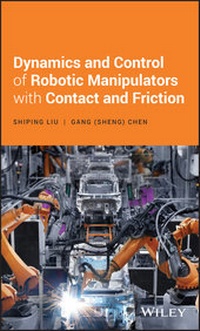
Dynamics and Control of Robotic Manipulators with Contact and Friction
Description

Dynamics and Control of Robotic Manipulators with Contact and Friction offers an authoritative guide to the basic principles of robot dynamics and control with a focus on contact and friction. The authors discuss problems in interaction between human and real or virtual robot where dynamics with friction and contact are relevant. The book fills a void in the literature with a need for a text that considers the contact and friction generated in robot joints during their movements.
Designed as a practical resource, the text provides the information needed for task planning in view of contact, impact and friction for the designer of a robot control system for high accuracy and long durability. The authors include a review of the most up-to-date advancements in robot dynamics and control. It contains a comprehensive resource to the effective design and fabrication of robot systems and components for engineering and scientific purposes. This important guide:
* Offers a comprehensive reference with systematic treatment and a unified framework
* Includes simulation and experiments used in dynamics and control of robot considering contact, impact and friction
* Discusses the most current tribology methodology used to treat the multiple-scale effects
* Contains valuable descriptions of experiments and software used
* Presents illustrative accounts on the methods employed to handle friction in the closed loop, including the principles, implementation, application scope, merits and demerits
* Offers a cohesive treatment that covers tribology and multi-scales, multi-physics and nonlinear stochastic dynamics control
Written for graduate students of robotics, mechatronics, mechanical engineering, tracking control and practicing professionals and industrial researchers, Dynamics and Control of Robotic Manipulators with Contact and Friction offers a review to effective design and fabrication of stable and durable robot system and components.
More details
Other editions
Additional editions

Persons
DR. SHIPING LIU is an Associate Professor in School of Mechanical Engineering & Science, Huazhong University of Science and Technology in Wuhan, Hubei, China.
DR. GANG (SHENG) CHEN is a Professor in College of Information Technology and Engineering, Marshall University, Huntington, WV, USA.
Content
Preface ix
1 Introduction 1
1.1 Robot Joint Friction Modeling and Parameter Identification 1
1.2 Contact Perception in Virtual Environment 2
1.3 Organization ofThis Book 3
References 4
2 Fundamentals of Robot Dynamics and Control 9
2.1 Robot Kinematics 9
2.1.1 Matrix Description of Robot Kinematics 9
2.1.2 Homogeneous Transformation Matrices 12
2.1.3 Forward Kinematics 14
2.1.4 Inverse Kinematics 24
2.1.5 Velocity Kinematics 29
2.2 Robot Dynamics 30
2.3 Robot Control 31
2.3.1 Introduction 31
2.3.2 Trajectory Control 31
2.3.2.1 Point-to-Point Control 32
2.3.2.2 Trajectories for Paths Specified by Points 33
2.3.3 Interaction Control 38
2.3.3.1 Impedance Control 38
2.3.3.2 Hybrid Force-Position Control 38
References 39
3 Friction and Contact of Solid Interfaces 45
3.1 Introduction 45
3.2 Contact Between Two Solid Surfaces 46
3.2.1 Description of Surfaces 46
3.2.2 Contact Mechanics of Two Solid Surfaces 48
3.3 Friction Between Two Solid Surfaces 55
3.3.1 Adhesion 55
3.3.2 Dry Friction 65
3.3.2.1 Friction Mechanisms 65
3.3.2.2 Friction Transitions andWear 75
3.3.2.3 Static Friction, Hysteresis, Time, and Displacement Dependence 78
3.3.2.4 Effects of Environmental and Operational Condition on Friction 80
3.3.3 Liquid Mediated Friction 81
3.3.3.1 Stribeck Curve 81
3.3.3.2 Unsteady Liquid-Mediated Friction 84
3.3.3.3 Negative Slope of Friction-Velocity Curve 87
3.3.4 Friction Models 87
References 99
4 Friction Dynamics of Manipulators 115
4.1 Friction Models of Robot Manipulator Joints 115
4.2 Modeling Friction with Varied Effects 119
4.3 The Motion Equations of Dynamics of Robot Manipulators with Friction 123
4.3.1 The General Motion Equation of Robot Manipulators 123
4.3.2 The Motion Equation of Two-Link Robot Manipulators 130
4.4 Nonlinear Dynamics and Chaos of Manipulators 132
4.5 Parameters Identification 142
4.5.1 Identification of Dynamic Parameters 142
4.5.2 Identification of Parameters of Friction Models 146
4.5.3 Uncertainty Analysis 151
4.6 Friction Compensation and Control of Robot Manipulator Dynamics 153
References 158
5 Force Feedback and Haptic Rendering 175
5.1 Overview of Robot Force Feedback 175
5.2 GeneratingMethods of Feedback Force 177
5.2.1 SerialMechanism 178
5.2.1.1 Kinematics 178
5.2.1.2 Inverse Kinematics 179
5.2.1.3 Dynamics 181
5.2.2 Parallel Mechanism 182
5.2.2.1 KinematicsModel 182
5.2.2.2 Forward Kinematics 185
5.2.2.3 Inverse Kinematics 188
5.2.2.4 Dynamics Based on VirtualWork 190
5.2.3 Friction Compensation 194
5.3 Calculation of Virtual Force 197
5.3.1 Collision Detection 197
5.3.1.1 The Construction of the Bounding Box 199
5.3.1.2 Calculation of Distance between Bounding Boxes 202
5.3.2 Calculating the Model of Virtual Force 206
5.3.2.1 1-DoF Interaction 206
5.3.2.2 2-DoF Interaction 207
5.3.2.3 3-DoF Interaction 208
5.3.2.4 6-DoF Interaction 210
5.4 Haptic Display Based on Point Haptic Device 210
5.4.1 Human Tactile Perception 211
5.4.2 Haptic Texture DisplayMethods 211
References 214
6 Virtual Simulation of Robot Control 225
6.1 Overview of Robot Simulation 225
6.2 3D Graphic Environment 227
6.3 Virtual Reality-Based Robot Control 228
6.3.1 Overview of Virtual Reality 228
6.3.2 Overview of Teleoperation 229
6.3.3 Virtual Reality-Based Teleoperation 231
6.4 Augmented Reality-Based Teleoperation 233
6.4.1 Overview of Augmented Reality 233
6.4.2 Augmented Reality-Based Teleoperation 234
6.5 Task PlanningMethods in Virtual Environment 235
6.5.1 Overview 235
6.5.2 Interactive Graphic Mode 236
References 238
Index 247
1
Introduction
1.1 Robot Joint Friction Modeling and Parameter Identification
Robot design generally considers only the ideal circumstances. The actual robot experiences great differences from the model built and simulated with MATLAB or other graphical tools, with manufacturing errors, friction, and gravity contributing the most to these differences [1]. There are also complex nonlinear problems [2]. With the wide application of robots in different industries involving humans, the demands of safety, accuracy, and reliability on robots is continually increasing. Contact and friction always influence the accuracy and reliability of the robot. For a more reliable and accurate solid robot, the design - especially control design - must account for friction, contact, and impact, as well as friction in the force feedback mechanism.
In recent decades, industries and academia have conducted research and developed related to robotic dynamics and control. In recent years, some have focused on the contact and friction generated in robot joints during movement [3-8]. There have been different methods presented to build an accurate model of joint friction based on experimentation and analysis of the corresponding results. Nonlinear characteristics of friction [9-15] are obvious, especially in the low-speed motion of robot, so nonlinear dynamics of robot must be considered as well.
Friction is a tangential resistant force to sliding in a dynamic system. To investigate friction, it is necessary to characterize the surface roughness in terms of its statistical properties. Friction has been demonstrated to be related to surface topography, and friction investigation has been conventionally attributed to the determination of the actual area of contact and understanding the contact mechanism. For instance, surface physics explains friction as the formation of adhesion between interacting asperities and their breakaway by shearing, whereas continuum mechanics interprets friction by interlocking and subsequent fracture of asperities.
To address the problem of actual sliding asperity contact is quite difficult, which involves complex dynamics. The feasible approach is to assume the contact to be quasi-static in nature, to certain extent. In many applications with relatively smooth surfaces, the deformation of contacting asperities can be assumed to be linear and elastic. For many problems the contact has to be extended to non-elastic and nonlinear conditions and involve dynamics.
1.2 Contact Perception in Virtual Environment
Research on robot dynamics and control with consideration of contact and friction is a major topic of this book. Contact perception, which is part of the interaction between a human and a real or virtual robot, is also discussed. In a virtual environment, force feedback or surface texture generally needs to be calculated according to dynamics with friction and contact.
Contact perception is generally achieved by different types of haptic devices [16-22]. The force signals or the surface texture signals, coming from the real measurement or calculation, is input into the haptic device so the operator gets the expected contact feeling. The real measurement is carried out when the real robot works in the real environment. In virtual simulation, the virtual interaction force between the virtual robot and the virtual environment needs to be calculated in real time according to relevant contact or friction models. The measured or calculated force signals are filtered and sometimes transformed according to a certain scale.
Virtual reality and mixed reality are widely used in robot control, especially for control simulation [23-31]. The purpose of the virtual simulation in some instances is to verify the underlying robot control algorithm, while others are to provide graphical modes to assist the operator with real-time robot control, reducing manual error. This book mainly discusses the related research of virtual reality or augmented reality teleoperation [30-37]. Interactive task planning with graphical assistance is also explored.
1.3 Organization of This Book
Chapter 1 introduces the book and major topics are stated.
Chapter 2 introduces the fundamentals of robot dynamics and control. Besides the typical kinematics and dynamics of a robot with six degrees of freedom (6 DoF) or less, the kinematic reverse solution of a 7 DoF robot is also introduced. In this chapter, different robot control modes are classified as either trajectory control or interaction control, and reviewed.
In Chapter 3, theories and methods in contact and friction are reviewed according to the classification of wet friction and dry friction. In this chapter, we present the fundamentals of contact and friction between two contact surfaces in the context of quasi-static state by assuming that the normal motion is ignored. We focus on the mechanics of contact and friction by outlining the mechanical attributes of various friction processes in the context of the problems of the friction-vibration interactions.
Chapter 4 introduces friction modeling and parameter identification of robot joints. The dynamic parameter identification methods of multiple-joint robot systems are also introduced. This chapter uses the two-link planar robotic arm as the experimental object to verify theories and methods discussed in previous chapters. Nonlinear dynamics and chaos are also discussed in this chapter.
The operator of a remote or virtual robot can feel the contact between the robot and its real or virtual working environment via a haptic device. In Chapter 5, principles of several common haptic devices with force feedback are analyzed. The calculation of virtual force caused by contact in a virtual environment is discussed. Haptic display based on point haptic devices is also reviewed.
Chapter 6 introduces virtual simulation of robot control and 3D graphic environment, virtual reality-based robot control and augmented reality-based teleoperation are reviewed. Task planning based on graphical mode is also discussed.
References
- 1 Japan Robot Association (2008). The New Handbook of Robot Technology Zong G.H., Cheng J.S., trans., 2e, 244-245. Beijing: Science Press.
- 2 Verduzco, F. and Alvarez, J. (2000). Homoclinic chaos in 2-DOF robot manipulators driven by PD controllers. Nonlinear Dynam. 21 (2): 157-171.
- 3 Parra-Vega, V. and Arimoto, S. (1996). A passivity based adaptive sliding mode position-force control for robot manipulators. Int. J. Adapt. Control Signal Process. 10 (4-5): 365-377.
- 4 de Wit, C.C., Olsson, H., Astron, K.J. et al. (1994). A new model for control of systems with friction. IEEE Trans. Autom. Control 40: 419-425.
- 5 Popovic, M.R., Gorinevsky, D.M., and Goldenberg, A.A. (2000). High-precision positioning of a mechanism with nonlinear friction using a fuzzy logic pulse controller. IEEE Trans. Control Syst. Technol. 8 (1): 151-158.
- 6 Llama, M.A., Kelly, R., and Santibáñez, V. (2000). Stable computedtorque control of robot manipulators via fuzzy self-tuning. IEEE Trans. Syst., Man, Cybern. - Part B 30 (1): 143-150.
- 7 Craig, J.J. (1988). Adaptive Control of Mechanical Manipulators. New York: Addison-Wesley Inc.
- 8 Wu, J., Wang, J., and You, Z. (2010). An overview of dynamic parameter identification of robots. Robot. Comput. Integr. Manuf. 26 (5): 414-419.
- 9 Wang, S.-G., Lin, S.B., Shieh, L.S. et al. (1998). Observer-based controller for robust pole clustering in a vertical strip and disturbance rejection in structured uncertain systems. Int. J. Robust Nonlinear Control 8 (3): 1073-1084.
- 10 Lin, S. and Wang, S.-G. (2000). Robust control with pole clustering for uncertain robotic systems. Int. J. Control Intell. Syst. 28 (2): 72-79.
- 11 Ryu, J.-H., Song, J., and Kwon, D.-S. (2001). A nonlinear friction compensation method using adaptive control and its practical application to an in-parallel actuated 6-DOF manipulator. Control. Eng. Pract. 9: 159-167.
- 12 Jin, M., Kang, S.H., and Chang, P.H. (2008). Robust compliant motion control of robot with nonlinear friction using time-delay estimation. IEEE Trans. Ind. Electron. 55 (1): 258-269.
- 13 Chang, P.H., Park, K., Kang, S.H. et al. (2013). Stochastic estimation of human arm impedance using robots with nonlinear frictions: an experimental validation. IEEE/ASME Trans. Mechatron. 18 (2): 775-786.
- 14 Sneider, H. and Frank, P.M. (1996). Observer-based supervision and fault detection in robots using nonlinear and fuzzy logic residual evaluation. IEEE Trans. Control Syst. Technol. 4 (3): 274-282.
- 15 Do, T.N., Tjahjowidodo, T., Lau, M.W.S. et al. (2015). Nonlinear friction modelling and compensation control of hysteresis phenomena for a pair of tendon-sheath actuated surgical robots. Mech. Syst. Signal Process. 60-61: 770-784.
- 16 Salisbury, K., Conti, F., and Barbagli, F. (2004). Haptic rendering: introductory concepts. IEEE Comput. Graphics Appl. 24 (2): 24-32.
- 17 Yi, L., Zhang, Y., Ye, X. et al. (2016). Haptic rendering...
