

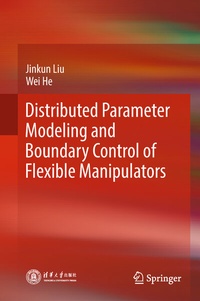
Distributed Parameter Modeling and Boundary Control of Flexible Manipulators
Description

The book investigates fundamental issues in flexible manipulator systems, including distributed parameter modeling and boundary controller design. It presents theoretical explorations of several fundamental problems concerning the dynamics and control of these systems. By integrating fresh concepts and results to form a systematic approach to control, it also provides a basic theoretical framework.
In turn, the book offers a comprehensive treatment of flexible manipulator systems, addressing topics ranging from related distributed parameter modeling and advanced boundary controller design for these systems with input constraint, to active control with output constraint.
In brief, the book addresses dynamical analysis and control design for flexible manipulator systems. Though primarily intended for researchers and engineers in the control system and mechanical engineering community, it can also serve as supplemental reading on the modeling and control of flexible manipulator systems at the postgraduate level.
More details
Other editions
Additional editions
Persons
Professor Wei He received his PhD from Department of Electrical & Computer Engineering, National University of Singapore (NUS), Singapore, in 2011, his M.Eng. and B.Eng. degrees both from School of Automation Science and Engineering, South China University of Technology (SCUT), Guangzhou, China, in 2008 and 2006, respectively. He iscurrently working as the Full Professor at School of Automation and Electric Engineering, University of Science and Technology Beijing (USTB), Beijing, China. He is a senior member of IEEE, the member of IEEE Control System Society (CSS), IEEE Computational Intelligence Society (CIS) and IEEE Industrial Electronics Society (IES). He has been awarded a Newton Advanced Fellowship from The Royal Society, London, UK in 2017. He is a recipient of the IEEE SMC Society Andrew P. Sage Best Transactions Paper Award in 2017. He is serving as the Associate Editor of IEEE Transactions on Systems, Man, and Cybernetics: Systems, IEEE Transactions on Neural Networks and Learning Systems, and IEEE Access, the Editor of Neurocomputing, Journal of Intelligent and Robotic Systems, Springer, and the Editor of IEEE/CAA Journal of Automatica Sinica. He is the member of the IFAC TC on Distributed Parameter Systems, IFAC TC on Computational Intelligence in Control and IEEE CSS TC on Distributed Parameter Systems. He served as Publication Chair for WCICA 2016, National Organizing Committee Chair for IEEE ICARM 2016 and IFAC ICONS 2013, Program Chair for 2012 IWR, Finance Chair for 2012 ICSR, etc. His current research interests include vibration control, adaptive control and robotics.
