

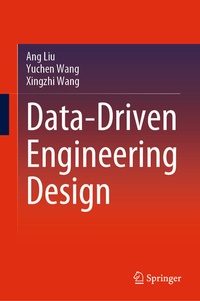
Data-Driven Engineering Design
Description

This book addresses the emerging paradigm of data-driven engineering design. In the big-data era, data is becoming a strategic asset for global manufacturers. This book shows how the power of data can be leveraged to drive the engineering design process, in particular, the early-stage design.
Based on novel combinations of standing design methodology and the emerging data science, the book presents a collection of theoretically sound and practically viable design frameworks, which are intended to address a variety of critical design activities including conceptual design, complexity management, smart customization, smart product design, product service integration, and so forth. In addition, it includes a number of detailed case studies to showcase the application of data-driven engineering design. The book concludes with a set of promising research questions that warrant further investigation.
Given its scope, the book will appeal to a broad readership, including postgraduate students, researchers, lecturers, and practitioners in the field of engineering design.
More details
Other editions
Additional editions
Persons
Dr. Ang Liu is an Associate Professor of Engineering Design at the School of Mechanical and Manufacturing Engineering, University of New South Wales, Australia. He received his M.S. and Ph.D. degrees from the University of Southern California, in 2008 and 2012, respectively. He is an Associate Member of the International Academy for Production Engineering (CIRP), Fellow of the PLuS Alliance, and Senior Fellow of the Higher Education Academy (SFHEA). He chaired multiple international design conferences such as the 13th International Conference on Axiomatic Design (ICAD2019). He serves in the editorial boards of multiple journals such as the Chinese Journal of Mechanical Engineering, Digital Twin, Scientific Reports, etc. He has published over 100 book chapters, journal articles, and conference papers. His research interests include innovative design thinking, design theory and methodology, smart manufacturing, digital twin, and engineering education.
Mr. Yuchen Wang is a Ph.D.candidate in Mechanical Engineering. He completed his undergraduate degree in Aerospace Engineering at the University of New South Wales (UNSW). His research lies at the intersections of design methodology, data science, and digital twin. As a head tutor, he had been teaching engineering design to a large cohort of college student at UNSW. He has published more than 10 journal articles, conference papers, and book chapters.
Mr. Xingzhi Wang is a Ph.D. candidate in Mechanical Engineering at the University of New South Wales (UNSW). He obtained his undergraduate degree and master's degree at the Sichuan University and UNSW, respectively. His research focuses on leveraging machine learning to enhance design customization.
