

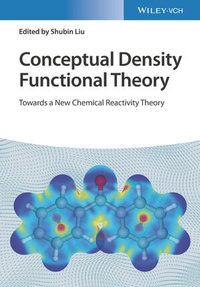
Conceptual Density Functional Theory
Description

More details
Other editions
Additional editions

Person
Content
Historic Overview
Basic Functions of CDFT
Basic Formulas of CDFT
Basic Principles of CDFT
PART II. EXTENSIONS
Excited state CDFT
Degenerate State CDFT
Spin CDFT
Temperature Dependent CDFT
Time-dependent CDFT
Regioselectivity in CDFT
Charge Transfer in CDFT
Action Flux
Mechanic Force
HSAB & Beyond
Information-Theoretic Approach
The Linear Response Function and Alchemical Method
Valence State Concepts and their Implications for Conceptual DFT
Chemical Information
Molecular Shape
Bridging Conceptual Density Functional and Valence Bond Theories
PART III. APPLICATIONS
Chemical Bonding
Molecular Acidity, PCET, and Metal Specificity
Reaction Mechanism
Polar Cycloaddition Reactions: Reactivity and Site Selectivity
Polymorphism
Variation in Reactivity on Hydrogen Storage
The Fukui Function in Extended Systems: Theory and Applications
Fermi Softness in Surface Catalysis
ABEEM Polarizable Force Field
Charge Transfer and Polarization in Force Fields
PART IV. IMPLEMENTATIONS
Realization of Conceptual Density Functional Theory and Information-Theoretic Approach in the Multiwfn Program
ChemTools: Gain Chemical Insight from Quantum Chemistry Calculations
1
Historic Overview
Paul Geerlings
Vrije Universiteit Brussel, Research Group of General Chemistry (ALGC), Faculty of Science and Bioengineering Science, Pleinlaan 2, Brussels 1050, Belgium
1.1 Introduction: From DFT to Conceptual DFT
Density Functional Theory goes back to the early days of Quantum Mechanics when, in 1926, Thomas and Fermi [1-3] presented a model to study the electronic structure of atoms on the basis of the electron density ? (r) instead of the wave function. The simplification is spectacular: for an N-electron system, one passes from an immensely complicated wave function ?(xN), a function of 4N variables (three spatial variables and one spin variable for each electron, gathered in a 4-vector x) to just three variables in the density ?(x, y, z). The results for atoms were encouraging, but the approach failed dramatically for (diatomic) molecules not being able to account for their stability. Was the loss of information when passing from a wave function to the density (in fact, an integration over 4N-3 variables) too drastic? An important step was taken by Slater in the 1950s. In his Xa method [4], he presented a simplification of the Hartree-Fock method replacing the complicated nonlocal Fock operator with a local, single parameter, operator involving the density. The method turned out to be a quite efficient technique for electronic structure calculations on molecules and solids.
One has, however, to wait until 1964 when Hohenberg and Kohn [5] turned density-based models into a full-fledged theory through their two famous theorems. The first theorem is an existence theorem presenting the ground-state energy of a system as functional of the density. The proof, based on a reductio ad absurdum, is, as quoted by Parr and Yang [6], "disarmingly simple." The second theorem offers a variational principle, and so, at least in principle, a road to the "best" density: look for the one yielding the lowest energy, as known for decades in wave function quantum mechanics. The crux of the first theorem is that it is proven that for a given N-electron system, its ground-state density ?(r) is compatible with a single external potential v(r), i.e. the potential felt by the electrons due to the nuclei, in the absence of external fields. This single external potential is equivalent to a unique constellation of nuclei: their number, position, and charge. To put it all succinctly: ? determines v, and as it also determines N by integration, it also determines the Hamiltonian, and at least in principle, "everything." Coming back to the second theorem, the variational procedure leads to the Euler equation of the problem
(1.1)where FHK is the Hohenberg-Kohn functional and µ the Lagrangian Multiplier introduced during the variational procedure ensuring that the density remains properly normalized to N. Equation (1.1) is the analogue of the time-independent Schrödinger equation H? = E ?, which also can be obtained in a variational ansatz, where the Lagrangian Multiplier ensuring proper normalization of the wave function ? is at the end identified with the system's energy E. The analogy is striking, but two aspects of this equation deserve further consideration. What is FHK, and what is the physical interpretation of µ? The Hohenberg-Kohn functional is a universal functional (i.e. v-independent), which contains unknown parts governing electron correlation and exchange assembled in the exchange-correlation functional Exc [?], which will be highlighted in other chapters in the "Fundamentals" part in this book. Quintessentially, it's the price to be paid for the simplification when passing from a wave function to the density, still retaining its essential information content. By introducing, in the context of a non-interacting reference system, orbitals in the variational procedure, Kohn and Sham [7] were able to cast the variational equation into a series of pseudo-one-electron eigenvalue equations, similar to the Hartree-Fock equations, be it, again, that part of the concerned operator is unknown: the functional derivative of Exc with respect to ?(r), dExc/d?(r), termed the exchange-correlation potential vxc (r).
The history of DFT is (among others) a quest for finding better and better approximations for this unknown vxc (r). The simplest approximation, of standard use, mainly by solid-state physicists, in the 1970s and the 1980s was the local density approximation (LDA) [7], showing however substantial over-binding in molecules [8]. Things became more interesting for chemists in the second half of the 1980s when the generalized gradient approximations (GGA) were launched [9, 10]. The great breakthrough, with the wide acceptance of DFT by the Quantum-Chemical community, came in the early 1990s when hybrid functionals were introduced, in which a fraction of the GGA exchange was replaced with exact HF exchange, with as most prominent example the still ubiquitous B3LYP functional [8-10]. This approach yielded at that time unsurpassed quality/computing time ratios, the latter aspect being reinforced by its implementation in Pople's widely used GAUSSIAN package [11]. At that time, DFT was on its way to become the standard method for obtaining an optimal quality/cost ratio for studying properties and reactions of not too exotic systems of varying sizes. Afterward, its "popularity" grew at incredible pace. In his excellent 2012 Journal of Chemical Physics perspective, Burke [12] plots the number of papers retrieved from the Web of Science when searching for DFT as a function of time, reaching in 1996 about 1000 papers, 5000 in 2005, and 8000 in 2010. Nowadays, DFT is the workhorse "par excellence" used, not only by theoreticians but also by experimentalists, in combined experimental-computational papers, when exploring structure, stability, electronic properties, reactivity, and reactions of molecules, polymers, and solids in the most diverse subdomains of chemistry [8].
1.1.1 But, Where Is Conceptual DFT in This Story?
As highlighted at the very beginning of this chapter, the variational Eq. (1.1) stands central in DFT, just as the Schrödinger equation in wave function theory. Besides the quest for the exact Hohenberg-Kohn functional, we already mentioned that a second fundamental question in relation to this equation arises: what is the physical/chemical meaning of the Lagrangian multiplier µ? Its identification by Parr et al. [13] can be considered as the birth of Conceptual DFT.
This genesis, its early years, and evolution with a short reflection on its present status and its future will be described in the following paragraphs. Note that detailed explanations and derivations leading to the various concepts, formulas, and equations will mostly not be given in view of space limitations and because the reader will find them in Part I (Foundations) and, in case of more recent developments, in Part II (Extensions) of this book. This is also the reason why the number of references is kept to the most essential ones. For the most extensive reviews on Conceptual DFT, we can now already refer the reader to items [14-20] in the reference list.
1.2 The Birth of Conceptual DFT: The Identification of the Electronic Chemical Potential (1978)
In a landmark paper in 1978, Parr et al. [13] showed that the Lagrangian Multiplier in the DFT variational equation could be written as the partial derivative of the system's energy with respect to the number of electrons at fixed external potential.
(1.2)The chemical importance of this demystification of the Lagrangian Multiplier shows up when going back to the early 1960s, when Iczkowski and Margrave [21] presented evidence, on the basis of experimental ionization energies and electron affinities, that the energy of an atom could reasonably well be written as a polynomial in n (the number of electrons N minus the nuclear charge) around n = 0 as
(1.3)Assuming continuity and differentiability of E, the slope at n = 0 and at fixed nuclear charge Z, (?E/?n)n=0, could easily be seen as a measure of electronegativity ? of the neutral system
(1.4)As it was recognized that the cubic and quartic terms were negligible, Mulliken's electronegativity definition [22]
(1.5)where I and A are the first ionization and electron affinity, respectively, were regained as a special case, so that within this approximation
(1.6)Generalizing the constant Z condition for atoms to a constant v...
