

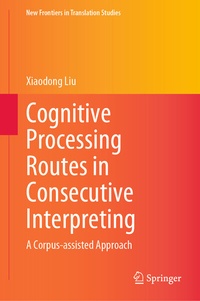
Cognitive Processing Routes in Consecutive Interpreting
Description

This book addresses a controversial issue regarding SL-TL transfer in the translation process, namely the question as to the dominant route in English-Chinese and Chinese-English professional consecutive interpretations, respectively: the form-based processing route or meaning-based processing route. It presents a corpus-assisted product study, in which the interpreting processing patterns of culture-specific items (CSIs) are analyzed. The study reveals that the dominant route in English vs. Chinese consecutive interpreting varies under different circumstances. Four factors are proposed to account for such differences: linguistic variables (e.g., grammatical complexity of the unit), type of CSI, language direction, and extra-linguistic variables (e.g., multilateral or bilateral settings). In summary, the book systematically introduces a corpus-assisted approach to translation process research, which will benefit all readers who are interested in translation process research but cannot employ neuroscientific measures.
More details
Other editions
Additional editions
Person
Dr. Xiaodong Liu is Head of the Business English Department at the School of Foreign Studies, and Director of the Center for Studies of Translation and Cognition, Hunan University of Humanities, Science and Technology, China.
He received his Ph.D. in Translation Studies from the University of Macau, Macao (2018). His main research interests include translation process research, corpus-assisted translation studies, and translation teaching research. He has (co-)initiated numerous translation process research projects at various levels, e.g., Corpus-assisted Translation Process Research (HUHST Startup Research Fund) and Corpus-assisted Research on Neurocognitive Processing Routes (19C0971) supported by the Education Department of Hunan Province. He has published numerous articles on translation studies in national and international journals, such as Babel, Digital Scholarship in the Humanities, Across Languages and Cultures, T & I Review, Foreign Language Education, Chinese Science & Technology Translators Journal, and so on.
He is Member of the Macao Federation of Translators, and created and is Vice President of the Loudi Association of Translators and Interpreters.
