

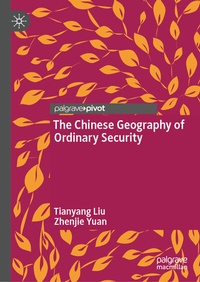
The Chinese Geography of Ordinary Security
Description

This book explores the geographies of (in-)security for ordinary Chinese. It advocates for a critical examination of the geography of Chinese school violence, arguing that schools are not simply containers for state policy but active channels through which spatial securitization and everyday violence converge. By analyzing the pervasive fear in schools, the analysis unravels the spatial dimensions of violence-its landscape, continuum, and social support networks. The narrative then shifts to public hospital spaces in China, arguing that local forms of hospital violence (known as Yi Nao) transforms these institutions into battlegrounds for moral and political resources. Contesting parties include patients, Yi Nao gangs, medical professionals, government agencies, and hospital administration. The final section demystifies security as applied to graves, often distanced from our daily existence, by adapting the cultural and spatial tenets of Feng Shui. It sheds light on the pursuit of Feng Shui-defined security during burial site selection and related conflicts in rural China. This study offers a compelling and vivid study of the ways that Chinese engage with their built environment, and will interest scholars of Asia, of geography and of politics.
More details
Other editions
Additional editions
Persons
Tianyang Liu is an Associate Professor in the School of Public Policy, Chinese University of Hong Kong (Shenzhen). He is the co-founder and director of WHU-Melbourne Study Center on Global Governance. He obtained his PhD from the University of Melbourne, Australia. He has written articles on Chinese politics, non-traditional security, social conflict and political geography. His recent publications appear in International Affairs, Political Geography, Critical Asian Studies, The Pacific Review, Terrorism and Political Violence, International Relations of the Asia-Pacific, Comunicar, Asian Studies Review, Political Studies Review, International Communication Gazette and others. In addition, he authored the book China's Soft War on Terror: Space-Making Processes of Securitisation and co-authored the book Chinese Paradiplomacy at the Peripheries: Beyond the Hinterland. He also authored two Chinese monographs.
Zhenjie Yuan is a Professor in the School of Geography and Remote Sensing at Guangzhou University. He obtained his PhD from the University of Melbourne, Australia. His research focuses on social and cultural geographies, regional development, and the geographies of infrastructure in contemporary China. His recent publications appear in prominent journals such as Transactions of the Institute of British Geographers, Journal of Ethnic and Migration Studies, Cities, Journal of Rural Studies, Political Geography, Cultural Geographies, The China Quarterly, China Information, Environment and Planning A, Eurasian Geography and Economics, Higher Education, Asian Studies Review, Journal of Multilingual and Multicultural Development and others.
Content
Chapter 1: Introduction.- Chapter 2: The Indistinction of Security: A Brief Look at Chinese Perspectives.- Chapter 3: Navigating Safety and Security: The Complex Landscape of Chinese Schools.- Chapter 4: Hospital Radicalization: The Rise of Yi Nao.- Chapter 5: Graveyard Politics: Feng Shui and rural Chinese Cemeteries.
