

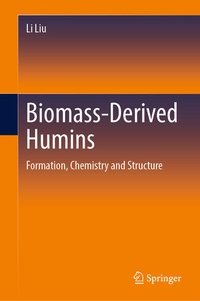
Biomass-Derived Humins
Description

This book provides a unique perspective on atom economical utilization of biomass resources into value-added productions. Humins are inevitably formed during the process of biomass conversion, which compete with desired products, restrain the activity of catalyst and hinder the recycling of catalyst and separation of products. To further improve the efficiency of biomass conversion toward downstream products, unambiguous elucidation of the chemical structure and formation mechanism of humins are prerequisite. This book primarily presents the chemical structure analysis and formation mechanism of various biomass-derived humins, from simple molecular models to raw biomass resources. The chemical similarities and differences of various biomass-derived humins have been systematically summarized according to advanced analytical interpretation, which offers a comprehensive viewpoint for readers with chemistry, engineering and material backgrounds. Furthermore, the progress that has been achieved on humins valorization and future perspectives are discussed. Given its scope, this book can be treated as an informative resource for undergraduates, postgraduates, lecturers and researchers interested in biomass conversion from academia and industry from entry to professional levels.
More details
Other editions
Additional editions
Person
Prof. Li Liu obtained her bachelor's degree from Nankai University in 1998 and completed her Ph.D. at Shanghai Institute of Organic Chemistry, CAS, in 2003. After postdoctoral research on nanotechnology in Portland State University (USA) and supramolecular chemistry in University of Cambridge (UK), she joined Dalian Institute of Chemical Physics, CAS, as an associate professor and DICP-100-talents in 2008. She moved to Dalian University of Technology in 2013, and since 2021, she was promoted to professor at Inner Mongolia University supported by Program of Higher-level Talents. Her research interests include biomass utilization, ionic liquids, supramolecular chemistry and nanotechnology. She has published 30+ papers on high impact factor journals along with eight patents.
Content
Chapter 1 Introduction.- Chapter 2 Structure and formation mechanism of 5-hydroxymethylfurfural (HMF)-derived humins.- Chapter 3 Structure and formation mechanism of furfural-derived humins.- Chapter 4 Structure and formation mechanism of glucose-derived humins.- Chapter 5 Structure and formation mechanism of xylose-derived humins.- Chapter 6 Structure and formation mechanism of cellulose-derived humins.- Chapter 7 Structure and formation mechanism of pseudo-lignin derived from lignocellulose.- Chapter 8 Analytical methods for humins characterization.- Chapter 9 Valorization of humins.- Chapter 10 Outlook and perspectives.
