

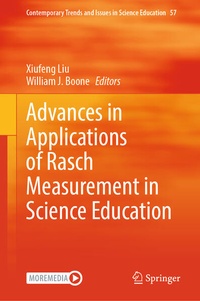
Advances in Applications of Rasch Measurement in Science Education
Description

This edited volume presents latest development in applications of Rasch measurement in science education. It includes a conceptual introduction chapter and a set of individual chapters. The introductory chapter reviews published studies applying Rasch measurement in the field of science education and identify important principles of Rasch measurement and best practices in applications of Rasch measurement in science education. The individual chapters, contributed by authors from Canada, China, Germany, Philippines and the USA, cover a variety of current topics on measurement concerning science conceptual understanding, scientific argumentation, scientific reasoning, three-dimensional learning, knowledge-in-use and cross-cutting concepts of the Next Generation Science Standards, medical education learning experiences, machine-scoring bias, formative assessment, and teacher knowledge of argument. There are additional chapters on advances in Rasch analysis techniquesand technology including R, Bayesian estimation, comparison between joint maximum likelihood (JML) and marginal maximum likelihood (MML) estimations on model-data-fit, and enhancement to Rasch models by Cognitive Diagnostic Models and Latent Class Analysis. The volume provides readers who are new and experienced in applying Rasch measurement with advanced and exemplary applications in the forefront of various areas of science education research.
More details
Other editions
Additional editions
Persons
Xiufeng Liu is a Professor of Science Education at University at Buffalo, and a Fellow of the American Association for the Advancement of Science (AAAS). He conducts research in applications of Rasch measurement in science education, particularly on conceptual learning and assessment. He is the author of Using and Developing Measurement Instruments in Science Education: A Rasch Modeling Approach (2nd Edition, IAP).
William Boone earned his Ph.D. from the University of Chicago's Program in Measurement, Evaluation and Statistical Analysis (Dept. of Education). He is the lead author of the two books- 1) Rasch Analysis in the Human Sciences, 2) Advances in Rasch Analysis in the Human Sciences. Professor Boone presents Rasch workshops throughout the world. Dr. Boone is a professor at Miami University (Oxford, Ohio, USA).
