

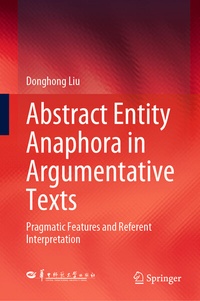
Abstract Entity Anaphora in Argumentative Texts
Description

This book focuses on abstract entity anaphora in argumentative texts with Asher's (1993) Segmented Discourse Representation Theory (SDRT) as the theoretical framework, investigating its pragmatic features and exploring its referent interpretation. The data sources include more than 160,000-word argumentative texts (80,000-word English texts and 80,000-word Chinese ones) selected from newspapers, journals, and books in China and America. At first, a comparative study was done between Chinese and English argumentative texts so as to compare the pragmatic features of abstract entity anaphora in the two languages. Then, referent interpretation is explored within the SDRT framework. Although SDRT can account for most of the instances of abstract entity anaphora, it appears incompetent in dealing with some phenomena in the data of our study. Seven problems in SDRT were found, and corresponding solutions were proposed in an attempt to improve this theory.
In general, this book hasthree aspects of significance. Firstly, it establishes abstract entity anaphora as an independent and a special kind of anaphora. Secondly, the research methods are the combination of empirical study and theoretical hypotheses as well as the coalescent of dynamic study and static study. Thirdly, the book is not limited to the application of SDRT to Mandarin Chinese and backward anaphora. Instead, based on the linguistic phenomena in the data, it challenges and improves the theory, and it even negates some aspects and meanwhile brings forward new solutions.
More details
Other editions
Additional editions
Person
Donghong Liu is a full professor in Southeast University in Nanjing, China. She obtained her Ph.D. degree from Fudan University in China, and worked in Central China Normal University before 2022. Professor Liu pursued her research in Purdue University as a Fulbright research scholar, in the University of Utah and Penn State University as a visiting scholar. Her research interests include rhetoric and composition, pragmatics, intercultural writing, and second language acquisition. She is the author of 5 monographs and has published over 60 articles in domestic and international journals. She serves as a major council member of Teaching and Researching L2 Writing of China Association and the Society of Global Rhetoric.
