

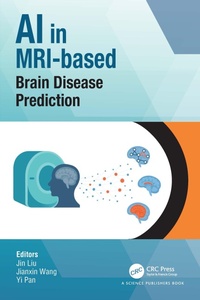
AI in MRI-based Brain Disease Prediction
Description

AI in MRI-based Brain Disease Prediction presents a comprehensive exploration of artificial intelligence technologies in the analysis of magnetic resonance imaging (MRI) for brain disease prediction. Bridging medical imaging, neuroscience, and AI, this volume covers core methodologies-such as deep learning, multimodal fusion, and fast MRI processing-and applies them to neurological disorders including Alzheimer's, Parkinson's, stroke, glioma, and autism. Featuring theoretical foundations, real-world case studies, and cutting-edge applications, the book serves as a valuable resource for researchers, clinicians, and students. It aims to foster interdisciplinary innovation and support the advancement of precision medicine in brain healthcare.
More details
Other editions
Additional editions
Persons
Jin Liu is a professor at Central South University, focusing on medical image computing and AI in neuroimaging. Jianxin Wang, also a professor at Central South University, specializes in foundational AI methods and their applications in healthcare. Yi Pan is a distinguished professor at Shenzhen Institute of Advanced Technology, focusing on core AI technologies and medical applications. Together, they bring complementary expertise to promote AI-driven innovations in brain disease prediction and neuroimaging analysis.
Content
Preface. INTRODUCTION OF BRAIN AND BRAIN MRI. Brain and Magnetic Resonance Brain Imaging. Technical Foundations. AI-Empowered Fast Magnetic Resonance Imaging. MRI-BASED BRAIN DISEASE PREDICTION. Unveiling the Interdisciplinary Landscape of Brain MRI in Ophthalmology. Brain Disease Diagnosis Through AI-MRI Integration. Advancements in Intelligent Auxiliary Diagnosis for Glioma using Multimodal MRI Images. Graph-based Deep Learning for MRI-based Brain Network Analysis. AI in Stroke Segmentation Study. Multi-Scale Feature Fusion-based Sweet Spots Localization from Microelectrode Recordings in STN-DBS Surgery. Intelligent Diagnosis and Classification of Intracerebral Hemorrhage. Prediction and Diagnosis for Autism Spectrum Disorder. Multi-Structure Segmentation for STN -DBS Surgery via Contrastive Learning. Alzheimer's Disease Diagnosis Methods Based on Biomedical Data. Applications of Hypergraph Learning for Brain Disorder Diagnosis with Neuroimaging: A Survey. Index.
