

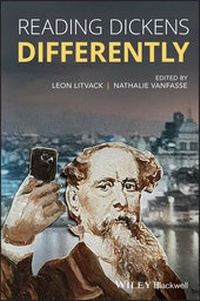
Reading Dickens Differently
Description

Reading Dickens Differently features contributions from many of the field's leading scholars, offering creative ways of reading Dickens and enriching understanding of the most celebrated author of his time. A diverse range of innovative reading strategies--archival, historical, textual, and digital--representing new and exciting approaches to contemporary literary and cultural studies. This groundbreaking volume brings together literature, history, politics, painting, illustration, social media, video games, and other topics to reveal new opportunities to engage with the author's life and work.
This unique book includes a re-evaluation of Dickens' death and burial, new research data drawn from legal records and newspapers, assessments of well-known paintings and lesser-known illustrations, experimental readings of Dickens' texts in digital form, and more. Much of the evidence presented has never been seen before, such as Dickens' funeral fee account from Westminster Abbey, Dickens' death certificate, and a telegram from Dickens' son asking for urgent assistance for his dying father. Revising and refreshing the critical strategies of traditional Dickens studies, this important volume:
* Features new research data on aspects of Dickens's life
* Discusses a range of innovative reading strategies (including physiological novel theory) for clarifying aspects of Dickens' work
* Examines the presence of Dickens in popular media and technology, such as Assassin's Creed video game and A Christmas Carol iPad app
* Features rare illustrations, including documents and images relating to Dickens's death and funeral
* Edited by world authorities on Dickens and his manuscripts
Authoritative, yet accessible, Reading Dickens Differently is a must-have book for Dickens specialists, instructors and students in Victorian fiction and Dickens courses, as well as general readers lookingfor innovative reading strategies of the author's work.
More details
Other editions
Additional editions
Persons
LEON LITVACK is Professor of Victorian Studies at Queen's University Belfast, Northern Ireland. He is Principal Editor of the Charles Dickens Letters Project and has authored numerous publications on the historical and visual approaches to Dickens.
NATHALIE VANFASSE is Professor of English at Aix-Marseille Université, France. Her monograph, La plume et la route: Charles Dickens, écrivain-voyageur was winner of the 2018 SELVA book prize.
Content
List of Figures vii
Notes on Contributors ix
Acknowledgements xiii
Abbreviations xv
Introduction 1
Leon Litvack and Nathalie Vanfasse
Part I Reconfiguring Dickens 13
1 Dickens's Burial in Westminster Abbey: The Untold Story 15
Leon Litvack
2 A Tale of Two Brothers: Reading Differently Dickens's French Revolution 47
Lillian Nayder
3 Parallel Lives, Converging Destinies: Charles Dickens and Thomas Babington Macaulay 61
David Paroissien
4 Decent Restraint Spurned: Dickens, Penal Policy and Conflict at Cold Bath Fields Prison, 1846-1850 75
Neil Davie
Part II Reincorporating Dickens 93
5 A Somatic Experience of Dickens's Fiction 95
Georges Letissier
6 Dickens and Lawrence: Mimicry, Totemism, Animism 113
Michael Hollington
7 Wreckage and Ruin: Turner, Dickens, Ruskin 125
Jeremy Tambling
8 Boz without Phiz: Reading Dickens with Different Illustrations 149
Chris Louttit
Part III Resetting Dickens 165
9 Speculation and Silence: Reading Dickens by Instalment in Time, at the Time and for Our Time 167
Pete Orford
10 Dickens Touches the Sky: Urban Exploration and London's Greatest Author 185
Gillian Piggott
11 Dickens as Icon and Antonomasia in Assassin's Creed: Syndicate 207
Francesca Orestano
12 From Movable Book to iPad App: Playing a Christmas Carol 223
Claire Wood
Index 243
1
Dickens's Burial in Westminster Abbey: The Untold Story
Leon Litvack
While Dickens's life and work have been pored over by countless biographers, his death and burial are given far more cursory treatment (see Garnett 2008, p. 107) - partly because of the apparent scarcity of verifiable detail, and also on account of the deliberate attempt, by John Forster and others, to frame the narrative in such a way as to advance, as quickly as possible, towards Poets' Corner: that national pantheon, reserved for the country's literary élite, in the south transept of Westminster Abbey.
The full story of what happened at Gad's Hill in Dickens's final hours is difficult to reconstruct; however, one important contributing factor is that Forster (his closest friend) was at the time 250 miles away, at Launceston in Cornwall (Henderson 1979, p. 36). Dickens collapsed, while at dinner, on Wednesday 8 June 1870, in the company of his sister-in-law Georgina Hogarth; she initiated a flurry of activity, which included sending for medical assistance, alerting the family, informing Wilkie Collins (another of Dickens's intimate associates; see Baker et al. 2005, 2:292), and telling the author's lover, Ellen Ternan (Storey 1939, p. 137; Adrian 1957, p. 137; Tomalin 1990, p. 275). Forster briefly recounts in his authorised Life of Charles Dickens that Dickens's daughters, Mamie and Katey (who were visiting a friend; see Storey 1939, p. 136; Mamie Dickens 1897, p. 122), arrived that night, together with the author's physician, Frank Beard (Forster 25 November 1873). They were informed by telegram (the quickest possible means), as was Charley Dickens, who arrived the following morning (Forster 1928, p. 852). Other sources reveal that the local doctor at Strood, Stephen Steele, was also fetched, by the young page-boy Isaac Armatage (E[dwards] 1931, p. 234); Steele reached Gad's Hill at 6:30 (20 minutes after the stroke) and, by his own account, "found Dickens lying on the floor of the dining room in a fit." After having him moved to a couch he "applied clysters [enemas] and other remedies to the patient without effect" (Hughes 1891, p. 244). Beard relieved Steele, and stayed with Dickens through the night, together with Georgina, Katey, and Mamie, who remembers "keeping hot bricks to the feet which nothing could warm, hoping and praying that [Dickens] might open his eyes and look at us" (Mamie Dickens 1897, p. 123). Steele returned in the morning (Thursday 9 June), and found that there was "no change in the symptoms, and stertorous [heavy] breathing, which had commenced before, now continued." While Georgina and the family were satisfied with the course of treatment, Steele thought otherwise:
I said, 'That may be so . but we have a duty to perform, not only to you, my dear madam, and the family of Mr. Dickens, but also to the public. What will the public say if we allow Charles Dickens to pass away without further medical assistance? Our advice is to send for Dr. Russell Reynolds.'
(Hughes 1891, p. 244)
Thus Charley Dickens sent a telegram (Figure 1.1) from Higham (the nearest village) to George Holsworth, at the office of All the Year Round in London, to fetch, "without losing a moment," the eminent consultant neurologist John Russell Reynolds (see Obituary 1896; Eadie 2007), as his father was "very ill" (Dickens Jr 9 June 1870). It is interesting to follow the physicians' train of thought: they recognised not only the anxiety of those assembled - Dickens's devoted sister-in-law, his children, friends, including Mary Boyle (Boyle and Boyle 1902, p. 243), and, as noted above, Ellen Ternan - but also the distress of the nation at the prospect of losing so prominent a figure without employing what would now be termed "heroic measures" - that is, extraordinary life-sustaining treatment. Rescuing Dickens for "the public" therefore became a factor in his care; but even someone as skilled and knowledgeable as Reynolds, whose "personal interest" in his patients was his guiding principle (Obituary 1896, p. 1423) could not save the dying author. Steele recalls that on seeing the patient, the neurologist concluded, "He cannot live" (Hughes 1891, p. 244). The Times records Dickens's physical state at the end: "The pupil of the right eye was much dilated, that of the left contracted, the breathing stertorous, the limbs flaccid until half an hour before death, when some convulsion occurred" (The Late 1870, p. 9). Dickens expired at about 6:10 p.m.
Figure 1.1 Telegram from Charley Dickens, Higham, to George Holsworth, All the Year Round Office, 26 Wellington St, Strand, London, 9 June 1870. The text (received at Somerset House) reads as follows: "Go without losing a moment to Russell Reynolds thirty eight Grosvenor St Grosvenor Sqr tell him to come by next train to Higham or Rochester to meet Cara Beard [sic; that is, Dickens's physician, Francis Carr Beard], at Gadshill if Reynolds not to be found go to Redcliffe [sic] twenty five Cavendish Sqr Mr Dickens very ill most urgent." "Redcliffe" is in fact Charles Bland Radcliffe (1822-1899), another eminent neurologist, who specialised in epilepsy and the electrical physiology of muscles and nerves.
By kind permission of the Guildhall Museum, Rochester.
It is important to note that medical cases like Dickens's should not be judged from a twenty-first-century perspective, where a range of effective treatments can be applied to victims of stroke. Pat Jalland usefully asserts that "Therapeutic medicine had a very limited power to cure disease" before the 1930s; nevertheless, she adds, "Upper- and middle-class Victorian families placed great reliance on their doctors while relatives were dying, despite their recognition of medicine's therapeutic weakness" (Jalland 1996, pp. 77, 81). When Reynolds submitted his fee note to Georgina, she sent it on to Dickens's solicitor, Frederic Ouvry, with a letter that began, "I enclose Dr. Reynolds' demand [of £20] for his fruitless visit" (Hogarth July 1870).
An exhaustive account of whom the family contacted first, in the hours following this momentous - though at that stage still private - event, is not discernible from existing evidence. Katey hurried to London to tell her mother (Storey 1939, p. 137), while Henry Dickens (who had been at Cambridge) arrived two hours too late, having been told the news by the porter at Higham railway station (Adrian 1957, p. 137; Curry 1988, p. 57). Letitia Austin (Dickens's surviving sister) also came. Thus by eight o'clock on the evening of 9 June word had begun to spread. The public, of course, had to be informed, though how this was effected, and by whom, is not recorded; what is now clear, though, is that one prominent person who did learn, on 9 June, of Dickens's death was the Dean of Westminster, Arthur Penrhyn Stanley.
Stanley (Figure 1.2) met Dickens on three occasions, very late on in the author's life (Adrian 1956, p. 152): at a dinner gathering in February 1870, at the Royal Academy Banquet in April (Banquet 1870, p. 10), and at the Deanery at Westminster Abbey in May. The introduction was made by Frederick Locker (later Locker-Lampson; Figure 1.3), whose first wife, Charlotte, was Stanley's sister-in-law. Locker was known as a poet and book collector; his literary friends included Thackeray, Bulwer Lytton, Wilkie Collins, George Cruikshank, Trollope and Tennyson (who was godfather to his eldest son). His reminiscences of Dickens were recorded in 1883, and published posthumously in a volume of memoirs, entitled My Confidences (1896). Locker's recollection of dates is somewhat imprecise: he writes that he first met the author in 1843 or 1844, at an Odd Fellows' club dinner; they encountered one another on several later occasions in succeeding years, including at the Athenaeum in 1848, and at the homes of Charles Knight and Richard Monckton Milnes, later Lord Houghton (Locker-Lampson 1896, pp. 319-321). Dickens and Locker corresponded in the 1850s and 1860s (Letters 6:566; 10:167) then met again after a long hiatus, in the summer of 1868, when they dined, together with Longfellow (who was visiting from America), at the home of the publisher George Routledge (Letters 12:133, 141, 143, 148).
Figure 1.2 Arthur Penrhyn Stanley, Dean of Westminster (1815-1881). Frontispiece to The Life and Correspondence of Arthur Penrhyn Stanley, vol. 1 (1893).
The pair corresponded on at least a couple of occasions in 1869 (Letters 12:366, 374), and in January 1870 Dickens wrote to Locker about the possibility of gaining an introduction to Stanley; he said, "I have the greatest respect for, and interest in, the Dean of Westminster; and should be unusually grateful to [sic] any available opportunity of knowing him better. He is to my thinking foremost among the generous and wise spirits of this time" (Letters 12:468); the origins of this admiration date from the 1840s, in...
