

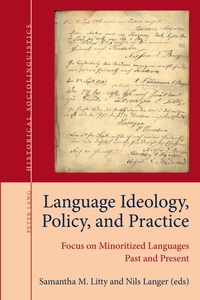
Language Ideology, Policy, and Practice
Description

This book combines studies of a broad range of minority and minoritized languages from the past and present to examine the dynamics of changes in the status of language use and language perception. They address two fundamental questions of sociolinguistics, namely,
A. How is linguistic variation at speaker and/or community level structured so that certain variants and varieties have a particular indexical value whereas others do not?
and
B. What language ideologies underpin our perceptions of the linguistic world, i.e. how do we perceive the way we speak, and/or the way other people speak, and what do we do with this perception?
Chapters include discussions of a large number of languages, some of which have largely been ignored in much scholarly discussion, such as Californian Spanish, Maritime Sign Language, or Danish and Frisian in the Duchy of Schleswig, as well as marginalized varieties of bigger languages, such as Scots or Nynorsk. The chapters, many of which were presented at the 2022 HiSoN conference in Murcia, offer insights into processes of stigmatization and promotion and offer a comprehensive comparison between seemingly different case studies focused on a core set of research questions.
More details
Other editions
Additional editions
Persons
Samantha M. Litty is a Research Associate at the Institute for Frisian Studies and Minority Research at the Europa-Universität Flensburg, where she is leading a German Research Foundation (DFG) funded project which focuses on the historically quintolingual Duchy of Schleswig.
Nils Langer is Professor of North Frisian and Minority Studies at the Europa-Universität Flensburg. He is a founding member of the Historical Sociolinguistics Network (HiSoN) and studies why people get upset about how other people speak.
