

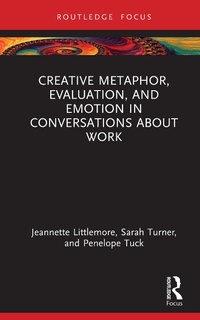
Creative Metaphor, Evaluation, and Emotion in Conversations about Work
1st Edition
Published on 6. September 2023
74 pages
978-1-000-99321-9 (ISBN)
Description

This book explores the roles played by creative and conventional metaphor in expressing positive and negative evaluation within a particular workplace, drawing on interviews with 31 current and former employees of the British Civil Service.
Metaphor is often used to express evaluation but relatively few studies have investigated the ways in which metaphor is used to evaluate personal emotionally charged experiences. The volume explores how metaphor serves a predominantly evaluative function, with creatively used metaphors often more likely than conventional metaphors to perform an evaluative function, particularly when the evaluation is negative or ambiguous. The findings provide a deeper understanding of the relationship between evaluation, creativity, and metaphor. Examples, including military metaphors and family metaphors, show how creativity often comes through subverting the norms of use of a particular metaphor category, or altering the valence from its conventional use. The study elucidates the myriad ways in which people push at the boundaries of linguistic creativity in their efforts to describe the qualitative nature of their experiences.
Demonstrating how metaphor can be a powerful tool for the nuanced expression of complex and ambiguous evaluation, this book will appeal to researchers interested in better understanding metaphor, creativity, evaluation, and workplace cultures.
Metaphor is often used to express evaluation but relatively few studies have investigated the ways in which metaphor is used to evaluate personal emotionally charged experiences. The volume explores how metaphor serves a predominantly evaluative function, with creatively used metaphors often more likely than conventional metaphors to perform an evaluative function, particularly when the evaluation is negative or ambiguous. The findings provide a deeper understanding of the relationship between evaluation, creativity, and metaphor. Examples, including military metaphors and family metaphors, show how creativity often comes through subverting the norms of use of a particular metaphor category, or altering the valence from its conventional use. The study elucidates the myriad ways in which people push at the boundaries of linguistic creativity in their efforts to describe the qualitative nature of their experiences.
Demonstrating how metaphor can be a powerful tool for the nuanced expression of complex and ambiguous evaluation, this book will appeal to researchers interested in better understanding metaphor, creativity, evaluation, and workplace cultures.
More details
Series
Edition
1. Auflage
Language
English
Place of publication
London
United Kingdom
Publishing group
Taylor & Francis Ltd
Target group
College/higher education
Product notice
Reflowable
Illustrations
13 Tables, black and white
ISBN-13
978-1-000-99321-9 (9781000993219)
Copyright in bibliographic data and cover images is held by Nielsen Book Services Limited or by the publishers or by their respective licensors: all rights reserved.
Schweitzer Classification
Other editions
Additional editions
Jeannette Littlemore | Sarah Turner | Penelope Tuck
Creative Metaphor, Evaluation, and Emotion in Conversations about Work
Book
12/2024
1st Edition
Routledge
€32.10
Available immediately
Jeannette Littlemore | Sarah Turner | Penelope Tuck
Creative Metaphor, Evaluation, and Emotion in Conversations about Work
Book
09/2023
1st Edition
Routledge
€74.90
Shipment within 10-20 days
Persons
Jeannette Littlemore is a Professor of Applied Linguistics in the Department of English Language and Linguistics at the University of Birmingham, UK. Her research focuses on the role played by creative and conventional metaphor and metonymy in the sharing of emotional experiences.
Sarah Turner is an Assistant Professor of Cognitive Linguistics in the Research Centre for Arts, Memory and Communities at Coventry University, UK. Her research focuses on the analysis of figurative language production to provide insights into physical, psychological, and social experiences.
Penelope Tuck is a Professor of Accounting, Public Finance, and Policy at Birmingham Business School, University of Birmingham, UK. Her research area is accounting from a social and institutional perspective. She focuses on engaged research and covers sites such as taxation, central government, and the health sector.
Sarah Turner is an Assistant Professor of Cognitive Linguistics in the Research Centre for Arts, Memory and Communities at Coventry University, UK. Her research focuses on the analysis of figurative language production to provide insights into physical, psychological, and social experiences.
Penelope Tuck is a Professor of Accounting, Public Finance, and Policy at Birmingham Business School, University of Birmingham, UK. Her research area is accounting from a social and institutional perspective. She focuses on engaged research and covers sites such as taxation, central government, and the health sector.
Content
Acknowledgements, 1. Chapter 1 "I'm sort of running on this soapy conveyor belt with people throwing wet sponges at me and I've got this sodding great elastic band attached to my back", Why look at creative metaphor, evaluation, and emotion in conversations about work?, The role played by metaphor in the sharing of emotional experiences, Are creative or conventional metaphors more likely to be used for evaluation?, Is (creative) metaphor more likely to be used for positive or negative evaluation?, Previous studies of the role played by metaphor in the workplace, and the approach taken in this study, A final (but important) comment on the nature of 'creative metaphor', The context of the study, Research questions, 2. Chapter 2 "I'm surprised anybody can hear anything going on for the crashing of all of these elephants in the room": Methodology and taxonomy of creative metaphor types, Introduction, Participants and interview procedure, Procedure used for the identification of metaphor, Procedure used for the identification of creative uses of metaphor and taxonomy of creative uses of metaphor, Procedure used for the identification of positive and negative evaluation, Conclusion, 3. Chapter 3 "She did the traditional sort of chuck it all up in the air, so get all the deckchairs and throw them up in the air, cause chaos for a year and a half and then leave": To what extent are creative metaphors used to perform evaluation and how do creative and conventional metaphors relate to one another?, Introduction, To what extent is metaphor used to express evaluation in conversations about work? Is the use of metaphor more likely to be associated with positive or negative evaluation? And do creative and conventional metaphor differ in terms of the extent to which they express (positive or negative) evaluation?, Which metaphors were used to perform what kinds of evaluation, and how were they employed?, Conclusion, 4. Chapter 4 Conclusion: "As people rotate round, some will spin off the merry-go-round and shoot off back to the private sector", Conclusion
