

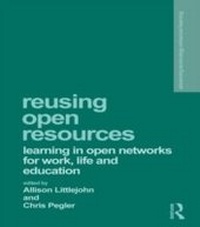
Reusing Open Resources
Learning in Open Networks for Work, Life and Education
1st Edition
Published on 17. July 2014
204 pages
978-1-135-04004-8 (ISBN)
Description

Every day, learners use and reuse open, digital resources for learning. Reusing Open Resources offers a vision of the potential of these open, online resources to support learning. The book follows on from Reusing Online Resources: A Sustainable Approach to E-learning. At that time focus was on the creation, release and reuse of digital learning resources modeled on educational materials. Since then the open release of resources and data has become mainstream, rather than specialist, changing societal expectations around resource reuse. Social and professional learning networks are now routine places for the exchange of online knowledge resources that are shared, manipulated and reused in new ways, opening opportunities for new models of business, research and learning.
The goal of this book is to extend the debate of how open, online resources might support learning across diverse contexts. Twenty-four distinguished experts from nine countries distributed across Europe and North America contribute empirical evidence and ideas. Collectively they provide a vision of the potential of open, online resources to support learning across everyday contexts of education, work and life.
The goal of this book is to extend the debate of how open, online resources might support learning across diverse contexts. Twenty-four distinguished experts from nine countries distributed across Europe and North America contribute empirical evidence and ideas. Collectively they provide a vision of the potential of open, online resources to support learning across everyday contexts of education, work and life.
Reviews / Votes
"As the use of open resources and open practices moves from a peripheral interest to mainstream practice, this book provides a timely insight into the issues and debates. It draws together an impressive range of authors to cover learning design, MOOCs, learning networks, learning analytics, OERs, and more. This range demonstrates how the open approach has successfully expanded to touch upon many aspects of academic practice. Understanding these issues is of significance to all those interested in the direction of higher education."--Martin Weller, Professor of Educational Technology, The Open University, UK
"In this collection, Allison Littlejohn and Chris Pegler have brought together leading authors in the field of online resources. The different perspectives help to clarify why and how we use and define them, and what they are, as well as the issues involved in implementations. I would recommend this book to educators and administrators interested in reusing online resources."
--Rory McGreal, UNESCO/COL/ICDE Chair in OER, Athabasca University, Canada
More details
Series
Language
English
Place of publication
London
United Kingdom
Publishing group
Taylor & Francis Ltd
Target group
College/higher education
Professional and scholarly
Illustrations
3 s/w Tabellen
3 Tables, black and white
File size
1,77 MB
ISBN-13
978-1-135-04004-8 (9781135040048)
Copyright in bibliographic data and cover images is held by Nielsen Book Services Limited or by the publishers or by their respective licensors: all rights reserved.
Schweitzer Classification
Other editions
Additional editions
Allison Littlejohn | Chris Pegler
Reusing Open Resources
Learning in Open Networks for Work, Life and Education
Book
07/2014
2nd Edition
Routledge
€75.50
Shipment within 15-20 days
Allison Littlejohn | Chris Pegler
Reusing Open Resources
Learning in Open Networks for Work, Life and Education
Book
07/2014
1st Edition
Routledge
€24.50
Shipment within 15-20 days
Persons
Professor Allison Littlejohn is Director of the Caledonian Academy and Chair of Learning Technology at Glasgow Caledonian University, UK.
Dr. Chris Pegler is a UK National Teaching Fellow and a Senior Lecturer in the Institute of Educational Technology at the Open University, UK.
Dr. Chris Pegler is a UK National Teaching Fellow and a Senior Lecturer in the Institute of Educational Technology at the Open University, UK.
Content
INTRODUCTION:
Chapter 1: Reusing Open Resources for Learning
Allison Littlejohn, Caledonian Academy, Glasgow Caledonian University and Chris Pegler, Open University (UK)
SECTION 1: Life
Chapter 2: Agoraphobia and the modern learner
Jon Dron and Terry Anderson, Athabasca University
Chapter 3: Open-sourcing personal learning
Sebastian H.D. Fiedler, Centre for Educational Technology, Tallinn University, Estonia
Chapter 4: Open networks and bounded communities: Tensions inherent in releasing Open Educational Resources
Allison Littlejohn, Isobel Falconer, Lou McGill and Helen Beetham, Caledonian Academy, Glasgow Caledonian University, UK
Chapter 5: OER: A European policy perspective
Jesus Maria Alquezar Sabadie, Jonatan Castano Munoz, Christine Redecker, Yves Punie, Riina Vuorikari, European Commission - Directorate General Education and Culture and Institute for Prospective Technological Studies (IPTS)
SECTION 2: Work
Chapter 6: Workplace Learning in Informal Networks
Colin Milligan, Allison Littlejohn, and Anoush Margaryan, Caledonian Academy, Glasgow Caledonian University, UK
Chapter 7: Challenges of Collaborative Knowledge Creation - Work with Shared Objects
Sami Paavola, University of Helsinki, Finland
Chapter 8: Open, lifewide learning: A vision
Allison Littlejohn, Isobel Falconer, Lou McGill, Caledonian Academy, Glasgow Caledonian University, UK
SECTION 3: Education
Chapter 9: Learning across Sites through Learning by Design in Use
Marisa Ponti, Department of Applied Information Technology, University of Gothenburg, and Department of Education and InterMedia, University of Oslo
Magnus Bergquist, Department of Applied Information Technology, University of Gothenburg
Ebba Ossiannilsson, Centre for Educational Development and Evaluation Office, Lund University and Oulu University
Chapter 10: Massive Open Online Courses: A traditional or transformative approach to learning?
Katie Vale, Harvard University and Allison Littlejohn, Caledonian Academy, Glasgow Caledonian University, UK
Chapter 11: Analytics for Education
Sheila MacNeill, Lorna M. Campbell and Martin Hawksey, Centre for Interoperability Standards (CETIS), UK
Chapter 12: Applying agile methods in researching open education
Patrick McAndrew, The Open University
Chapter 1: Reusing Open Resources for Learning
Allison Littlejohn, Caledonian Academy, Glasgow Caledonian University and Chris Pegler, Open University (UK)
SECTION 1: Life
Chapter 2: Agoraphobia and the modern learner
Jon Dron and Terry Anderson, Athabasca University
Chapter 3: Open-sourcing personal learning
Sebastian H.D. Fiedler, Centre for Educational Technology, Tallinn University, Estonia
Chapter 4: Open networks and bounded communities: Tensions inherent in releasing Open Educational Resources
Allison Littlejohn, Isobel Falconer, Lou McGill and Helen Beetham, Caledonian Academy, Glasgow Caledonian University, UK
Chapter 5: OER: A European policy perspective
Jesus Maria Alquezar Sabadie, Jonatan Castano Munoz, Christine Redecker, Yves Punie, Riina Vuorikari, European Commission - Directorate General Education and Culture and Institute for Prospective Technological Studies (IPTS)
SECTION 2: Work
Chapter 6: Workplace Learning in Informal Networks
Colin Milligan, Allison Littlejohn, and Anoush Margaryan, Caledonian Academy, Glasgow Caledonian University, UK
Chapter 7: Challenges of Collaborative Knowledge Creation - Work with Shared Objects
Sami Paavola, University of Helsinki, Finland
Chapter 8: Open, lifewide learning: A vision
Allison Littlejohn, Isobel Falconer, Lou McGill, Caledonian Academy, Glasgow Caledonian University, UK
SECTION 3: Education
Chapter 9: Learning across Sites through Learning by Design in Use
Marisa Ponti, Department of Applied Information Technology, University of Gothenburg, and Department of Education and InterMedia, University of Oslo
Magnus Bergquist, Department of Applied Information Technology, University of Gothenburg
Ebba Ossiannilsson, Centre for Educational Development and Evaluation Office, Lund University and Oulu University
Chapter 10: Massive Open Online Courses: A traditional or transformative approach to learning?
Katie Vale, Harvard University and Allison Littlejohn, Caledonian Academy, Glasgow Caledonian University, UK
Chapter 11: Analytics for Education
Sheila MacNeill, Lorna M. Campbell and Martin Hawksey, Centre for Interoperability Standards (CETIS), UK
Chapter 12: Applying agile methods in researching open education
Patrick McAndrew, The Open University
