

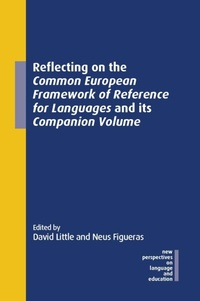
Reflecting on the Common European Framework of Reference for Languages and its Companion Volume
Published on 2. March 2022
232 pages
978-1-80041-021-3 (ISBN)
Description

The Common European Framework of Reference for Languages (CEFR) and its Companion Volume have established themselves as an indispensable reference point for all aspects of second and foreign language education. This book discusses the impact of the CEFR on curricula, teaching/learning and assessment in a wide range of educational contexts, identifies challenges posed by the Companion Volume and sheds light on areas that require further research and development. Particular attention is paid to three features of the two documents: their action-oriented approach, their focus on plurilingualism, and the potential of their scales and descriptors to support the alignment of curricula, teaching/learning and assessment. The book suggests a way forward for future engagement with the CEFR, taking account of new developments in applied linguistics and related disciplines.
Reviews / Votes
The authors of the different chapters are experienced users of the CEFR who provide a wide range of contrasting and complementary perspectives. Their contributions demonstrate the open, dynamic nature of the reference instrument, and while the book adopts a positive approach to the CEFR and the CV, the authors also point to issues that require further work. This publication is a timely reminder of the challenges in implementing plurilingual and intercultural education and the further potential of the CEFR and CV in that regard. * Joe Sheils, formerly Head of the Language Policy Division, Council of Europe * This edited volume provides a useful account of the application of the key concepts discussed in the CEFR, such as emphasis on the role of the learner as an active user of the language, rather than a passive receiver of language instruction, plurilingualism, and mediation. The chapters in this book can help educators explore the full potential of the application of the CEFR in their own language teaching and assessment contexts. * Spiros Papageorgiou, Educational Testing Service * The scope and depth of this timely volume are impressive, and every researcher working with some aspect of the CEFR will find at least a few chapters to be of direct relevance. The richness of this book extends to the range of viewpoints that are given a forum. The editorial decision to leave room for contrasting viewpoints allows for a substantive discussion of the benefits and drawbacks of the CEFR and its Companion Volume. * Bart Deygers, Ghent University, Belgium *More details
Series
Language
English
Place of publication
Bristol
United Kingdom
Target group
College/higher education
Product notice
Reflowable
ISBN-13
978-1-80041-021-3 (9781800410213)
Copyright in bibliographic data and cover images is held by Nielsen Book Services Limited or by the publishers or by their respective licensors: all rights reserved.
Schweitzer Classification
Other editions
Additional editions
David Little | Neus Figueras
Reflecting on the Common European Framework of Reference for Languages and its Companion Volume
Book
03/2022
Multilingual Matters
€48.20
Shipment within 10-20 days
Persons
David Little is a Fellow Emeritus of Trinity College Dublin, Ireland. He has been a regular contributor to the Council of Europe's language education projects since the 1980s. In 2010, the National University of Ireland awarded him an honorary doctorate in recognition of his contribution to language education in Ireland and further afield.
Neus Figueras coordinated the development of foreign language curricula and certificate examinations for adult language learners in the Catalan ministry of education in Spain for over 20 years. She has been involved in international projects and collaborated with the Council of Europe in the dissemination of the CEFR. She was one of the authors of the Manual for Relating Examinations to the CEFR (Council of Europe, 2009).
Neus Figueras coordinated the development of foreign language curricula and certificate examinations for adult language learners in the Catalan ministry of education in Spain for over 20 years. She has been involved in international projects and collaborated with the Council of Europe in the dissemination of the CEFR. She was one of the authors of the Manual for Relating Examinations to the CEFR (Council of Europe, 2009).
Content
Acknowledgements
Contributors
David Little and Neus Figueras: Introduction
Part 1: The Common European Framework of Reference for Languages: Past, Present and Future
David Little: Introduction
Chapter 1. Masashi Negishi: The Impact of The CEFR in Japan
Chapter 2. Margaret E. Malone: ACTFL and CEFR: Relationships, Influences and Looking Forward
Chapter 3. Brian North: The CEFR Companion Volume Project: What Has Been Achieved
Part 2: The Action-oriented Approach: A Change of Paradigm?
David Little: Introduction
Chapter 4. John H.A.L. de Jong: The Action-oriented Approach and Language Testing: A Critical View
Chapter 5. Mark Levy and Neus Figueras: The Action-Oriented Approach in The CEFR and The CEFR Companion Volume: A Change of Paradigm(s)? A Case Study from Spain
Chapter 6. Constant Leung: Action-oriented Plurilingual Mediation: A Search for Fluid Foundations
Part 3: Plurilingualism, Plurilingual Education and Mediation
David Little: Introduction
Chapter 7. Bessie Dendrinos: A Data-driven Curriculum with Mediation Descriptors for Plurilingual Education
Chapter 8. Peter Lenz: Some Thoughts about the Testing of Mediation
Chapter 9. Deirdre Kirwan and David Little: Implementing Plurilingual Education: The Experience of an Irish Primary School
Part 4: Descriptors, Scales and Constructive Alignment
David Little: Introduction
Chapter 10. Armin Berger: Refining the Vertical Axis of the CEFR for Classroom Purposes: Local Reference Points
Chapter 11. Elaine Boyd: Commonality versus Localization in Curricula
Chapter 12. Elif Kantarcioglu: The CEFR Companion Volume and Mediation: An Assessment Perspective
Part 5: Afterword
Chapter 13. Barry O'Sullivan: Making the CEFR Work: Considerations for a Future Roadmap
Index
Contributors
David Little and Neus Figueras: Introduction
Part 1: The Common European Framework of Reference for Languages: Past, Present and Future
David Little: Introduction
Chapter 1. Masashi Negishi: The Impact of The CEFR in Japan
Chapter 2. Margaret E. Malone: ACTFL and CEFR: Relationships, Influences and Looking Forward
Chapter 3. Brian North: The CEFR Companion Volume Project: What Has Been Achieved
Part 2: The Action-oriented Approach: A Change of Paradigm?
David Little: Introduction
Chapter 4. John H.A.L. de Jong: The Action-oriented Approach and Language Testing: A Critical View
Chapter 5. Mark Levy and Neus Figueras: The Action-Oriented Approach in The CEFR and The CEFR Companion Volume: A Change of Paradigm(s)? A Case Study from Spain
Chapter 6. Constant Leung: Action-oriented Plurilingual Mediation: A Search for Fluid Foundations
Part 3: Plurilingualism, Plurilingual Education and Mediation
David Little: Introduction
Chapter 7. Bessie Dendrinos: A Data-driven Curriculum with Mediation Descriptors for Plurilingual Education
Chapter 8. Peter Lenz: Some Thoughts about the Testing of Mediation
Chapter 9. Deirdre Kirwan and David Little: Implementing Plurilingual Education: The Experience of an Irish Primary School
Part 4: Descriptors, Scales and Constructive Alignment
David Little: Introduction
Chapter 10. Armin Berger: Refining the Vertical Axis of the CEFR for Classroom Purposes: Local Reference Points
Chapter 11. Elaine Boyd: Commonality versus Localization in Curricula
Chapter 12. Elif Kantarcioglu: The CEFR Companion Volume and Mediation: An Assessment Perspective
Part 5: Afterword
Chapter 13. Barry O'Sullivan: Making the CEFR Work: Considerations for a Future Roadmap
Index
