

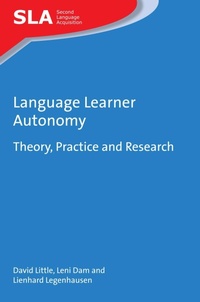
Language Learner Autonomy
Theory, Practice and Research
Published on 25. September 2017
280 pages
978-1-78309-861-3 (ISBN)
Description

This is the first book on language learner autonomy to combine comprehensive accounts of classroom practice with empirical and case-study research and a wide-ranging engagement with applied linguistic and pedagogical theory. It provides a detailed description of an autonomy classroom in action, focusing on Danish mixed-ability learners of English at lower secondary level, and reports the findings of a longitudinal research project that explored the learning achievement over four years of one class in the same Danish school. It also presents two learner case studies to show that the autonomy classroom responds to the challenges of differentiation and inclusion, and two institutional case studies that illustrate the power of autonomous learning to support the social inclusion of adult refugees and the educational inclusion of immigrant children. The concluding chapter offers some reflections on teacher education for language learner autonomy. Each chapter ends with discussion points and suggestions for further reading.
Reviews / Votes
This book connects theory and practice in a way that is rare in writing about language learner autonomy. Based on more than 25 years of research and practice, it is an invaluable source on strategies for autonomy in the language classroom. Chapters on autonomy and inclusion extend our understanding of strategies for teaching students with behavioural difficulties and new migrants. * Phil Benson, Macquarie University, Australia * At last, we have a book-length synthesis of a longstanding and hugely influential body of work on language learner autonomy. Firmly grounded in accounts of actual classrooms and rich in illustrative detail and empirical evidence, the book integrates theory, practice, research, and teacher education in a clear, coherent and compelling manner. * Ema Ushioda, University of Warwick, UK * A rich resource for language teachers, language teacher educators, and researchers! Detailed descriptions of successful autonomous learning techniques and materials (extremely useful for practitioners) are followed by insights into the theoretical framework and research basis of language learner autonomy. Practical examples for preparing teachers to create an autonomy classroom are especially welcome. * Anna Uhl Chamot, The George Washington University, USA * Language Learner Autonomy is a refreshing take on a topic which has been debated and discussed for a long time. The authors are clearly passionate about what they feel is the best way for achieving autonomous learning. The book is a very worthwhile read for anyone involved in language education and offers much food for thought on the role we assign to learners for their own learning. -- Rory O'Kane, EAP teacher at IIBIT, Adelaide, Australia * IATEFL Voices, 266, January/February 2019 * This is an excellent book and one that will become a key reference for language teachers and researchers. It draws upon years of dedicated practice, research and collaborative theorising. It shares some important and compelling theoretical ideas supported by research-based principles and practical applications. In addition, it suggests some future directions. -- Jo Mynard, Kanda University of International Studies, Japan * SiSAL Journal Vol. 8, No. 4, December 2017 * For readers who are seeking to find answers to widespread educational challenges such as lack of learners' motivation, low TL proficiency achievements or the inclusion of students with different educational needs, this is a must-read book. -- Mariangel Carreno, Universidad Interamericana de Puerto Rico - Ponce * LINGUIST List 29.3214 *More details
Series
Language
English
Place of publication
Bristol
United Kingdom
Publishing group
Channel View Publications Ltd
Target group
College/higher education
Product notice
Reflowable
ISBN-13
978-1-78309-861-3 (9781783098613)
Copyright in bibliographic data and cover images is held by Nielsen Book Services Limited or by the publishers or by their respective licensors: all rights reserved.
Schweitzer Classification
Other editions
Additional editions
David Little | Leni Dam | Lienhard Legenhausen
Language Learner Autonomy
Theory, Practice and Research
Book
09/2017
Multilingual Matters
€56.20
Shipment within 10-20 days
Persons
David Little is Associate Professor Emeritus and Fellow Emeritus at Trinity College Dublin, Ireland. He has been a regular contributor to the Council of Europe's language education projects since the 1980s. In 2010, the National University of Ireland awarded him an honorary doctorate in recognition of his contribution to language education in Ireland and further afield.
Leni Dam works as a freelance pedagogical advisor for pre- and in-service language teachers. She is a committee member of the Learner Autonomy Special Interest Group within IATEFL. In 2004, she received an honorary doctorate in pedagogy from Karlstad University, Sweden in recognition of her innovative work in language teaching.
Lienhard Legenhausen is Professor Emeritus, Westfaelische Wilhelms-Universitaet Muenster, Germany and Visiting Professor, National Bohdan Khmelnytsky University of Cherkasy, Ukraine. He is a committee member of IATEFL's Learner Autonomy Special Interest Group.
Leni Dam works as a freelance pedagogical advisor for pre- and in-service language teachers. She is a committee member of the Learner Autonomy Special Interest Group within IATEFL. In 2004, she received an honorary doctorate in pedagogy from Karlstad University, Sweden in recognition of her innovative work in language teaching.
Lienhard Legenhausen is Professor Emeritus, Westfaelische Wilhelms-Universitaet Muenster, Germany and Visiting Professor, National Bohdan Khmelnytsky University of Cherkasy, Ukraine. He is a committee member of IATEFL's Learner Autonomy Special Interest Group.
Content
Preface
Introduction
Part I: The Autonomy Classroom In Practice: An Example From Lower Secondary Education
1. Using the Target Language: Spontaneity, Identity, Authenticity
2. Interaction and Collaboration: The Dialogic Construction of Knowledge
3. Letting Go and Taking Hold: Giving Control to the Learners
4. Evaluation: The Hinge on Which Learner Autonomy Turns
Part II: Language Learner Autonomy: Evidence Of Success
5. Exploring Learning Outcomes: Some Research Findings
6. Language Learner Autonomy and Inclusion: Two Case Studies
Part III: Language Learner Autonomy: Meeting Future Challenges
7. The Linguistic, Social and Educational Inclusion of Immigrants: A New Challenge for Language Learner Autonomy
8. Teacher Education for Language Learner Autonomy: Some Reflections and Proposals
Conclusion
References
Introduction
Part I: The Autonomy Classroom In Practice: An Example From Lower Secondary Education
1. Using the Target Language: Spontaneity, Identity, Authenticity
2. Interaction and Collaboration: The Dialogic Construction of Knowledge
3. Letting Go and Taking Hold: Giving Control to the Learners
4. Evaluation: The Hinge on Which Learner Autonomy Turns
Part II: Language Learner Autonomy: Evidence Of Success
5. Exploring Learning Outcomes: Some Research Findings
6. Language Learner Autonomy and Inclusion: Two Case Studies
Part III: Language Learner Autonomy: Meeting Future Challenges
7. The Linguistic, Social and Educational Inclusion of Immigrants: A New Challenge for Language Learner Autonomy
8. Teacher Education for Language Learner Autonomy: Some Reflections and Proposals
Conclusion
References
