

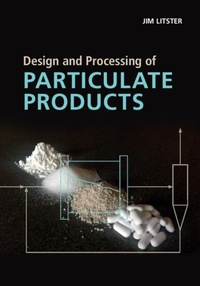
Design and Processing of Particulate Products
Published on 5. October 2016
978-1-316-72855-0 (ISBN)
Description

With this unique and comprehensive text, readers will gain the quantitative tools needed to engineer the particulate processes and products that are ubiquitous in modern life. Covering a series of particle and particulate delivery form design processes, with emphasis on design and operation to control particle attributes, and supported by many worked examples, it is essential reading for students and practitioners. Topics covered include a range of particle design processes such as crystallization and precipitation, granulation, grinding, aerosol processes and spray drying, as well as forms of delivery such as granules, tablets, dry powders, and aerosols. Readers will learn from real-world examples how the primary particle properties and the structure and properties of the delivery form can lead to high performance products, ranging from pharmaceuticals, consumer goods and foods, to specialty chemicals, paints, agricultural chemicals and minerals.
Reviews / Votes
'Jim has a clear and unique way of teaching that is both academically and industrially valuable. In this book, Jim has taken the next step in producing a textbook that provides both the background science and engineering required to work in this area and provides numerous practical examples of how the real-world engineer needs to work through practical everyday problems. In industry we are always looking for the bright new engineer who can step into a role of a practical problem solver, but how is that normally possible when a new engineer has no concept of what industrial particle processing is or practice in solving problems in this area? Jim's book is a great start in overviewing and teaching this broad field and providing great, concrete examples on how to solve the exact problems that the new and seasoned engineer will face. This book grasps the challenges of particle processing and engineering and teaches the reader to be a better engineer.' W. A. Hendrickson, President of IFPRI '... provides an excellent introduction to particulate manufacturing processes suitable for any engineer starting out in this area. In particular, I would strongly recommend this book if you are starting a research project in this area, as it will provide you with a solid foundation from which to progress in terms of your knowledge. 5 stars.' Christopher Hewitt, The Chemical Engineer 'This volume is a short and readable text on the subject of particulates and particulate delivery. Within the field of engineering, it takes an interdisciplinary approach to particulate characteristics, formation, and applications, with a focus on materials custom-designed for specific tasks. Furthermore, it addresses both process and product design approaches, encouraging students to think about designing particles for specific functions, while considering issues of efficiency in long-term and large-scale creation of the desired materials. Each chapter begins with a case study and then moves through short sections of learning goals, specific lessons, a summary, a bibliography, and problem sets illustrated sparingly with graphs, tables, and occasional images. Given the specialized nature of the text, its usefulness in a collection will be determined by the needs of the users. This volume will serve as an excellent reference book, as well as a strong textbook for a course on the subject.' CHOICEMore details
Series
Language
English
Place of publication
Cambridge
United Kingdom
Publishing group
Cambridge University Press
Target group
Professional and scholarly
Illustrations
38 Tables, black and white; 35 Halftones, black and white; 122 Line drawings, black and white
File size
21251,40 MB
ISBN-13
978-1-316-72855-0 (9781316728550)
Copyright in bibliographic data and cover images is held by Nielsen Book Services Limited or by the publishers or by their respective licensors: all rights reserved.
Schweitzer Classification
Other editions
Additional editions
Jim Litster
Design and Processing of Particulate Products
Book
10/2016
Cambridge University Press
€143.00
Shipment within 15-20 days
Person
Jim Litster is Professor of Chemical and Pharmaceutical Engineering at the University of Sheffield. His research area is Particulate Products and Processes, and he is an international leading expert on wet granulation with over 30 years of experience in the field. In recognition of his contribution to the field, he was elected a Fellow of the Australian Academy of Technological Sciences and Engineering in 2010, was awarded the Thomas Barron Award in Fluid-Particle Systems from the American Institute of Chemical Engineers in 2012, and received the Pharmaceutical Discovery, Development and Manufacturing Forum Award from the American Institute of Chemical Engineers in 2015.
Content
1. Introduction; 2. Particle characterization and particle property distributions; 3. The population balance; 4. Crystallization and precipitation; 5. Particle size reduction; 6. Aerosol processes; 7. Spray drying and spray cooling; 8. Wet granulation; 9. Strength, breakage and attrition of particulate delivery forms; 10. Dispersion, disintegration and dissolution.
