

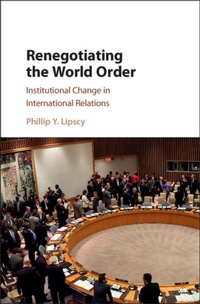
Renegotiating the World Order
Institutional Change in International Relations
Published on 26. May 2017
978-1-108-11067-9 (ISBN)
Description

Rising powers often seek to reshape the world order, triggering confrontations with those who seek to defend the status quo. In recent years, as international institutions have grown in prevalence and influence, they have increasingly become central arenas for international contestation. Phillip Y. Lipscy examines how international institutions evolve as countries seek to renegotiate the international order. He offers a new theory of institutional change and explains why some institutions change flexibly while others successfully resist or fall to the wayside. The book uses a wealth of empirical evidence - quantitative and qualitative - to evaluate the theory from international organizations such as the International Monetary Fund, World Bank, European Union, League of Nations, United Nations, the International Telecommunications Satellite Organization, and the Internet Corporation for Assigned Names and Numbers. The book will be of particular interest to scholars interested in the historical and contemporary diplomacy of the United States, Japan, and China.
Reviews / Votes
'Phillip Y. Lipscy shows, using rationalist theory, that variation in competition among international institutions explains variation in their willingness to undergo fundamental institutional change. Renegotiating the World Order is a theoretically innovative and empirically impressive book on an important topic.' Robert O. Keohane, Princeton University, New Jersey 'Why is it that some international institutional arrangements respond in flexible ways to changes in the distribution of power whereas others do not? Lipscy offers an original and persuasive answer to this question that troubles both policymakers and theorists. This book is a must read for anyone interested in understanding the past and future of international organizations.' Eric Voeten, Georgetown University, Washington DC 'How will rising states such at Brazil, China, and India seek to reshape the global order? Will they be responsible stakeholders working within the existing Western-led order, or will they be revisionists seeking to overturn it? ... Lipscy provides the most elegant and systematic explanation yet for these diverse and shifting choices.' G. John Ikenberry, Foreign Affairs 'Lipscy's book provides well-written historical accounts with a compelling theory that provides both an academic case as well as fruitful insight for policy-makers.' Felicity Vabulas, Review of International OrganizationsMore details
Language
English
Place of publication
Cambridge
United Kingdom
Target group
Professional and scholarly
Illustrations
Worked examples or Exercises; 32 Line drawings, black and white
File size
6,77 MB
ISBN-13
978-1-108-11067-9 (9781108110679)
Copyright in bibliographic data and cover images is held by Nielsen Book Services Limited or by the publishers or by their respective licensors: all rights reserved.
Schweitzer Classification
Other editions
Additional editions
Book
06/2017
Cambridge University Press
€111.50
Shipment within 15-20 days
Person
Phillip Y. Lipscy is Assistant Professor of Political Science, Stanford University, California and the Thomas Rohlen Center Fellow at the Freeman Spogli Institute for International Studies. His fields of research include international relations, international organizations, international and comparative political economy, and the politics of East Asia, particularly Japan. Lipscy obtained his Ph.D. in political science at Harvard University, Massachusetts and his M.A. in international policy studies and B.A. in economics and political science at Stanford University, California.
Content
1. Introduction; 2. A theory of institutional change; 3. The International Monetary Fund and the World Bank; 4. Japan in the International Monetary Fund and the World Bank; 5. INTELSAT; 6. ICANN; 7. The League of Nations and the United Nations Security Council; 8. Policy area discipline: development institutions and regional integration projects; 9. China-Taiwan competition over international organizations: a placebo test; 10. Conclusion.
