

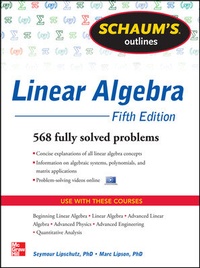
Schaum's Outline of Linear Algebra, 5th Edition
568 Solved Problems + 25 Videos
5th Edition
Published on 16. January 2013
633 pages
978-0-07-179457-2 (ISBN)
Description

Tough Test Questions? Missed Lectures? Not Enough Time?Fortunately, there's Schaum's. This all-in-one-package includes 612 fully solved problems, examples, and practice exercises to sharpen your problem-solving skills. Plus, you will have access to 25 detailed videos featuring Math instructors who explain how to solve the most commonly tested problems--it's just like having your own virtual tutor! You'll find everything you need to build confidence, skills, and knowledge for the highest score possible.More than 40 million students have trusted Schaum's to help them succeed in the classroom and on exams. Schaum's is the key to faster learning and higher grades in every subject. Each Outline presents all the essential course information in an easy-to-follow, topic-by-topic format. You also get hundreds of examples, solved problems, and practice exercises to test your skills.This Schaum's Outline gives you - 612 fully solved problems
- Concise explanations of all course concepts
- Support for all major textbooks for linear algebra courses
Fully compatible with your classroom text, Schaum's highlights all the important facts you need to know. Use Schaum's to shorten your study time--and get your best test scores!
- Concise explanations of all course concepts
- Support for all major textbooks for linear algebra courses
Fully compatible with your classroom text, Schaum's highlights all the important facts you need to know. Use Schaum's to shorten your study time--and get your best test scores!
More details
Other editions
Additional editions
Book
12/2012
5th Edition
McGraw-Hill Professional
€23.51
Article exhausted; check for reprint
Persons
Content
- Cover Page
- SCHAUM'S outlines® Linear Algebra, Fifth Edition
- Copyright Page
- Preface
- List of Symbols
- Contents
- Chapter 1 Vectors in Rn and Cn, Spatial Vectors
- 1.1 Introduction
- 1.2 Vectors in Rn
- 1.3 Vector Addition and Scalar Multiplication
- 1.4 Dot (Inner) Product
- 1.5 Located Vectors, Hyperplanes, Lines, Curves in Rn
- 1.6 Vectors in R3 (Spatial Vectors), ijk Notation
- 1.7 Complex Numbers 1.8 Vectors in Cn
- Chapter 2 Algebra of Matrices
- 2.1 Introduction
- 2.2 Matrices
- 2.3 Matrix Addition and Scalar Multiplication
- 2.4 Summation Symbol
- 2.5 Matrix Multiplication
- 2.6 Transpose of a Matrix
- 2.7 Square Matrices
- 2.8 Powers of Matrices, Polynomials in Matrices
- 2.9 Invertible (Nonsingular) Matrices
- 2.10 Special Types of Square Matrices
- 2.11 Complex Matrices
- 2.12 Block Matrices
- Chapter 3 Systems of Linear Equations
- 3.1 Introduction
- 3.2 Basic Definitions, Solutions
- 3.3 Equivalent Systems, Elementary Operations
- 3.4 Small Square Systems of Linear Equations
- 3.5 Systems in Triangular and Echelon Forms
- 3.6 Gaussian Elimination
- 3.7 Echelon Matrices, Row Canonical Form, Row Equivalence
- 3.8 Gaussian Elimination, Matrix Formulation
- 3.9 Matrix Equation of a System of Linear Equations
- 3.10 Systems of Linear Equations and Linear Combinations of Vectors
- 3.11 Homogeneous Systems of Linear Equations
- 3.12 Elementary Matrices
- 3.13 LU Decomposition
- Chapter 4 Vector Spaces
- 4.1 Introduction
- 4.2 Vector Spaces
- 4.3 Examples of Vector Spaces
- 4.4 Linear Combinations, Spanning Sets
- 4.5 Subspaces
- 4.6 Linear Spans, Row Space of a Matrix
- 4.7 Linear Dependence and Independence
- 4.8 Basis and Dimension
- 4.9 Application to Matrices, Rank of a Matrix
- 4.10 Sums and Direct Sums
- 4.11 Coordinates
- Chapter 5 Linear Mappings
- 5.1 Introduction
- 5.2 Mappings, Functions
- 5.3 Linear Mappings (Linear Transformations)
- 5.4 Kernel and Image of a Linear Mapping
- 5.5 Singular and Nonsingular Linear Mappings, Isomorphisms
- 5.6 Operations with Linear Mappings
- 5.7 Algebra A(V) of Linear Operators
- Chapter 6 Linear Mappings and Matrices
- 6.1 Introduction
- 6.2 Matrix Representation of a Linear Operator
- 6.3 Change of Basis
- 6.4 Similarity
- 6.5 Matrices and General Linear Mappings
- Chapter 7 Inner Product Spaces, Orthogonality
- 7.1 Introduction
- 7.2 Inner Product Spaces
- 7.3 Examples of Inner Product Spaces
- 7.4 Cauchy-Schwarz Inequality, Applications
- 7.5 Orthogonality
- 7.6 Orthogonal Sets and Bases
- 7.7 Gram-Schmidt Orthogonalization Process
- 7.8 Orthogonal and Positive Definite Matrices
- 7.9 Complex Inner Product Spaces
- 7.10 Normed Vector Spaces (Optional)
- Chapter 8 Determinants
- 8.1 Introduction
- 8.2 Determinants of Orders 1 and 2
- 8.3 Determinants of Order 3
- 8.4 Permutations
- 8.5 Determinants of Arbitrary Order
- 8.6 Properties of Determinants
- 8.7 Minors and Cofactors
- 8.8 Evaluation of Determinants
- 8.9 Classical Adjoint
- 8.10 Applications to Linear Equations, Cramer's Rule
- 8.11 Submatrices, Minors, Principal Minors
- 8.12 Block Matrices and Determinants
- 8.13 Determinants and Volume
- 8.14 Determinant of a Linear Operator
- 8.15 Multilinearity and Determinants
- Chapter 9 Diagonalization: Eigenvalues and Eigenvectors
- 9.1 Introduction
- 9.2 Polynomials of Matrices
- 9.3 Characteristic Polynomial, Cayley-Hamilton Theorem
- 9.4 Diagonalization, Eigenvalues and Eigenvectors
- 9.5 Computing Eigenvalues and Eigenvectors, Diagonalizing Matrices
- 9.6 Diagonalizing Real Symmetric Matrices and Quadratic Forms
- 9.7 Minimal Polynomial
- 9.8 Characteristic and Minimal Polynomials of Block Matrices
- Chapter 10 Canonical Forms
- 10.1 Introduction
- 10.2 Triangular Form
- 10.3 Invariance
- 10.4 Invariant Direct-Sum Decompositions
- 10.5 Primary Decomposition
- 10.6 Nilpotent Operators
- 10.7 Jordan Canonical Form
- 10.8 Cyclic Subspaces
- 10.9 Rational Canonical Form
- 10.10 Quotient Spaces
- Chapter 11 Linear Functionals and the Dual Space
- 11.1 Introduction
- 11.2 Linear Functionals and the Dual Space
- 11.3 Dual Basis
- 11.4 Second Dual Space
- 11.5 Annihilators
- 11.6 Transpose of a Linear Mapping
- Chapter 12 Bilinear, Quadratic, and Hermitian Forms
- 12.1 Introduction
- 12.2 Bilinear Forms
- 12.3 Bilinear Forms and Matrices
- 12.4 Alternating Bilinear Forms
- 12.5 Symmetric Bilinear Forms, Quadratic Forms
- 12.6 Real Symmetric Bilinear Forms, Law of Inertia
- 12.7 Hermitian Forms
- Chapter 13 Linear Operators on Inner Product Spaces
- 13.1 Introduction
- 13.2 Adjoint Operators
- 13.3 Analogy Between A(V) and C, Special Linear Operators
- 13.4 Self-Adjoint Operators
- 13.5 Orthogonal and Unitary Operators
- 13.6 Orthogonal and Unitary Matrices
- 13.7 Change of Orthonormal Basis
- 13.8 Positive Definite and Positive Operators
- 13.9 Diagonalization and Canonical Forms in Inner Product Spaces
- 13.10 Spectral Theorem
- Appendix A Multilinear Products
- Appendix B Algebraic Structures
- Appendix C Polynomials over a Field
- Appendix D Odds and Ends
- Index
