

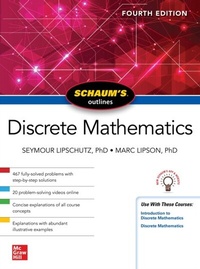
Schaum's Outline of Discrete Mathematics, Fourth Edition
1st Edition
Published on 30. November 2021
512 pages
978-1-264-25881-9 (ISBN)
Available for download
Description

Study smarter and stay on top of your discrete mathematics course with the bestselling Schaum's Outline-now with the NEW Schaum's app and website! Schaum s Outline of Discrete Mathematics, Fourth Edition is the go-to study guide for more than 115,000 math majors and first- and second-year university students taking basic computer science courses. With an outline format that facilitates quick and easy review, Schaum s Outline of Discrete Mathematics, Fourth Edition helps you understand basic concepts and get the extra practice you need to excel in these courses.Coverage includes set theory, relations, functions and algorithms, logic and propositional calculus, techniques of counting, advanced counting techniques, recursion, probability, graph theory, directed graphs, binary trees, properties of the integers, languages, automata, machines, finite state machines and Turning machines, ordered sets and lattices, and Boolean algebra.Features NEW to this edition: the new Schaum s app and website! NEW to this edition: 20 NEW problem-solving videos online 467 solved problems, and hundreds of additional practice problems Outline format to provide a concise guide to the standard college course in discrete mathematics Clear, concise explanations of discrete mathematics concepts Expanded coverage of logic, the rules of inference and basic types of proofs in mathematical reasoning Increased emphasis on discrete probability and aspects of probability theory, and greater accessibility to counting techniques. Logic chapter emphasizes the IF-THEN and IF-THEN-ELSE sequencing that occurs in computer programming Computer arithmetic chapter covers binary and hexagon addition and multiplication Cryptology chapter includes substitution and RSA method Supports these major texts: Discrete Mathematics and Its Applications (Rosen), and Discrete Mathematics (Epp) Appropriate for the following courses: Introductory Discrete Mathematics and Discrete Mathematics
More details
Other editions
Additional editions
Seymour Lipschutz | Marc Lipson
Schaum's Outline of Discrete Mathematics, Fourth Edition
Book
12/2021
4th Edition
McGraw-Hill Education
€21.29
Available immediately
Content
- Cover
- Title Page
- Copyright Page
- Preface
- Contents
- CHAPTER 1 Set Theory
- 1.1 Introduction
- 1.2 Sets and Elements, Subsets
- 1.3 Venn Diagrams
- 1.4 Set Operations
- 1.5 Algebra of Sets, Duality
- 1.6 Finite Sets, Counting Principle
- 1.7 Classes of Sets, Power Sets, Partitions
- 1.8 Mathematical Induction
- Solved Problems
- Supplementary Problems
- CHAPTER 2 Relations
- 2.1 Introduction
- 2.2 Product Sets
- 2.3 Relations
- 2.4 Pictorial Representatives of Relations
- 2.5 Composition of Relations
- 2.6 Types of Relations
- 2.7 Closure Properties
- 2.8 Equivalence Relations
- 2.9 Partial Ordering Relations
- Solved Problems
- Supplementary Problems
- CHAPTER 3 Functions and Algorithms
- 3.1 Introduction
- 3.2 Functions
- 3.3 One-to-One, Onto, and Invertible Functions
- 3.4 Mathematical Functions, Exponential and Logarithmic Functions
- 3.5 Sequences, Indexed Classes of Sets
- 3.6 Recursively Defined Functions
- 3.7 Cardinality
- 3.8 Algorithms and Functions
- 3.9 Complexity of Algorithms
- Solved Problems
- Supplementary Problems
- CHAPTER 4 Logic and Propositional Calculus
- 4.1 Introduction
- 4.2 Propositions and Compound Statements
- 4.3 Basic Logical Operations
- 4.4 Propositions and Truth Tables
- 4.5 Tautologies and Contradictions
- 4.6 Logical Equivalence
- 4.7 Algebra of Propositions
- 4.8 Conditional and Biconditional Statements
- 4.9 Arguments
- 4.10 Propositional Functions, Quantifiers
- 4.11 Negation of Quantified Statements
- Solved Problems
- Supplementary Problems
- CHAPTER 5 Counting: Permutations and Combinations
- 5.1 Introduction
- 5.2 Basic Counting Principles
- 5.3 Mathematical Functions
- 5.4 Permutations
- 5.5 Combinations
- 5.6 The Pigeonhole Principle
- 5.7 The Inclusion-Exclusion Principle
- 5.8 Tree Diagrams
- Solved Problems
- Supplementary Problems
- CHAPTER 6 Advanced Counting Techniques, Recursion
- 6.1 Introduction
- 6.2 Combinations with Repetitions
- 6.3 Ordered and Unordered Partitions
- 6.4 Inclusion-Exclusion Principle Revisited
- 6.5 Pigeonhole Principle Revisited
- 6.6 Recurrence Relations
- 6.7 Linear Recurrence Relations with Constant Coefficients
- 6.8 Solving Second-Order Homogeneous Linear Recurrence Relations
- 6.9 Solving General Homogeneous Linear Recurrence Relations
- Solved Problems
- Supplementary Problems
- CHAPTER 7 Discrete Probability Theory
- 7.1 Introduction
- 7.2 Sample Space and Events
- 7.3 Finite Probability Spaces
- 7.4 Conditional Probability
- 7.5 Independent Events
- 7.6 Independent Repeated Trials, Binomial Distribution
- 7.7 Random Variables
- 7.8 Chebyshev's Inequality, Law of Large Numbers
- Solved Problems
- Supplementary Problems
- CHAPTER 8 Graph Theory
- 8.1 Introduction, Data Structures
- 8.2 Graphs and Multigraphs
- 8.3 Subgraphs, Isomorphic and Homeomorphic Graphs
- 8.4 Paths, Connectivity
- 8.5 Traversable and Eulerian Graphs, Bridges of Königsberg
- 8.6 Labeled and Weighted Graphs
- 8.7 Complete, Regular, and Bipartite Graphs
- 8.8 Tree Graphs
- 8.9 Planar Graphs
- 8.10 Graph Colorings
- 8.11 Representing Graphs in Computer Memory
- 8.12 Graph Algorithms
- 8.13 Traveling-Salesman Problem
- Solved Problems
- Supplementary Problems
- CHAPTER 9 Directed Graphs
- 9.1 Introduction
- 9.2 Directed Graphs
- 9.3 Basic Definitions
- 9.4 Rooted Trees
- 9.5 Sequential Representation of Directed Graphs
- 9.6 Warshall's Algorithm, Shortest Paths
- 9.7 Linked Representation of Directed Graphs
- 9.8 Graph Algorithms: Depth-First and Breadth-First Searches
- 9.9 Directed Cycle-Free Graphs, Topological Sort
- 9.10 Pruning Algorithm for Shortest Path
- Solved Problems
- Supplementary Problems
- CHAPTER 10 Binary Trees
- 10.1 Introduction
- 10.2 Binary Trees
- 10.3 Complete and Extended Binary Trees
- 10.4 Representing Binary Trees in Memory
- 10.5 Traversing Binary Trees
- 10.6 Binary Search Trees
- 10.7 Priority Queues, Heaps
- 10.8 Path Lengths, Huffman's Algorithm
- 10.9 General (Ordered Rooted) Trees Revisited
- Solved Problems
- Supplementary Problems
- CHAPTER 11 Properties of the Integers
- 11.1 Introduction
- 11.2 Order and Inequalities, Absolute Value
- 11.3 Mathematical Induction
- 11.4 Division Algorithm
- 11.5 Divisibility, Primes
- 11.6 Greatest Common Divisor, Euclidean Algorithm
- 11.7 Fundamental Theorem of Arithmetic
- 11.8 Congruence Relation
- 11.9 Congruence Equations
- Solved Problems
- Supplementary Problems
- CHAPTER 12 Languages, Automata, Grammars
- 12.1 Introduction
- 12.2 Alphabet, Words, Free Semigroup
- 12.3 Languages
- 12.4 Regular Expressions, Regular Languages
- 12.5 Finite State Automata
- 12.6 Grammars
- Solved Problems
- Supplementary Problems
- CHAPTER 13 Finite State Machines and Turing Machines
- 13.1 Introduction
- 13.2 Finite State Machines
- 13.3 Gödel Numbers
- 13.4 Turing Machines
- 13.5 Computable Functions
- Solved Problems
- Supplementary Problems
- CHAPTER 14 Ordered Sets and Lattices
- 14.1 Introduction
- 14.2 Ordered Sets
- 14.3 Hasse Diagrams of Partially Ordered Sets
- 14.4 Consistent Enumeration
- 14.5 Supremum and Infimum
- 14.6 Isomorphic (Similar) Ordered Sets
- 14.7 Well-Ordered Sets
- 14.8 Lattices
- 14.9 Bounded Lattices
- 14.10 Distributive Lattices
- 14.11 Complements, Complemented Lattices
- Solved Problems
- Supplementary Problems
- CHAPTER 15 Boolean Algebra
- 15.1 Introduction
- 15.2 Basic Definitions
- 15.3 Duality
- 15.4 Basic Theorems
- 15.5 Boolean Algebras as Lattices
- 15.6 Representation Theorem
- 15.7 Sum-of-Products Form for Sets
- 15.8 Sum-of-Products Form for Boolean Algebras
- 15.9 Minimal Boolean Expressions, Prime Implicants
- 15.10 Logic Gates and Circuits
- 15.11 Truth Tables, Boolean Functions
- 15.12 Karnaugh Maps
- Solved Problems
- Supplementary Problems
- APPENDIX A Vectors and Matrices
- A.1 Introduction
- A.2 Vectors
- A.3 Matrices
- A.4 Matrix Addition and Scalar Multiplication
- A.5 Matrix Multiplication
- A.6 Transpose
- A.7 Square Matrices
- A.8 Invertible (Nonsingular) Matrices, Inverses
- A.9 Determinants
- A.10 Elementary Row Operations, Gaussian Elimination (Optional)
- A.11 Boolean (Zero-One) Matrices
- Solved Problems
- Supplementary Problems
- APPENDIX B Algebraic Systems
- B.1 Introduction
- B.2 Operations
- B.3 Semigroups
- B.4 Groups
- B.5 Subgroups, Normal Subgroups, and Homomorphisms
- B.6 Rings, Integral Domains, and Fields
- B.7 Polynomials Over a Field
- Solved Problems
- Supplementary Problems
- Index

