

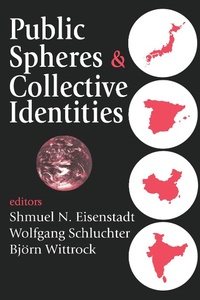
Public Spheres and Collective Identities
1st Edition
Published on 17. April 2018
291 pages
978-1-351-30754-3 (ISBN)
Description

Today it is assumed that we understand contemporary nationalism and nation-building. Researchers rarely consider the very different traditions from which such state-building emerged. Instead, there is almost too much discussion of the "global village," with its supposed uniformity and inevitable trajectories. We need to view modernity as something other than a single condition with a preordained future. New visions of a modern civilization are emerging throughout the world, calliing for a far-reaching appraisal of the older visions of modernization.
Following Eisenstadt's and Schluchter's introduction, Bjorn Wittrock explores the varieties and transitions of early modern societies, noting that only by looking at societies' collective identities and their modes of mediating in the public sphere can the distinguishing factors between modernity be appreciated. Sheldon Pollock discusses the use of vernacular language in India through its literary culture and polity, 1000-1500. Sanjay Subrahmanyam, sums up major developments in the recent historiography of South Asia from 1400 to 1750. David L. Howell focuses on the boundaries of the early modern Japanese state, including its political boundaries and the boundaries of collective identity and social status. Mary Elizabeth Berry examines public life in authoritarian Japan. Frederic Wakeman, Jr. probes the boundaries of the political game and how they were affected by the increased political centralization that developed after the disorder of the Ming-Qing transition during the seventeenth century. Alexander Woodside discusses territorial order and collective-identity tensions in Confucian Asia. Bernhard Giesen argues that the French Enlightenment can be described as an extension of absolutist court culture. Finally essay, Victor Perez-Diaz examines the state and public sphere in Spain during the Ancient Regime contrasting two ideal types of states--a "nomocratic" model and a "teleocratic" model.
This volume addresses cultural and political practices not only from outside the European and American spheres but also over long periods of time in which the internal dynamics of other civilizations become visible. Its broad-ranging use of empirical materials enables us to think comparatively and historically about the ways in which different modernities took shape.
Following Eisenstadt's and Schluchter's introduction, Bjorn Wittrock explores the varieties and transitions of early modern societies, noting that only by looking at societies' collective identities and their modes of mediating in the public sphere can the distinguishing factors between modernity be appreciated. Sheldon Pollock discusses the use of vernacular language in India through its literary culture and polity, 1000-1500. Sanjay Subrahmanyam, sums up major developments in the recent historiography of South Asia from 1400 to 1750. David L. Howell focuses on the boundaries of the early modern Japanese state, including its political boundaries and the boundaries of collective identity and social status. Mary Elizabeth Berry examines public life in authoritarian Japan. Frederic Wakeman, Jr. probes the boundaries of the political game and how they were affected by the increased political centralization that developed after the disorder of the Ming-Qing transition during the seventeenth century. Alexander Woodside discusses territorial order and collective-identity tensions in Confucian Asia. Bernhard Giesen argues that the French Enlightenment can be described as an extension of absolutist court culture. Finally essay, Victor Perez-Diaz examines the state and public sphere in Spain during the Ancient Regime contrasting two ideal types of states--a "nomocratic" model and a "teleocratic" model.
This volume addresses cultural and political practices not only from outside the European and American spheres but also over long periods of time in which the internal dynamics of other civilizations become visible. Its broad-ranging use of empirical materials enables us to think comparatively and historically about the ways in which different modernities took shape.
More details
Edition
1. Auflage
Language
English
Place of publication
London
United Kingdom
Publishing group
Taylor & Francis Ltd
Target group
College/higher education
Product notice
Reflowable
File size
0,54 MB
ISBN-13
978-1-351-30754-3 (9781351307543)
Copyright in bibliographic data and cover images is held by Nielsen Book Services Limited or by the publishers or by their respective licensors: all rights reserved.
Schweitzer Classification
Other editions
Additional editions
Walter Lippmann
Public Spheres and Collective Identities
Book
06/2018
1st Edition
Routledge
€208.10
Shipment within 10-20 days
Walter Lippmann
Public Spheres and Collective Identities
Book
12/2000
1st Edition
Transaction Publishers
€73.80
Shipment within 10-20 days
Content
Introduction: Paths to Early Modernities-A Comparative View; Early Modernities: Varieties and Transitions; India in the Vernacular Millennium: Literary Culture and Polity, 1000-1500; Hearing Voices: Vignettes of Early Modernity in South Asia, 1400-1750; Territoriality and Collective Identity in Tokugawa Japan; Public Life in Authoritarian Japan; Boundaries of the Public Sphere in Ming and Qing China; Territorial Order and Collective-Identity Tensions in Confucian Asia: China, Vietnam, Korea; Cosmopolitans, Patriots, Jacobins, and Romantics; State and Public Sphere in Spain during the Ancient Regime
