

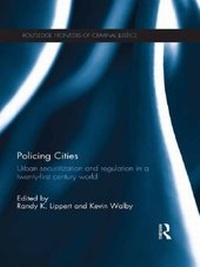
Policing Cities
Urban Securitization and Regulation in a 21st Century World
1st Edition
Published on 18. July 2013
304 pages
978-1-136-26163-3 (ISBN)
Description

Policing Cities brings together international scholars from numerous disciplines to examine urban policing, securitization, and regulation in nine countries and the conceptual issues these practices raise. Chapters cover many of the world's major cities, including New York, Beijing, Paris, London, Berlin, Mexico City, Johannesburg, Rio de Janeiro, Boston, Melbourne, and Toronto, as well as other urban areas in Britain, United States, South Africa, Germany, Australia and Georgia.
The collection examines the activities and reforms of the traditional public police, but also those of emerging public and private policing agents and spaces that fall outside the public police's purview and which previously have received little attention. It explores dramatic changes in public policing arrangements and strategies, exclusion of urban homeless people, new forms of urban surveillance and legal regulation, and securitization and militarization of urban spaces. The core argument in the volume is that cities are more than mere background for policing, securitization and regulation. Policing and the city are intimately intertwined. This collection also reveals commonalities in the empirical interests, methodological preferences, and theoretical concerns of scholars working in these various disciplines and breaks down barriers among them. This is the first collection on urban policing, regulation, and securitization with such a multi-disciplinary and international character.
This collection will have a wide readership among upper level undergraduate and graduate level students in several disciplines and countries and can be used in geography/urban studies, legal and socio-legal studies, sociology, anthropology, political science, and criminology courses.
The collection examines the activities and reforms of the traditional public police, but also those of emerging public and private policing agents and spaces that fall outside the public police's purview and which previously have received little attention. It explores dramatic changes in public policing arrangements and strategies, exclusion of urban homeless people, new forms of urban surveillance and legal regulation, and securitization and militarization of urban spaces. The core argument in the volume is that cities are more than mere background for policing, securitization and regulation. Policing and the city are intimately intertwined. This collection also reveals commonalities in the empirical interests, methodological preferences, and theoretical concerns of scholars working in these various disciplines and breaks down barriers among them. This is the first collection on urban policing, regulation, and securitization with such a multi-disciplinary and international character.
This collection will have a wide readership among upper level undergraduate and graduate level students in several disciplines and countries and can be used in geography/urban studies, legal and socio-legal studies, sociology, anthropology, political science, and criminology courses.
Reviews / Votes
This work provides an important contribution to the academic study of criminology, policing and urban security in the 21st century. The authors are respected contributors in their field and their insights will assist both undergraduate and postgraduate students to inform and develop their own perspectives on a number of key criminological issues.Tim Parsons, Senior Lecturer in Policing and Criminology at the John Grieve Centre, London Metropolitan University, UK
'This innovative book collapses disciplinary barriers in helping us to understand the ways in which policing both constitutes and is constituted by rapidly changing cities across the world. It should be mandatory reading for police managers, policy makers and social scientists across the board.'
Professor Kevin Stenson, Mannheim Centre for Criminology, London School of Economics, UK
'As strategies for the control of our urbanizing world proliferate, it is getting more difficult to get a clear overview of what is happening. However, this volume manages to do just that. Featuring an excellent selection of the best writers on urban security, Policing Cities is an essential collection.'
David Murakami Wood, Associate Professor, Canada Research Chair (Tier II) in Surveillance Studies, Queen's University, Canada
'Ultimately however, this is a timely contribution which demonstrates the need for further work to contextualise the broader shift to a pluralized landscape of urban securitization and policing.'
Andrew Wooff, Research Associate, School of Law, University of Sheffield, UK
More details
Series
Language
English
Place of publication
London
United Kingdom
Publishing group
Taylor & Francis Ltd
Target group
College/higher education
Illustrations
8 Tables, black and white; 8 Line drawings, black and white; 10 Halftones, black and white; 18 Illustrations, black and white
File size
3,71 MB
ISBN-13
978-1-136-26163-3 (9781136261633)
Copyright in bibliographic data and cover images is held by Nielsen Book Services Limited or by the publishers or by their respective licensors: all rights reserved.
Schweitzer Classification
Other editions
Additional editions
Randy Lippert | Kevin Walby
Policing Cities
Urban Securitization and Regulation in a 21st Century World
Book
01/2015
1st Edition
Routledge
€69.20
Shipment within 15-20 days
Randy Lippert | Kevin Walby
Policing Cities
Urban Securitization and Regulation in a 21st Century World
Book
07/2013
1st Edition
Routledge
€232.10
Shipment within 15-20 days
Persons
Randy K. Lippert is Professor of Criminology at the University of Windsor, Canada specializing in security, governance, and policing. He is co-editor of two other Routledge publications, Eyes Everywhere: the Global Growth of Camera Surveillance (2012) and Sanctuary Practices in International Perspective (2013) as well as author of Sanctuary, Sovereignty, Sacrifice (UBC Press, 2006).
Kevin Walby is Assistant Professor of Sociology at the University of Victoria, Canada specializing in surveillance and policing. He has authored or co-authored articles in Policing and Society, British Journal of Criminology, Criminology and Criminal Justice, Punishment and Society, Social and Legal Studies, International Sociology, and Current Sociology. He is the Prisoners' Struggles editor for the Journal of Prisoners on Prisons and co-editor of Brokering Access: Power, Politics, and Freedom of Information Process in Canada with M. Larsen (UBC Press, 2012).
Kevin Walby is Assistant Professor of Sociology at the University of Victoria, Canada specializing in surveillance and policing. He has authored or co-authored articles in Policing and Society, British Journal of Criminology, Criminology and Criminal Justice, Punishment and Society, Social and Legal Studies, International Sociology, and Current Sociology. He is the Prisoners' Struggles editor for the Journal of Prisoners on Prisons and co-editor of Brokering Access: Power, Politics, and Freedom of Information Process in Canada with M. Larsen (UBC Press, 2012).
Content
Foreword, The Complexity of Urban Law, Nicholas Blomley, Introduction: How the World's Cities are Policed, Regulated, and Securitized, Randy K. Lippert and Kevin Walby, Part 1: Public Police Reform and Community Policing in 21st Century Cities, 1. Policing Urban Insecurities through Visible Patrols: Managing Public Expectations in Times of Fiscal Restraint, Anna Barker and Adam Crawford, 2. From Revolution to Government, From Contradictions to Harmony: Urban Community Policing in Post-Deng China, Gary Sigley 3. To Know the City: Urban Policing Innovations in the Post-Soviet Republic of Georgia, Matthew Light 4. Policing-Centered Community Cohesion in Two British Cities, Don Mitchell, Kafui Attoh, and Lynn A. Staeheli Part 2: New Modes of Urban Policing and Governance, 5. Zonal Banning and Public Order in Urban Australia, Ian Warren and Darren Palmer, 6. Polychrome Policing in German Cities: Extending the State's Monopoly on the Use of Force, Volker Eick, 7. Rescaling Security Strategies: State Tactics and Citizen Responses to Violence in Mexico City, Diane E. Davis and Guillermo Ruiz de Teresa Mariscal, 8. Legal Tails: Policing American Cities through Animals, Irus Braverman, Part 3: Policing City Spaces and Regulating Conduct, 9. Reconfiguring Urban Britain: Policing, Spatial Justice and Postmodern (In) security, John Flint, 10. Governing Security in Public Spaces: Urban Improvement Districts in South Africa, Julie Berg 11.Get lost! The Impact of Punitive Policy on Homeless People's Life Chances in Berlin, Juergen von Mahs, 12. Contentious Policing in Paris: The Confrontation between Two Public Orders, Virginie Milliot and Stephane Tonnelat, Part 4: Securitization of 21st Century Cities 13. A New Military Urbanism? Risk Mitigation and Municipal Corporate Security in Canadian Cities, Kevin Walby and Randy K. Lippert, 14. Securitization Strategies: Gated Communities and Market Rate Co-ops in New York, Setha Low 15. Urban Securitization in Mexico City: a New Public Order?, Nelson Arteaga Botello 16. Pretext Securitization of Boston's public realm after 9/11: Motives, actors and a role for planners, Susan Silberberg
