

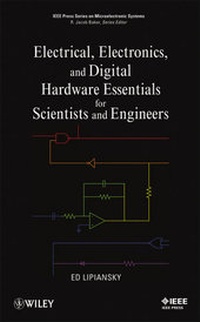
Electrical, Electronics, and Digital Hardware Essentials for Scientists and Engineers
Description

More details
Other editions
Additional editions
Person
Content
About the Author xix
1 From the Bottom Up: Voltages, Currents, and Electrical Components 1
1.1 An Introduction to Electric Charges and Atoms 1
1.2 Electric DC Voltage and Current Sources 3
1.3 Electric Components: Resistors, Inductors, and Capacitors 12
1.4 Ohm's Law, Power Delivered and Power Consumed 25
1.5 Capacitors 33
1.6 Inductors 44
1.7 Kirchhoff's Voltage Law (KVL) and Kirchhoff's Current Law (KCL) 73
1.8 Summary 87
2 Alternating Current Circuits 98
2.1 AC Voltage and Current Sources, Root Mean Square Values (RMS), and Power 98
2.2 Sinusoidal Steady State: Time and Frequency Domains 111
2.3 Time Domain Equations: Frequency Domain Impedance and Phasors 123
2.4 Power in AC Circuits 136
2.5 Dependent Voltage and Current Sources 145
2.6 Summary of Key Points 149
3 Circuit Theorems and Methods of Circuit Analysis 155
3.1 Introduction 155
3.2 The Superposition Method 156
3.3 The Thévenin Method 165
3.4 Norton's Method 172
3.5 The Mesh Method of Analysis 179
3.6 The Nodal Method of Analysis 199
3.7 Which One Is the Best Method? 210
3.8 Using all the Methods 213
3.9 Summary and Conclusions 225
4 First- and Second-Order Circuits under Sinusoidal and Step Excitations 233
4.1 Introduction 233
4.2 The First-Order RC Low-Pass Filter (LPF) 235
4.3 The First-Order RC High-Pass Filter (HPF) 252
4.4 Second-Order Circuits 265
4.5 Series RLC Second-Order Circuit 266
4.6 Second-Order Circuit in Sinusoidal Steady State: Bode Plots 275
4.7 Drawing the Second-Order Bode Plots Using Asymptotic Approximations 278
4.8 Summary 279
5 The Operational Amplifi er as a Circuit Element 287
5.1 Introduction to the Operational Amplifier 287
5.2 Ideal and Real Op Amps 288
5.3 Brief Defi nition of Linear Amplifiers 290
5.4 Linear Applications of Op Amps 294
5.5 Op Amps Nonlinear Applications 331
5.6 Operational Amplifi ers Nonidealities 341
5.7 Op Amp Selection Criteria 343
5.8 Summary 347
6 Electronic Devices: Diodes, BJTs, and MOSFETs 354
6.1 Introduction to Electronic Devices 354
6.2 The Ideal Diode 355
6.3 Bipolar Junction Transistors (BJT) 374
6.4 Metal Oxide Field Effect Transistor (MOSFET) 420
6.5 Summary 443
7 Combinational Circuits 456
7.1 Introduction to Digital Circuits 456
7.2 Binary Numbers: a Quick Introduction 456
7.3 Boolean Algebra 460
7.4 Minterms: Standard or Canonical Sum of Products (SOP) Form 467
7.5 Maxterms: Standard or Canonical Product of Sums (POS) Form 472
7.6 Karnaugh Maps and Design Examples 473
7.7 Product of Sums Simplifi cations 490
7.8 Don't Care Conditions 491
7.9 Logic Gates: Electrical and Timing Characteristics 495
7.10 Summary 500
8 Digital Design Building Blocks and More Advanced Combinational Circuits 503
8.1 Combinational Circuits with More than One Output 503
8.2 Decoders and Encoders 510
8.3 Multiplexers and Demultiplexers (MUXes and DEMUXes) 519
8.4 Signed and Unsigned Binary Numbers 527
8.5 Arithmetic Circuits: Half-Adders (HA) and Full-Adders (FA) 533
8.6 Carry Look Ahead (CLA) or Fast Carry Generation 543
8.7 Some Short-Hand Notation for Large Logic Blocks 546
8.8 Summary 547
9 Sequential Logic and State Machines 550
9.1 Introduction 550
9.2 Latches and Flip-Flops (FF) 552
9.3 Timing Characteristics of Sequential Elements 571
9.4 Simple State Machines 574
9.5 Synchronous State Machines General Considerations 592
9.6 Summary 599
10 A Simple CPU Design 603
10.1 Our Simple CPU Instruction Set 603
10.2 Instruction Set Details: Register Transfer Language (RTL) 605
10.3 Building a Simple CPU: A Bottom-Up Approach 607
10.4 Data Path Architecture: Putting the Logic Blocks Together 615
10.5 The Simple CPU Controller 620
10.6 CPU Timing Requirements 626
10.7 Other System Pieces: Clock, Reset and Power Decoupling 628
10.8 Summary 633
Further Reading 633
Problems 633
Index 637
1
FROM THE BOTTOM UP: VOLTAGES, CURRENTS, AND ELECTRICAL COMPONENTS
1.1 AN INTRODUCTION TO ELECTRIC CHARGES AND ATOMS
The ancient Greek philosophers knew that when amber was rubbed against wool, it would attract lightweight particles of other materials like small pieces of paper or lint. Also, little pieces of paper get attracted to a plastic comb when the weather is dry. These experiments reveal that electric charge exists. If we rub one end of a glass rod with silk, charges will move toward that end of the rod. Rubbing a second glass rod in the same fashion and placing it close to the rubbed end of the first glass rod will exhibit a repelling force between the rods. However, when a plastic rod is rubbed with fur and it is placed near the rubbed glass rod, the plastic and the glass rods will attract each other. These simple experiments prove the existence of two different types of charge. Benjamin Franklin* called one of them positive and the other one negative. Most charge in an everyday object appears to be nonexistent because there is an equal amount of positive and negative charge. The word electron is derived from the Greek word “elektron,” which means amber. From the above experiments the following can be asserted:
Charges of the same sign repel each other, while charges of opposite signs attract each other.
All matter is made of the basic elements, those elements listed in the periodic table of chemical elements. As of 2006, there are 117 elements of which 94 are found naturally on the Earth. The remaining elements are synthesized in particle accelerators. Loosely speaking, all matter is made of some combination of atoms, where an atom is the basic unit of matter. An atom contains a nucleus surrounded by a cloud of electrons. The nucleus consists of positively charged protons and electrically neutral neutrons. Neutrons have no electrical charge, but their mass is about 1800 times the mass of electrons. The electronic cloud around the nucleus is negatively charged, and an atom with an equal number of protons and electrons is said to be neutral. Protons have a positive charge and a mass about 1800 times larger than the mass of electrons. Different element atoms are different from each other because of the different numbers and arrangements of the atom’s basic particles: electrons, neutrons, and protons. Traditionally in elementary physics and chemistry, the atom was compared to our planetary system. The nucleus is in the center of the atom, like the sun is the center of our system. The electrons are like the planets, orbiting around the sun. Electrons occupy different layers or shells that are at different distances away from nucleus. The outermost shell is referred to as the valence shell. The valence shell electrons determine the electrical characteristics of an atom.
Table 1.1 presents the elementary charge, which has a positive sign for a proton and a negative sign for an electron. Values for the mass of the electron, proton, and neutron are also tabulated.
Table 1.1 Some atomic constants
From an electrical point of view, there are four main types of materials: conductors, nonconductors or insulators, semiconductors, and superconductors. The fourth type of material, the superconductor, is beyond the scope of this book.
Conductors are materials through which charge can move quite freely, such as copper or gold. Insulators are materials through which charge cannot move freely such as plastic or rubber. Semiconductors are materials that have an intermediate behavior between that of conductors and insulators. More on semiconductors will be covered in Chapter 6.
1.2 ELECTRIC DC VOLTAGE AND CURRENT SOURCES
Two types of independent sources are available, voltage and current sources. A source is said to be independent when either its nominal voltage or current is constant and does not depend on any other voltage or current present in a circuit. In a later section, we will cover the concept of dependent sources. The ideal voltage source produces a constant voltage across its terminals, regardless of the current that is being drawn from it by a load. Conversely, an ideal current source produces a constant current to a load connected across its terminals regardless of the voltage that is developed across the load. Let us now address the concepts of electric current and voltage.
1.2.1 Electric Current and Voltage
A net flow of electric charges through a circuit establishes an electric current. Note that conductors in isolation, such as a piece of copper not connected to anything else, contain free electrons or conduction electrons that randomly move. Such electrons do not constitute an electric current since in any cross section of the copper wire, the net amount of charge moved through the wire is zero. The emphasis here is on the word “net”; the net flow of charge constitutes an electric current. Current is defined as
(1.1)
where i(t) represents electric current as a function of time and dq/dt is the net variation of charge with respect to time. Traditionally, electric current was referred to as current intensity. In most places, the term “current” is used, which is a short form of current intensity. The letter i denotes current, while dq differential of charge over dt differential of time refers to the net passage of charge during a time interval through a cross section of the conductor. On the other hand, a voltage can be interpreted as the “pressure” that needs to be asserted in a circuit in order to cause electric current to flow.
Throughout the book, we will assume that a conductor or a wire is ideal and will have zero resistance to the flow of current, unless it is stated otherwise. The unit of resistance is the ohm (Ω). Electric components that have greater than 0 Ω resistance are called resistors. The current that flows through a resistor times the resistance value equals the voltage drop that is produced across such resistor. Conventional current in a resistor flows from higher voltages or potentials to lower voltages or potentials.
Figure 1.1 depicts a resistor, a current flowing through it, and the voltage with its polarities that is produced across the resistor. The current through the resistor times its resistance value equals the voltage obtained across the resistor terminals. Mathematically,
Figure 1.1 Ohm’s Law: (a) DC voltage source powering a resistor; (b) linear variation of resistor voltage versus current.
Equation (1.2) states the voltage across a resistor is proportional to the current flowing through it. The constant of proportionality is the resistor value R. Equation (1.2) is Ohm’s Law. In Figure 1.1a, a resistor powered by a DC source is shown; Figure 1.1b depicts the variation of resistor voltage versus current variation. The slope of the line V = I R is the resistance value. Ohm’s law in Equation (1.2) denotes a linear variation of the voltage across the resistor versus the current flowing through it.
Example 1.1 Given a 10-V DC voltage source that is connected across a 0.1 Ω resistor, calculate for the current that will flow through the resistor. Solution to Example 1.1 From Equation (1.2), And since1.2.2 DC Voltage and Current Sources
We all have some familiarity with electricity and electronics. We have seen flashlights, batteries, battery chargers, lightbulbs, portable electronic devices, and electrical and electronic appliances such as toasters and microwave ovens.
Flashlight batteries, toy batteries, and automobile batteries are all examples of DC voltage sources. DC stands for direct current, and what this means is that the current polarity that the source supplies does not change; that is, the current always flows in the same direction through the load.
An idealization of the DC voltage source is that its DC voltage is always constant with respect to time and independent of the amount of current that it may supply. In practical devices such as batteries, that voltage is “somewhat” constant, and it varies based on factors such as temperature, environmental factors, mechanical vibration, age of the battery, and use of the battery. However, unless we state otherwise, the first-order approximation of a battery is that of a constant or DC voltage source.
Current sources are as also idealized like DC voltage sources. An everyday example of a current source is a battery charger. A battery charger provides a constant current to recharge a battery with rechargeable chemistry. Note that not all batteries are rechargeable. No attempt should be made to recharge batteries that are not of the rechargeable kind, since this causes a hazard to the user. Another example of a current source is that of a transistor hooked up to operate as a current source.
A DC voltage source may not always be a chemical battery. It may, for example, be built with electronic components that behave largely like a DC source. An example of this is a DC power supply (see Figure 1.2).
Figure 1.2 Mathematical representation of a DC voltage source as a function of time.
When a DC voltage source is not...
