

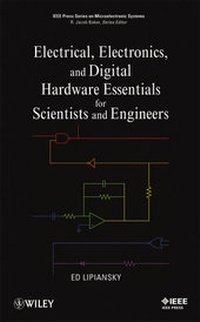
Electrical, Electronics, and Digital Hardware Essentials for Scientists and Engineers
Description

More details
Other editions
Additional editions
Person
Content
About the Author xix
1 From the Bottom Up: Voltages, Currents, and Electrical Components 1
1.1 An Introduction to Electric Charges and Atoms 1
1.2 Electric DC Voltage and Current Sources 3
1.3 Electric Components: Resistors, Inductors, and Capacitors 12
1.4 Ohm's Law, Power Delivered and Power Consumed 25
1.5 Capacitors 33
1.6 Inductors 44
1.7 Kirchhoff's Voltage Law (KVL) and Kirchhoff's Current Law (KCL) 73
1.8 Summary 87
2 Alternating Current Circuits 98
2.1 AC Voltage and Current Sources, Root Mean Square Values (RMS), and Power 98
2.2 Sinusoidal Steady State: Time and Frequency Domains 111
2.3 Time Domain Equations: Frequency Domain Impedance and Phasors 123
2.4 Power in AC Circuits 136
2.5 Dependent Voltage and Current Sources 145
2.6 Summary of Key Points 149
3 Circuit Theorems and Methods of Circuit Analysis 155
3.1 Introduction 155
3.2 The Superposition Method 156
3.3 The Thévenin Method 165
3.4 Norton's Method 172
3.5 The Mesh Method of Analysis 179
3.6 The Nodal Method of Analysis 199
3.7 Which One Is the Best Method? 210
3.8 Using all the Methods 213
3.9 Summary and Conclusions 225
4 First- and Second-Order Circuits under Sinusoidal and Step Excitations 233
4.1 Introduction 233
4.2 The First-Order RC Low-Pass Filter (LPF) 235
4.3 The First-Order RC High-Pass Filter (HPF) 252
4.4 Second-Order Circuits 265
4.5 Series RLC Second-Order Circuit 266
4.6 Second-Order Circuit in Sinusoidal Steady State: Bode Plots 275
4.7 Drawing the Second-Order Bode Plots Using Asymptotic Approximations 278
4.8 Summary 279
5 The Operational Amplifi er as a Circuit Element 287
5.1 Introduction to the Operational Amplifier 287
5.2 Ideal and Real Op Amps 288
5.3 Brief Defi nition of Linear Amplifiers 290
5.4 Linear Applications of Op Amps 294
5.5 Op Amps Nonlinear Applications 331
5.6 Operational Amplifi ers Nonidealities 341
5.7 Op Amp Selection Criteria 343
5.8 Summary 347
6 Electronic Devices: Diodes, BJTs, and MOSFETs 354
6.1 Introduction to Electronic Devices 354
6.2 The Ideal Diode 355
6.3 Bipolar Junction Transistors (BJT) 374
6.4 Metal Oxide Field Effect Transistor (MOSFET) 420
6.5 Summary 443
7 Combinational Circuits 456
7.1 Introduction to Digital Circuits 456
7.2 Binary Numbers: a Quick Introduction 456
7.3 Boolean Algebra 460
7.4 Minterms: Standard or Canonical Sum of Products (SOP) Form 467
7.5 Maxterms: Standard or Canonical Product of Sums (POS) Form 472
7.6 Karnaugh Maps and Design Examples 473
7.7 Product of Sums Simplifi cations 490
7.8 Don't Care Conditions 491
7.9 Logic Gates: Electrical and Timing Characteristics 495
7.10 Summary 500
8 Digital Design Building Blocks and More Advanced Combinational Circuits 503
8.1 Combinational Circuits with More than One Output 503
8.2 Decoders and Encoders 510
8.3 Multiplexers and Demultiplexers (MUXes and DEMUXes) 519
8.4 Signed and Unsigned Binary Numbers 527
8.5 Arithmetic Circuits: Half-Adders (HA) and Full-Adders (FA) 533
8.6 Carry Look Ahead (CLA) or Fast Carry Generation 543
8.7 Some Short-Hand Notation for Large Logic Blocks 546
8.8 Summary 547
9 Sequential Logic and State Machines 550
9.1 Introduction 550
9.2 Latches and Flip-Flops (FF) 552
9.3 Timing Characteristics of Sequential Elements 571
9.4 Simple State Machines 574
9.5 Synchronous State Machines General Considerations 592
9.6 Summary 599
10 A Simple CPU Design 603
10.1 Our Simple CPU Instruction Set 603
10.2 Instruction Set Details: Register Transfer Language (RTL) 605
10.3 Building a Simple CPU: A Bottom-Up Approach 607
10.4 Data Path Architecture: Putting the Logic Blocks Together 615
10.5 The Simple CPU Controller 620
10.6 CPU Timing Requirements 626
10.7 Other System Pieces: Clock, Reset and Power Decoupling 628
10.8 Summary 633
Further Reading 633
Problems 633
Index 637
