

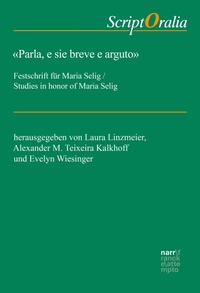
"Parla, e sie breve e arguto"
Festschrift für Maria Selig / Studies in honor of Maria Selig
1st Edition
Published on 28. July 2025
366 pages
978-3-381-11042-1 (ISBN)
Description

Maria Selig ist seit 1998 Professorin für Romanische Sprachwissenschaft, seit 2003 an der Universität Regensburg. Während ihrer akademischen Karriere hat sie einen substantiellen Beitrag zur sprachwissenschaftlichen Forschung geleistet und wichtige theoretische Impulse in- und außerhalb der Romanistik gesetzt. Dies soll in dieser Festschrift durch ihr weitverzweigtes, interdisziplinäres und internationales Netzwerk an Forschenden gewürdigt werden. Um dieses große Panorama abzubilden, ist die Festschrift als eine Squib-Sammlung konzipiert, die pointiert und schlaglichtartig Forschungsfragen aufwirft und diskutiert. Die Squibs von über 50 Forschenden sind in den verschiedenen thematischen Feldern angesiedelt, die Maria Seligs breite Forschungsinteressen widerspiegeln. Diese reichen von Phonetik/Phonologie, Morphologie und Syntax über (Spät-)Latein und ältere Sprachstufen der romanischen Sprachen bis zum Nähe-Distanz-Modell.
More details
Other editions
Additional editions
Laura Linzmeier | Alexander M. Teixeira Kalkhoff | Evelyn Wiesinger
"Parla, e sie breve e arguto"
Festschrift für Maria Selig / Studies in honor of Maria Selig
Book
07/2025
1st Edition
Narr Francke Attempto
€88.00
Shipment within 7-9 days
Persons
Laura Linzmeier ist akademische Rätin a.Z. an der Universität Regensburg (Italienische/Französische Sprachwissenschaften).
Alexander M. Teixeira Kalkhoff lehrt Romanische Sprachwissenschaft (Spanisch, Französisch) an der Universität Heidelberg.
Evelyn Wiesinger ist Juniorprofessorin für Romanische Sprachwissenschaft (Französisch, Spanisch) an der Universität Tübingen.
Alexander M. Teixeira Kalkhoff lehrt Romanische Sprachwissenschaft (Spanisch, Französisch) an der Universität Heidelberg.
Evelyn Wiesinger ist Juniorprofessorin für Romanische Sprachwissenschaft (Französisch, Spanisch) an der Universität Tübingen.
Content
Tabula gratulatoria
Laura Linzmeier (Regensburg), Evelyn Wiesinger (Tübingen) & Alexander M. Teixeira Kalkhoff (Heidelberg)
Einleitung - Introduction
LATEIN UND SPÄTLATEIN
Martin Becker (Köln)
Congiuntivo presente e futurum exactum nelle subordinate condizionali in latino - dalla concorrenza alla differenziazzione micro-tipologica
Céline Guillot-Barbance (Lyon) & Anne Carlier (Paris)
Ipse : entre anaphore et marquage de la définitude
Pierluigi Cuzzolin (London)
What the language of papyri can tell the linguist
Rosanna Sornicola (Cambridge)
Language variation can be evidence of language change: The case of the Italian papyri
Jörg Oberste (Regensburg)
Königliche Begräbnisse und Sakraltopografie im merowingischen Paris
Rembert Eufe (Tübingen)
Investigating direct speech in PaLaFraLat: The special case of the Visio Baronti
Paolo Greco (Napoli)
Sintassi e semantica del pronome quem nelle carte notarili della Langobardia Minor (IX secolo)
Marianne Pade (Aarhus) & Johann Ramminger (München)
Diaphasische Variation in Dantes Latein
Elisabeth Reichle (Leipzig) & Matthias Schöffel (München)
Lokalität, Regionalität und Überregionalität im Wortschatz der spätmittelalterlichen Verwaltungsschriftlichkeit von Saint-Flour
Susanne Ehrich (Regensburg)
Die Fünfzehn Zeichen vor dem Jüngsten Gericht in einem spätmittelalterlichen Stundenbuch. Impulse für eine historische Bildlinguistik
Franz Lebsanft (Bonn)
Écrire un épisode de l'histoire du concept philosophique de DISCOURS : m.fr. discours et latin médiéval
ÄLTERE SPRACHSTUFE, SPRACHGESCHICHTE UND PHILOLOGIEGESCHICHTE
Sabine Tittel (Heidelberg)
A quick zoom into the software development of the ALMA project
Roger Wright (Liverpool)
Cultismo as error
Barbara Frank-Job (Bielefeld)
Frühromanische Schrift- und Federproben in ihrem kodikologischen
Kontext
Ludwig Fesenmeier (Erlangen-Nürnberg)
"Avrebbe ella desiderato riposar l'animo...": Manzonis Revision revisited
Michel Banniard (Paris)
Langues mirages et langues masquées
Laura Linzmeier (Regensburg)
Short but connecting. How the use of a ligature in colonial documents from New France gives insights into the interchange of religious and maritime networks
Ingrid Neumann-Holzschuh (Regensburg)
Die Bedeutung der christlichen Orden für das Bildungswesen im kolonialen Kanada und in Louisiana - ein Vergleich
Roland Schmidt-Riese (Eichstätt-Ingolstadt)
Gestalt und instabile Wortränder. Anchieta (1595) zur Formvarianz des Nomens im Tupinambá
Ursula Bähler (Zürich)
Quand des femmes écrivent à et sur Gaston Paris
PHONETIK, PHONOLOGIE UND PROSODIE
Elisabeth Delais-Roussarie (Nantes)
Interprétation et détails phonétiques : quelques conséquences pour la grammaire
Martin Haase (Bamberg)
Deep structure in French phonology
Elissa Pustka (Wien)
Staged phonology: schwa and liaison in Riad Sattouf's comics
Christine Mooshammer (Berlin)
The Latin-Lover effect for Elvish? Phonaesthetic judgements of constructed languages by Italian and German listeners
Lucia Kloiber (Regensburg)
Prosodie - die "sauce of the sentence"
Matthias Heinz (Salzburg)
Picchi abnormi: non-canonical pitch accents, a prosodic phenomenon (not only) of Italian
Morphologie und Syntax
Daniela Marzo & Marinus Wiedner (Freiburg)
Remarks on grammatical gender in Romance
Hans-Jörg Döhla (Tübingen)
Paradigmatic bridging contexts in object marking. The use of the comitative as object marker
Georg A. Kaiser (Konstanz)
Parallele Beobachtungen zur Differenziellen Objektmarkierung im Romanischen
Andreas Dufter (München)
Zur Geschichte von Optionalität: expletive Negation nach französisch avant que 'bevor'
Christoph Gabriel (Mainz) & Trudel Meisenburg (Osnabrück)
Laura Linzmeier (Regensburg), Evelyn Wiesinger (Tübingen) & Alexander M. Teixeira Kalkhoff (Heidelberg)
Einleitung - Introduction
LATEIN UND SPÄTLATEIN
Martin Becker (Köln)
Congiuntivo presente e futurum exactum nelle subordinate condizionali in latino - dalla concorrenza alla differenziazzione micro-tipologica
Céline Guillot-Barbance (Lyon) & Anne Carlier (Paris)
Ipse : entre anaphore et marquage de la définitude
Pierluigi Cuzzolin (London)
What the language of papyri can tell the linguist
Rosanna Sornicola (Cambridge)
Language variation can be evidence of language change: The case of the Italian papyri
Jörg Oberste (Regensburg)
Königliche Begräbnisse und Sakraltopografie im merowingischen Paris
Rembert Eufe (Tübingen)
Investigating direct speech in PaLaFraLat: The special case of the Visio Baronti
Paolo Greco (Napoli)
Sintassi e semantica del pronome quem nelle carte notarili della Langobardia Minor (IX secolo)
Marianne Pade (Aarhus) & Johann Ramminger (München)
Diaphasische Variation in Dantes Latein
Elisabeth Reichle (Leipzig) & Matthias Schöffel (München)
Lokalität, Regionalität und Überregionalität im Wortschatz der spätmittelalterlichen Verwaltungsschriftlichkeit von Saint-Flour
Susanne Ehrich (Regensburg)
Die Fünfzehn Zeichen vor dem Jüngsten Gericht in einem spätmittelalterlichen Stundenbuch. Impulse für eine historische Bildlinguistik
Franz Lebsanft (Bonn)
Écrire un épisode de l'histoire du concept philosophique de DISCOURS : m.fr. discours et latin médiéval
ÄLTERE SPRACHSTUFE, SPRACHGESCHICHTE UND PHILOLOGIEGESCHICHTE
Sabine Tittel (Heidelberg)
A quick zoom into the software development of the ALMA project
Roger Wright (Liverpool)
Cultismo as error
Barbara Frank-Job (Bielefeld)
Frühromanische Schrift- und Federproben in ihrem kodikologischen
Kontext
Ludwig Fesenmeier (Erlangen-Nürnberg)
"Avrebbe ella desiderato riposar l'animo...": Manzonis Revision revisited
Michel Banniard (Paris)
Langues mirages et langues masquées
Laura Linzmeier (Regensburg)
Short but connecting. How the use of a ligature in colonial documents from New France gives insights into the interchange of religious and maritime networks
Ingrid Neumann-Holzschuh (Regensburg)
Die Bedeutung der christlichen Orden für das Bildungswesen im kolonialen Kanada und in Louisiana - ein Vergleich
Roland Schmidt-Riese (Eichstätt-Ingolstadt)
Gestalt und instabile Wortränder. Anchieta (1595) zur Formvarianz des Nomens im Tupinambá
Ursula Bähler (Zürich)
Quand des femmes écrivent à et sur Gaston Paris
PHONETIK, PHONOLOGIE UND PROSODIE
Elisabeth Delais-Roussarie (Nantes)
Interprétation et détails phonétiques : quelques conséquences pour la grammaire
Martin Haase (Bamberg)
Deep structure in French phonology
Elissa Pustka (Wien)
Staged phonology: schwa and liaison in Riad Sattouf's comics
Christine Mooshammer (Berlin)
The Latin-Lover effect for Elvish? Phonaesthetic judgements of constructed languages by Italian and German listeners
Lucia Kloiber (Regensburg)
Prosodie - die "sauce of the sentence"
Matthias Heinz (Salzburg)
Picchi abnormi: non-canonical pitch accents, a prosodic phenomenon (not only) of Italian
Morphologie und Syntax
Daniela Marzo & Marinus Wiedner (Freiburg)
Remarks on grammatical gender in Romance
Hans-Jörg Döhla (Tübingen)
Paradigmatic bridging contexts in object marking. The use of the comitative as object marker
Georg A. Kaiser (Konstanz)
Parallele Beobachtungen zur Differenziellen Objektmarkierung im Romanischen
Andreas Dufter (München)
Zur Geschichte von Optionalität: expletive Negation nach französisch avant que 'bevor'
Christoph Gabriel (Mainz) & Trudel Meisenburg (Osnabrück)
