

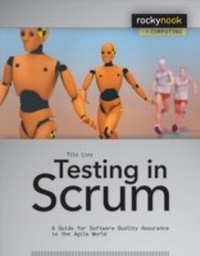
Testing in Scrum
A Guide for Software Quality Assurance in the Agile World
1st Edition
Published on 28. March 2014
242 pages
978-1-4920-0154-6 (ISBN)
Description

These days, more and more software development projects are being carried out using agile methods like Scrum. Agile software development promises higher software quality, a shorter time to market, and improved focus on customer needs.However, the transition to working within an agile methodology is not easy. Familiar processes and procedures change drastically. Software testing and software quality assurance have a crucial role in ensuring that a software development team, department, or company successfully implements long-term agile development methods and benefits from this framework. This book discusses agile methodology from the perspective of software testing and software quality assurance management. Software development managers, project managers, and quality assurance managers will obtain tips and tricks on how to organize testing and assure quality so that agile projects maintain their impact. Professional certified testers and software quality assurance experts will learn how to work successfully within agile software teams and how best to integrate their expertise.Topics include:Agile methodology and classic process modelsHow to plan an agile projectUnit tests and test first approachIntegration testing and continuous integrationSystem testing and test nonstopQuality management and quality assuranceAlso included are five case studies from the manufacturing, online-trade, and software industry as well as test exercises for self-assessment.This book covers the new ISTQB Syllabus for Agile Software Testing and is a relevant resource for all students and trainees worldwide who plan to undertake this ISTQB certification.
More details
Other editions
Additional editions
Book
04/2014
1st Edition
Rocky Nook
€40.50
Article not available at the moment
E-Book
03/2014
1st Edition
Rocky Nook
from
€31.99
Available for download
Content
- Testing in Scrum
- Contents
- 1 Introduction
- 1.1 Target Audience
- 1.2 Book Contents
- 1.3 Case Study
- 1.4 Website
- 2 Agile vs. Traditional Approaches
- 2.1 Scrum
- 2.2 Kanban
- 2.3 Traditional Process Models
- 2.4 Comparing Process Models
- 3 Planning an Agile Project
- 3.1 Product Vision
- 3.2 Architecture Vision
- 3.3 Product Backlog
- 3.4 Story Map
- 3.5 Sprint Backlog
- 3.6 Team Charter
- 3.7 Test Planning and Test Management
- 3.7.1 Traditional Test Management
- 3.7.2 Test Management in Scrum
- 3.7.3 Test Levels in Scrum
- 3.8 Introducing Agile Planning
- 3.9 Questions and Exercises
- 3.9.1 Self-Assessment
- 3.9.2 Methods and Techniques
- 3.9.3 Other Exercises
- 4 Unit Testing and Test First
- 4.1 Unit Testing
- 4.1.1 Classes and Objects
- 4.1.2 Testing the Methods of a Class
- 4.1.3 Object State Testing
- 4.1.4 State-Based Coverage Criteria
- 4.1.5 Testing with Method Permutations
- 4.2 Test First
- 4.2.1 Test First and Scrum
- 4.2.2 Implementing Test First
- 4.2.3 Using Test First
- 4.3 Unit Testing Frameworks
- 4.4 Stubs, Mocks and Dummies
- 4.5 Unit Test Management
- 4.5.1 Unit Test Planning
- 4.6 Questions and Exercises
- 4.6.1 Self-Assessment
- 4.6.2 Methods and Techniques
- 4.6.3 Other Exercises
- 5 Integration Testing and Continuous Integration
- 5.1 Integration Testing
- 5.1.1 Typical Integration Failures and Their Causes
- 5.1.2 Designing Integration Test Cases
- 5.1.3 The Differences between Unit and Integration Tests
- 5.2 The Role Played by System Architecture
- 5.2.1 Dependencies and Interfaces
- 5.2.2 Testability and Testing Effort
- 5.3 Integration Levels
- 5.3.1 Class Integration
- 5.3.2 Subsystem Integration
- 5.3.3 System Integration
- 5.4 Traditional Integration Strategies
- 5.5 Continuous Integration
- 5.5.1 The CI Process
- 5.5.2 Implementing CI
- 5.5.3 Optimizing CI
- 5.6 Integration Test Management
- 5.7 Questions and Exercises
- 5.7.1 Self-Assessment
- 5.7.2 Methods and Techniques
- 5.7.3 Other Exercises
- 6 System Testing and Testing Nonstop
- 6.1 System Testing
- 6.2 The System Testing Environment
- 6.3 Manual System Testing
- 6.3.1 Exploratory Testing
- 6.3.2 Session-Based Testing
- 6.3.3 Acceptance Testing
- 6.4 Automated System Testing
- 6.4.1 Record/Playback Testing
- 6.4.2 Keyword-Driven Testing
- 6.4.3 Behavior-Driven Testing
- 6.5 Using Test First for System Testing
- 6.5.1 System Test Repository
- 6.5.2 Pair Programming
- 6.6 Non-functional Testing
- 6.7 Automated Acceptance Testing
- 6.8 When Should System Testing Take Place?
- 6.8.1 System Testing in a Final Sprint
- 6.8.2 System Testing at the End of a Sprint
- 6.8.3 System Testing Nonstop
- 6.9 The Release Sprint and Deployment
- 6.10 System Test Management
- 6.11 Questions and Exercises
- 6.11.1 Self-Assessment
- 6.11.2 Methods and Techniques
- 6.11.3 Other Exercises
- 7 Quality Management and Quality Assurance
- 7.1 Traditional Quality Management
- 7.1.1 The ISO 9000 Standard
- 7.1.2 The Principles of PDCA
- 7.1.3 Strengths and Weaknesses
- 7.1.4 Process Modeling and Software Development
- 7.2 Agile Quality Management
- 7.2.1 Simplifying QM Documentation
- 7.2.2 Changing QM Culture
- 7.2.3 Retrospectives and Process Improvement
- 7.3 Dealing with Compliance Requirements
- 7.3.1 Requirements of Software Development Processes
- 7.3.2 Traceability Requirements
- 7.3.3 Product Attribute Requirements
- 7.4 Traditional Quality Assurance
- 7.4.1 QA Tools
- 7.4.2 Organization
- 7.5 Agile Quality Assurance
- 7.5.1 Principles and Tools
- 7.5.2 Strengths and Weaknesses
- 7.6 Agile Testing
- 7.6.1 Critical Factors for Successful Agile Testing
- 7.6.2 Test Planning in Scrum
- 7.7 Skills, Training, Values
- 7.8 Questions and Exercises
- 7.8.1 Self-Assessment
- 7.8.2 Methods and Techniques
- 7.8.3 Other Exercises
- 8 Case Studies
- 8.1 Using Scrum to Develop Video and Audio Production Software
- 8.2 Nonstop System Final Testing-Using Scrum to Develop the TestBench Tool
- 8.3 Using Scrum to Develop an Online Store
- 8.4 Introducing Scrum at ImmobilienScout24
- 8.5 Scrum in a Medical Technology Environment
- 8.6 Testing in Scrum at GE Oil & Gas
- Appendix
- A Glossary
- B References
- B.1 Literature
- B.2 Websites
- B.3 Standards
- Index
