

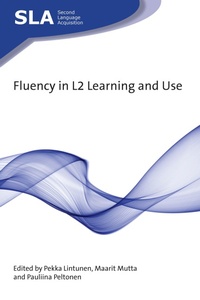
Fluency in L2 Learning and Use
Published on 6. December 2019
216 pages
978-1-78892-632-4 (ISBN)
Description

This book brings together theoretical and empirical approaches to second language (L2) fluency and provides a state-of-the-art overview of current research on the topic. The strength of the volume lies in its interdisciplinarity: the chapters approach fluency from non-traditional starting points and go beyond disciplinary boundaries in their contributions. The volume includes chapters investigating fluency from an L2 perspective and integrates perspectives from related fields, such as psycholinguistics, sign language studies and L2 assessment. The book extends the common foci and approaches of fluency studies and offers new perspectives that enable readers to evaluate critically existing paradigms and models. This encourages the development of more comprehensive frameworks and directs future L2 fluency research into new areas of L2 learning and use.
Reviews / Votes
This volume's strength rests in the coverage of multi-disciplinary perspectives that offer a comprehensive conceptualization of fluency. Based on reviews of theoretical frameworks and actual empirical findings, the discussion on fluency extends from SLA to areas, such as sign language and translation studies, where fluency research has been less prominent. It represents an invaluable source for students, teachers, and scholars who are interested in fluency as a multi-faceted phenomenon. * Slobodanka Dimova, University of Copenhagen, Denmark * This volume makes an extremely valuable contribution to fluency research. The chapters take refreshingly new perspectives on the topic and put forward innovative theoretical and methodological additions to the field. The volume is highly thought-provoking and extremely hard to put down. A must-read for every researcher interested in fluency. * Sandra Goetz, University of Giessen, Germany * This book provides a comprehensive and thoughtful collection of texts on L2 fluency by offering fresh perspectives from various fields including SLA, English as a lingua franca, gestures, sign language, and translation. -- Jimin Kahng, University of Mississippi, USA * Journal of Second Language Pronunciation 7:1 * The editors achieve their goal of presenting a panorama of L2 fluency with state-of-the-art disciplinary theories and context-dependent cutting-edge methodologies through reviewing the literature mostly generated in the last 20 years [...] Moreover, the monograph is well written with clarity and lucidity, intelligible for readers from a range of backgrounds and interests. -- Weiwei Zhang and Lawrence Jun Zhang, University of Auckland, New Zealand * Frontiers in Psychology, April 2021 *More details
Series
Language
English
Place of publication
Bristol
United Kingdom
Target group
College/higher education
ISBN-13
978-1-78892-632-4 (9781788926324)
Copyright in bibliographic data and cover images is held by Nielsen Book Services Limited or by the publishers or by their respective licensors: all rights reserved.
Schweitzer Classification
Other editions
Additional editions
Pekka Lintunen | Maarit Mutta | Pauliina Peltonen
Fluency in L2 Learning and Use
Book
12/2019
Multilingual Matters
€48.20
Shipment within 3-4 weeks
Persons
Pekka Lintunen is a Senior Lecturer in English, University of Turku, Finland and an Adjunct Professor in Applied Linguistics, University of Jyvaeskylae, Finland. His main research field is L2 spoken language and pronunciation. Recently he has focused on the fluency and complexity of learner language, learner perceptions and beliefs, and informal language learning.
Maarit Mutta is a Senior Lecturer in French, University of Turku, Finland and an Adjunct Professor in Foreign Language Learning, University of Jyvaeskylae, Finland. Her research has mainly focused on online processes of writing, role of vocabulary in writing, writing fluency and writer profiles. Recently she has also studied informal language learning.
Pauliina Peltonen is a Doctoral Student in the Department of English, University of Turku, Finland. In her doctoral dissertation, she examines the interplay between fluency and problem-solving mechanisms. She has also collaborated on papers focusing on intonation and fluency and pronunciation feedback.
Maarit Mutta is a Senior Lecturer in French, University of Turku, Finland and an Adjunct Professor in Foreign Language Learning, University of Jyvaeskylae, Finland. Her research has mainly focused on online processes of writing, role of vocabulary in writing, writing fluency and writer profiles. Recently she has also studied informal language learning.
Pauliina Peltonen is a Doctoral Student in the Department of English, University of Turku, Finland. In her doctoral dissertation, she examines the interplay between fluency and problem-solving mechanisms. She has also collaborated on papers focusing on intonation and fluency and pronunciation feedback.
Content
Chapter 1. Pekka Lintunen, Maarit Mutta and Pauliina Peltonen: Defining Fluency in L2 Learning and Use
Chapter 2. Pekka Lintunen and Pauliina Peltonen: What is Fluency? Learner Perceptions of the Concept
Chapter 3. Sanna Olkkonen and Maarit Mutta: Cognitive fluency in L2: What Inaccuracies Can Reveal about Processing and Proficiency
Chapter 4. Joanna Anckar and Outi Veivo: Fluency in L2 Listening
Chapter 5. Maarit Mutta: L2 Fluency and Writer Profiles
Chapter 6. Niina Hynninen: Fluency in English as a Lingua Franca Interaction
Chapter 7. Laura Kanto and Ulla-Maija Haapanen: Fluency in Sign Language
Chapter 8. Pauliina Peltonen: Gestures as Fluency-enhancing Resources in L2 Interaction: A Case Study on Multimodal Fluency
Chapter 9. Ari Huhta, Heini Kallio, Sari Ohranen and Riikka Ullakonoja: Fluency in Language Assessment
Chapter 10. Leena Salmi: Fluency in Evaluating and Assessing Translations
Chapter 11. Leena Maria Heikkola and Jenni Alisaari: The Effects of Songs on L2 Proficiency and Spoken Fluency: A Pedagogical Perspective
Chapter 12. Pekka Lintunen, Maarit Mutta and Pauliina Peltonen: Synthesising Approaches to Second Language Fluency: Implications and Future Directions
