

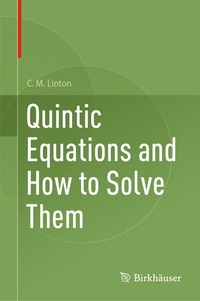
Quintic Equations and How to Solve Them
Description

This monograph explores the well-known problem of the solvability of polynomial equations.
While equations up to the fourth degree are solvable, there are, as demonstrated by Niels Henrik Abel, no general algebraic formulas leading to the solution of equations of fifth or higher degree. Nevertheless, some fifth degree (quintic) equations are indeed solvable. The author describes how Galois theory can be used to identify those quintic equations that can be solved algebraically and then shows how the solutions can be found. This involves shining a light on some little known works dating back to the late 19th century, bringing new life to a classical problem.
This book is a valuable resource for both students and researchers and it constitutes a good basis for a seminar on polynomials and the solvability of equations.
More details
Other editions
Additional editions
Person
Chris Linton is a Professor Emeritus at Loughborough University, UK. Educated at Oxford and Bristol Universities, he moved to Loughborough in 1993. He served as the University's Provost from 2011 to 2024. In addition to having a distinguished research career in applied mathematics, he has also written books on the history of mathematical astronomy and on the mathematics of map projections.
Content
Chapter 1. Introduction.- Chapter 2. Quadratics, cubics, quartics and complex numbers.- Chapter 3. Polynomials and their roots.- Chapter 4. Symmetric polynomials and groups.-Chapter 5. Field extensions.- Chapter 6. Galois theory.- Chapter 7. There is no general quintic formula.- Chapter 8. Tschirnhaus transformations.- Chapter 9. Solvable quintics and how to solve them.- Chapter 10. Epilogue.
