

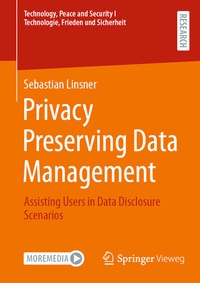
Privacy Preserving Data Management
Description

Users face many situations in which they have to disclose their data to others. In many cases, they are not properly informed about the usage of their data or the consequences of data disclosure. This book investigates how users can be supported by researching three core aspects: Firstly, problems and risks that lead to (unintended) data disclosure or arise from it have to be identified. Secondly, measures are investigated that developers can apply to mitigate these risks and meet the needs of the users. Finally, the developed solutions have to be adopted into practice. Strategies to bring security- and privacy-enhancing technologies to use are essential because a tool that is not used cannot protect anyone.
The investigated scenarios are twofold: Firstly, business-to-business (B2B) collaborations, especially highlighting the perspective of owners of small and medium enterprises (SMEs) who are forced to provide data for business processes. Secondly, scenarios of everyday usage for private users that require the disclosure of data are investigated.
More details
Other editions
Additional editions
Person
Dr.-Ing. Sebastian Linsner researches the topics of Usable Privacy and Usable Security at the chair for "Science and Technology for Peace and Security (PEASEC)" at the Technical University of Darmstadt. His main areas of expertise are studies on the adoption of new technologies into practice and how to assist users handling their data.
Content
Introduction.- Research Design.- Findings.- Discussion.- Conclusion.- Paper A: The Role of Privacy in Digitalization Analyzing Perspectives of German Farmers.- Paper B: Blockchain in Agriculture 4.0 Empirical Study on Farmers' Expectations Towards Decentralized Services Based on Distributed Ledger Technology.- Paper C: Supporting Users in Data Disclosure Scenarios in Agriculture through Transparency.- Paper D: Support Personas: A Concept for Tailored Support of Users of Privacy-Enhancing Technologies.- Paper E: Building Trust in Remote Attestation through Transparency A Qualitative User Study on Observable Attestation.- Paper F: Decision-based Data Distribution (D3): Enabling Users to Minimize Data Propagation in Privacy-sensitive Scenarios.
